

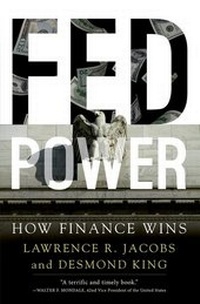
Fed Power
How Finance Wins
Published on 7. December 2017
Book
Paperback/Softback
264 pages
978-0-19-069050-2 (ISBN)
Description
The Federal Reserve, created nearly a century ago, is the most powerful central bank in the world. The Fed's power, which derives from its ability to alter the money supply and move interest rates, weighs heavily not only on the US economy, but on the world economy as well. Not surprisingly, most scholarship on the Fed has focused on its economic role; however, the Fed's power isn't merely economic but is also political. Since its decisions benefit some economic
sectors (and hence interest groups) and not others, it effectively makes political choices when shaping economic policy.
Lawrence R. Jacobs and Desmond King's Fed Power is the first sustained synthesis of the Fed's political role-especially the way in which it uses its power to benefit some interest groups and not others-since the 2008 financial crisis. The book closely examines the Fed's unilateral actions during the 2008-9 financial crisis when it leveraged half of the country's net worth without a congressional vote or presidential authorization. While the country was spared a second depression, the
Fed's actions doled out lopsided benefits to finance. The Fed's favoritism and unprecedented assertions of power provoked public unease and a bipartisan congressional backlash to restrain it. Fed Power concludes with bold proposals to reform America's financial management to prevent future crises and to
restore democratic accountability. A powerful critique of how the Federal Reserve governs the American economy, Fed Power will be essential reading for anyone interested in how inequality has increased since 2009, even throughout a liberal presidency committed to reducing inequality.
sectors (and hence interest groups) and not others, it effectively makes political choices when shaping economic policy.
Lawrence R. Jacobs and Desmond King's Fed Power is the first sustained synthesis of the Fed's political role-especially the way in which it uses its power to benefit some interest groups and not others-since the 2008 financial crisis. The book closely examines the Fed's unilateral actions during the 2008-9 financial crisis when it leveraged half of the country's net worth without a congressional vote or presidential authorization. While the country was spared a second depression, the
Fed's actions doled out lopsided benefits to finance. The Fed's favoritism and unprecedented assertions of power provoked public unease and a bipartisan congressional backlash to restrain it. Fed Power concludes with bold proposals to reform America's financial management to prevent future crises and to
restore democratic accountability. A powerful critique of how the Federal Reserve governs the American economy, Fed Power will be essential reading for anyone interested in how inequality has increased since 2009, even throughout a liberal presidency committed to reducing inequality.
Reviews / Votes
[A] careful argument for balancing sound financial management and the public interest." * Kirkus Reviews * [A] groundbreaking book...Fed Power represents a vibrant form of 21st century financial populism and a vital intervention in our political and social debates. * The Huffington Post* [Jacobs and King] use the tools of political science to examine the Federal Reserve as an institution... [and] argue that the democratic accountability of the Federal Reserve has suffered because of the bailouts. And it's completely true that the Federal Reserve pushed their powers beyond what anyone had expected... There is a lot to be impressed with in this book. * The American Prospect
* A welcome demonstration that grounded academic work can be entertaining as well as informative. Lawrence Jacobs and Desmond King, political scientists from the universities of Minnesota and Oxford respectively, live up to their claim to 'jettison the all-too-common hermetic language of academia in favor of candor and directness'... A book that is engaging throughout and generally persuasive in its principal thesis that the Fed is a politically loaded institution that
drives rising inequality. * The Financial Times, Philip Augar
* Jacobs and King bring a political economy perspective to the debate... Recommended. * Choice Reviews
*
More details
Language
English
Place of publication
New York
United States
Target group
College/higher education
Dimensions
Height: 228 mm
Width: 148 mm
Thickness: 18 mm
Weight
332 gr
ISBN-13
978-0-19-069050-2 (9780190690502)
Copyright in bibliographic data and cover images is held by Nielsen Book Services Limited or by the publishers or by their respective licensors: all rights reserved.
Schweitzer Classification
Other editions
Additional editions
E-Book
02/2021
2nd Edition
OUP eBook
€16.49
Available for download
E-Book
02/2021
2nd Edition
OUP eBook
€16.49
Available for download
Book
04/2016
Oxford University Press Inc
€21.03
Article exhausted; check different version
Persons
Lawrence R. Jacobs is Walter F. and Joan Mondale Chair for Political Studies at the Humphrey School for Public Affairs, the University of Minnesota, and co-author of both Health Care Reform and American Politics (Oxford) and Class War? (Chicago).
Desmond King is Andrew W. Mellon Professor of American Government at Oxford University and author of Making Americans (Harvard), as well as co-author of Still a House Divided (Princeton).
Desmond King is Andrew W. Mellon Professor of American Government at Oxford University and author of Making Americans (Harvard), as well as co-author of Still a House Divided (Princeton).
Content
Chapter 1: Why Fed Power Matters
Chapter 2: The Rise of the Fed State
Chapter 3: Concealed Advantage
Chapter 4: The Fed's Legitimacy Gap
Chapter 5: Preparing for the Next Financial Crisis
Chapter 2: The Rise of the Fed State
Chapter 3: Concealed Advantage
Chapter 4: The Fed's Legitimacy Gap
Chapter 5: Preparing for the Next Financial Crisis