

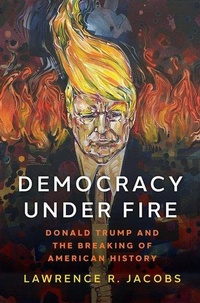
Democracy under Fire
Donald Trump and the Breaking of American History
Published on 23. June 2022
Book
Hardback
288 pages
978-0-19-087724-8 (ISBN)
Description
Donald Trump's presidency offered Americans a dire warning regarding the vulnerabilities in their democracy, but the threat is broader and deeper-and looms still.
"January 6th was a disgrace," Senate Republican Leader Mitch McConnell solemnly intoned at the end of Donald Trump's second impeachment trial on February 13, 2021. As to the culprit, Senator McConnell declared that "there is no question that President Donald Trump is practically and morally responsible." Before Trump even ran for President, his disdain for the rules, procedures, and norms of American democracy and the US Constitution was well-known and led prominent Republicans to repudiate him as "unfit" for the GOP nomination. Given the clear-eyed assessment of candidate Trump, why did the Republican Party nominate him as its presidential candidate in 2016 and then stand by him during the next four years?
Much of the attention paid to Trump's rise to power has focused on his corrosive personality and divisive style of governing. But he alone is not the problem. The vulnerability is much broader and deeper. The ascendance of Trump is the culmination of nearly 250 years of political reforms that gradually ceded party nominations to small cliques of ideologically-motivated party activists, interest groups, and donors. Trump's rise is not an aberration but a predictable outcome of trends deeply rooted in American history but which accelerated in the last few decades.
In Democracy under Fire, Lawrence Jacobs provides a highly engaging, if disturbing, history of political reforms since the late-eighteenth century that over time dangerously weakened democracy, widened political inequality as well as racial disparities, and rewarded toxic political polarization. Jacobs' searing indictment of political reformers concludes with recommendations to restrain the unbridled ambition of politicians who thrive on division and instead generate broad citizen engagement with tangible policy making.
"January 6th was a disgrace," Senate Republican Leader Mitch McConnell solemnly intoned at the end of Donald Trump's second impeachment trial on February 13, 2021. As to the culprit, Senator McConnell declared that "there is no question that President Donald Trump is practically and morally responsible." Before Trump even ran for President, his disdain for the rules, procedures, and norms of American democracy and the US Constitution was well-known and led prominent Republicans to repudiate him as "unfit" for the GOP nomination. Given the clear-eyed assessment of candidate Trump, why did the Republican Party nominate him as its presidential candidate in 2016 and then stand by him during the next four years?
Much of the attention paid to Trump's rise to power has focused on his corrosive personality and divisive style of governing. But he alone is not the problem. The vulnerability is much broader and deeper. The ascendance of Trump is the culmination of nearly 250 years of political reforms that gradually ceded party nominations to small cliques of ideologically-motivated party activists, interest groups, and donors. Trump's rise is not an aberration but a predictable outcome of trends deeply rooted in American history but which accelerated in the last few decades.
In Democracy under Fire, Lawrence Jacobs provides a highly engaging, if disturbing, history of political reforms since the late-eighteenth century that over time dangerously weakened democracy, widened political inequality as well as racial disparities, and rewarded toxic political polarization. Jacobs' searing indictment of political reformers concludes with recommendations to restrain the unbridled ambition of politicians who thrive on division and instead generate broad citizen engagement with tangible policy making.
More details
Language
English
Place of publication
New York
United States
Target group
Professional and scholarly
Product notice
sewn/stitched
Cloth over boards
Dimensions
Height: 216 mm
Width: 150 mm
Thickness: 29 mm
Weight
431 gr
ISBN-13
978-0-19-087724-8 (9780190877248)
Copyright in bibliographic data and cover images is held by Nielsen Book Services Limited or by the publishers or by their respective licensors: all rights reserved.
Schweitzer Classification
Other editions
Additional editions
Book
12/2024
Oxford University Press Inc
€22.50
Available immediately
Lawrence R. Jacobs
Democracy under Fire
The Rise of Extremists and the Hostile Takeover of the Republican Party
E-Book
02/2022
OUP eBook
€9.99
Available for download
Lawrence R. Jacobs
Democracy under Fire
The Rise of Extremists and the Hostile Takeover of the Republican Party
E-Book
02/2022
OUP eBook
€9.99
Available for download
Person
Lawrence R. Jacobs is founder and director of the Center for the Study of Politics and Governance (CSPG) and holds the Walter F. and Joan Mondale Chair for Political Studies at the University of Minnesota's Humphrey School of Public Affairs. He is a member of the American Academy of Arts and Sciences.
Author
McKnight Presidential Chair in Public Affairs, the Walter F. and Joan Mondale Chair for Political Studies, and director of the Center for the Study of Politics and GovernanceMcKnight Presidential Chair in Public Affairs, the Walter F. and Joan Mondale Chair for Political Studies, and director of the Center for the Study of Politics and Governance, Hubert H. Humphrey School and the Department of Political Science at the University of Minnesota
Content
Chapter One. The Making of Democratic Vulnerability
Part I. A New Synthesis: Democracy and Order
Chapter Two. Strong Democracy and Political Representation, 1776 to 1787
Chapter Three. The American Form of Democracy, 1796 to 1836
Part II. Abandoning Democratic Institutions
Chapter Four. Progressive Frustrations: Institutional Limits and Reform Prophesies, 1880s to 1920s
Chapter Five. Political Elites and the Failure to Protect Democratic Institutions, 1960s to 1972
Part III. Reviving American Democracy
Chapter Six. The Ills of Primary Elections and Democratic Deformation
Chapter Seven. Renewing American Democracy and Restraining Political Elites
Part I. A New Synthesis: Democracy and Order
Chapter Two. Strong Democracy and Political Representation, 1776 to 1787
Chapter Three. The American Form of Democracy, 1796 to 1836
Part II. Abandoning Democratic Institutions
Chapter Four. Progressive Frustrations: Institutional Limits and Reform Prophesies, 1880s to 1920s
Chapter Five. Political Elites and the Failure to Protect Democratic Institutions, 1960s to 1972
Part III. Reviving American Democracy
Chapter Six. The Ills of Primary Elections and Democratic Deformation
Chapter Seven. Renewing American Democracy and Restraining Political Elites