

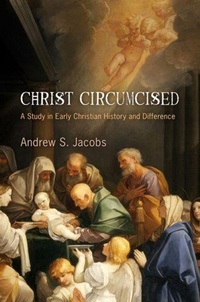
Christ Circumcised
A Study in Early Christian History and Difference
Published on 16. March 2012
Book
Hardback
328 pages
978-0-8122-4397-0 (ISBN)
Description
In the first full-length study of the circumcision of Jesus, Andrew S. Jacobs turns to an unexpected symbol-the stereotypical mark of the Jewish covenant on the body of the Christian savior-to explore how and why we think about difference and identity in early Christianity.
Jacobs explores the subject of Christ's circumcision in texts dating from the first through seventh centuries of the Common Era. Using a diverse toolkit of approaches, including the psychoanalytic, postcolonial, and poststructuralist, he posits that while seeming to desire fixed borders and a clear distinction between self (Christian) and other (Jew, pagan, and heretic), early Christians consistently blurred and destabilized their own religious boundaries. He further argues that in this doubled approach to others, Christians mimicked the imperial discourse of the Roman Empire, which exerted its power through the management, not the erasure, of difference.
For Jacobs, the circumcision of Christ vividly illustrates a deep-seated Christian duality: the fear of and longing for an other, at once reviled and internalized. From his earliest appearance in the Gospel of Luke to the full-blown Feast of the Divine Circumcision in the medieval period, Christ circumcised represents a new way of imagining Christians and their creation of a new religious culture.
Jacobs explores the subject of Christ's circumcision in texts dating from the first through seventh centuries of the Common Era. Using a diverse toolkit of approaches, including the psychoanalytic, postcolonial, and poststructuralist, he posits that while seeming to desire fixed borders and a clear distinction between self (Christian) and other (Jew, pagan, and heretic), early Christians consistently blurred and destabilized their own religious boundaries. He further argues that in this doubled approach to others, Christians mimicked the imperial discourse of the Roman Empire, which exerted its power through the management, not the erasure, of difference.
For Jacobs, the circumcision of Christ vividly illustrates a deep-seated Christian duality: the fear of and longing for an other, at once reviled and internalized. From his earliest appearance in the Gospel of Luke to the full-blown Feast of the Divine Circumcision in the medieval period, Christ circumcised represents a new way of imagining Christians and their creation of a new religious culture.
Reviews / Votes
"This book is a tour de force in demonstrating how varieties of theory can enable fresh readings and understanding of old problems, namely orthodoxy and heresy or the relation of Judaism and Christianity." (J. Rebecca Lyman, Church Divinity School of the Pacific)More details
Series
Language
English
Place of publication
Pennsylvania
United States
Target group
College/higher education
Product notice
Paper over boards
Dimensions
Height: 236 mm
Width: 159 mm
Thickness: 27 mm
Weight
608 gr
ISBN-13
978-0-8122-4397-0 (9780812243970)
Copyright in bibliographic data and cover images is held by Nielsen Book Services Limited or by the publishers or by their respective licensors: all rights reserved.
Schweitzer Classification
Other editions
Additional editions
E-Book
05/2012
1st Edition
University of Pennsylvania Press
€92.99
Available for download
Person
Andrew S. Jacobs is Associate Professor and Chair of the Religious Studies department at Scripps College and the author of Remains of the Jews.
Content
Preface
Introduction: Splitting the Difference
Chapter 1. Circumcision and the Cultural Economy of Difference
Chapter 2. (De-)Judaizing Christ's Circumcision: The Dialogue of Difference
Chapter 3. Heresy, Theology, and the Divine Circumcision
Chapter 4. Dubious Difference: Epiphanius on the Jewish Christians
Chapter 5. Scriptural Distinctions: Reading Between the Lines
Chapter 6. "Let Us Be Circumcised!": Ritual Differences
Conclusion
Notes
Index
Acknowledgments
Introduction: Splitting the Difference
Chapter 1. Circumcision and the Cultural Economy of Difference
Chapter 2. (De-)Judaizing Christ's Circumcision: The Dialogue of Difference
Chapter 3. Heresy, Theology, and the Divine Circumcision
Chapter 4. Dubious Difference: Epiphanius on the Jewish Christians
Chapter 5. Scriptural Distinctions: Reading Between the Lines
Chapter 6. "Let Us Be Circumcised!": Ritual Differences
Conclusion
Notes
Index
Acknowledgments