

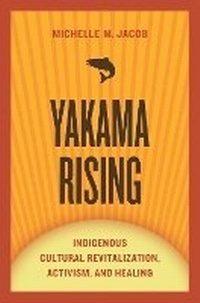
Yakama Rising
Indigenous Cultural Revitalization, Activism, and Healing
Published on 26. September 2013
Book
Hardback
144 pages
978-0-8165-3049-6 (ISBN)
Description
The Yakama Nation of present-day Washington State has responded to more than a century of historical trauma with a resurgence of grassroots activism and cultural revitalization. This path-breaking ethnography shifts the conversation from one of victimhood to one of ongoing resistance and resilience as a means of healing the soul wounds of settler colonialism. Yakama Rising: Indigenous Cultural Revitalization, Activism, and Healing argues that Indigenous communities themselves have the answers to the persistent social problems they face. This book contributes to discourses of Indigenous social change by articulating a Yakama decolonizing praxis that advances the premise that grassroots activism and cultural revitalization are powerful examples of decolonization.
Michelle M. Jacob employs ethnographic case studies to demonstrate the tension between reclaiming traditional cultural practices and adapting to change. Through interviewees' narratives, she carefully tacks back and forth between the atrocities of colonization and the remarkable actions of individuals committed to sustaining Yakama heritage. Focusing on three domains of Indigenous revitalization-dance, language, and foods-Jacob carefully elucidates the philosophy underlying and unifying each domain while also illustrating the importance of these practices for Indigenous self-determination, healing, and survival.
In the impassioned voice of a member of the Yakama Nation, Jacob presents a volume that is at once intimate and specific to her home community and that also advances theories of Indigenous decolonization, feminism, and cultural revitalization. Jacob's theoretical and methodological contributions make this work valuable to a range of students, academics, tribal community members, and professionals, and an essential read for anyone interested in the ways that grassroots activism can transform individual lives, communities, and society.
Michelle M. Jacob employs ethnographic case studies to demonstrate the tension between reclaiming traditional cultural practices and adapting to change. Through interviewees' narratives, she carefully tacks back and forth between the atrocities of colonization and the remarkable actions of individuals committed to sustaining Yakama heritage. Focusing on three domains of Indigenous revitalization-dance, language, and foods-Jacob carefully elucidates the philosophy underlying and unifying each domain while also illustrating the importance of these practices for Indigenous self-determination, healing, and survival.
In the impassioned voice of a member of the Yakama Nation, Jacob presents a volume that is at once intimate and specific to her home community and that also advances theories of Indigenous decolonization, feminism, and cultural revitalization. Jacob's theoretical and methodological contributions make this work valuable to a range of students, academics, tribal community members, and professionals, and an essential read for anyone interested in the ways that grassroots activism can transform individual lives, communities, and society.
More details
Series
Language
English
Place of publication
Tucson
United States
Target group
Professional and scholarly
Illustrations
6 photographs, 4 illustrations
Dimensions
Height: 229 mm
Width: 152 mm
ISBN-13
978-0-8165-3049-6 (9780816530496)
Copyright in bibliographic data and cover images is held by Nielsen Book Services Limited or by the publishers or by their respective licensors: all rights reserved.
Schweitzer Classification
Person
Michelle M. Jacob (Yakama) is an associate professor of ethnic studies and affiliated faculty in sociology at the University of San Diego, USA. She is also the director of the Center for Native Health and Culture at Heritage University on the Yakama Reservation.