


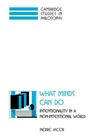
What Minds Can Do
Intentionality in a Non-Intentional World
Published on 23. January 1997
Book
Hardback
312 pages
978-0-521-57401-3 (ISBN)
Description
Some of a person's mental states have the power to represent real and imagined states of affairs: they have semantic properties. What Minds Can Do has two goals: to find a naturalistic or non-semantic basis for the representational powers of a person's mind, and to show that these semantic properties are involved in the causal explanation of the person's behaviour. In the process, this 1997 book addresses issues that are central to much contemporary philosophical debate. It will be of interest to a wide range of readers in philosophy of mind and of language, cognitive science, and psychology.
Reviews / Votes
'... the book addresses issues that are central to much contemporary philosophical debate, in both Anglo-Saxon and Continental philosophy. It will be of interest to a wide range of readers in philosophy of mind and language, cognitive science and psychology.' French Book NewsMore details
Series
Language
English
Place of publication
Cambridge
United Kingdom
Target group
Professional and scholarly
Dimensions
Height: 222 mm
Width: 145 mm
Thickness: 22 mm
Weight
573 gr
ISBN-13
978-0-521-57401-3 (9780521574013)
Copyright in bibliographic data and cover images is held by Nielsen Book Services Limited or by the publishers or by their respective licensors: all rights reserved.
Schweitzer Classification
Other editions
Additional editions
Book
01/1997
Cambridge University Press
€48.80
Shipment within 15-20 days
Content
Part I. The Naturalization of Intentionality: 1. What is intentional realism?; 2. Introduction to informational semantics; 3. Three problems for informational semantics; 4. Information and teleology; Part II. The Casual Role of Intentionality: 5. The computational representational theory of mind (CRTM); 6. Must an intentional realist be a meaning atomist?; 7. Functionalism and the threat of pre-emption; 8. Explaining intentional behaviour; 9. Conclusion: a postlude on semantics and psychology; References; Index.