

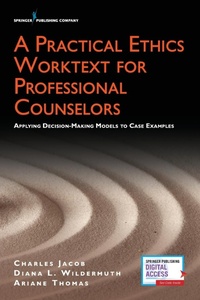
A Practical Ethics Worktext for Professional Counselors
Applying Decision-Making Models to Case Examples
Published on 19. March 2020
Book
Paperback/Softback
220 pages
978-0-8261-6533-6 (ISBN)
Description
Teaches counselors how to think and act quickly when facing ethical dilemmas
This practical worktext addresses common ethical challenges faced by counseling professionals. Boasting 63 case examples that map with CACREP's accreditation standards, this must-have resource demonstrates step-by-step application of decision-making models to real-life counseling scenarios. Each chapter includes seven cases related to a section of the ACA's Code of Ethics examined carefully using a specific decision-making model.
The case examples included are designed to be relatable and accessible while demonstrating the process of arriving at a solution that reflects the standards of professional counseling. Valuable features include "Questions for Discussion," "Straight From the Code," "Applying a Decision-Making Model," "The Likely Answer," and in-class discussion activities and exercises at the end of each chapter.
KEY FEATURES:Includes 63 real-life case examples demonstrating step-by-step application of decision-making models
Teaches counselors how to think and act quickly when facing ethical dilemmas
Maps with ACA Code of Ethics and CACREP accreditation standards
Includes group discussion questions
Includes role-playing activities
Helps professionals to reconcile personal and professional values
This practical worktext addresses common ethical challenges faced by counseling professionals. Boasting 63 case examples that map with CACREP's accreditation standards, this must-have resource demonstrates step-by-step application of decision-making models to real-life counseling scenarios. Each chapter includes seven cases related to a section of the ACA's Code of Ethics examined carefully using a specific decision-making model.
The case examples included are designed to be relatable and accessible while demonstrating the process of arriving at a solution that reflects the standards of professional counseling. Valuable features include "Questions for Discussion," "Straight From the Code," "Applying a Decision-Making Model," "The Likely Answer," and in-class discussion activities and exercises at the end of each chapter.
KEY FEATURES:Includes 63 real-life case examples demonstrating step-by-step application of decision-making models
Teaches counselors how to think and act quickly when facing ethical dilemmas
Maps with ACA Code of Ethics and CACREP accreditation standards
Includes group discussion questions
Includes role-playing activities
Helps professionals to reconcile personal and professional values
More details
Language
English
Place of publication
New York
United States
Target group
Professional and scholarly
Dimensions
Height: 229 mm
Width: 152 mm
Thickness: 12 mm
Weight
329 gr
ISBN-13
978-0-8261-6533-6 (9780826165336)
Copyright in bibliographic data and cover images is held by Nielsen Book Services Limited or by the publishers or by their respective licensors: all rights reserved.
Schweitzer Classification
Persons
Charles Jacob, PhD, is a lecturer in the Counseling and Mental Health Services Program at the University of Pennsylvania's Graduate School of Education and is licensed as both a counselor and a psychologist. He is also the interim director of the Professional Counseling Program at Seton Hall University.
Ariane Thomas, University of Pennsylvania. Ariane Thomas is a full-time lecturer in educational practice in the Counseling and Mental Health Services Program at the University of Pennsylvania's Graduate School of Education and is licensed as a psychologist.
Diana L. Wildermuth, PhD, NCC, LPC, is an associate professor of practice at Temple University in the Counseling Psychology Program and is licensed as a professional counselor and certified as a professional school counselor.
Ariane Thomas, University of Pennsylvania. Ariane Thomas is a full-time lecturer in educational practice in the Counseling and Mental Health Services Program at the University of Pennsylvania's Graduate School of Education and is licensed as a psychologist.
Diana L. Wildermuth, PhD, NCC, LPC, is an associate professor of practice at Temple University in the Counseling Psychology Program and is licensed as a professional counselor and certified as a professional school counselor.
Content
Preface
Acknowledgments
1. The Counseling Relationship (Section A of the ACA Code of Ethics)
2. Confidentiality and Privacy (Section B of the ACA Code of Ethics)
3. Professional Responsibility (Section C of the ACA Code of Ethics)
4. Relationships With Other Professionals (Section D of the ACA Code of Ethics)
5. Evaluation, Assessment, and Interpretation (Section E of the ACA Code of Ethics)
6. Supervision, Teaching, and Training (Section F of the ACA Code of Ethics)
7. Research and Publication (Section G of the ACA Code of Ethics)
8. Distance Counseling, Technology, and Social Media (Section H of the ACA Code of Ethics)
9. Resolving Ethical Issues (Section I of the ACA Code of Ethics)
Index
Acknowledgments
1. The Counseling Relationship (Section A of the ACA Code of Ethics)
2. Confidentiality and Privacy (Section B of the ACA Code of Ethics)
3. Professional Responsibility (Section C of the ACA Code of Ethics)
4. Relationships With Other Professionals (Section D of the ACA Code of Ethics)
5. Evaluation, Assessment, and Interpretation (Section E of the ACA Code of Ethics)
6. Supervision, Teaching, and Training (Section F of the ACA Code of Ethics)
7. Research and Publication (Section G of the ACA Code of Ethics)
8. Distance Counseling, Technology, and Social Media (Section H of the ACA Code of Ethics)
9. Resolving Ethical Issues (Section I of the ACA Code of Ethics)
Index