

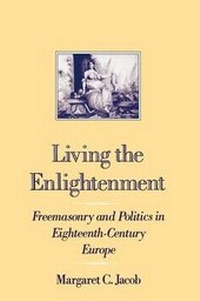
Living the Enlightenment
Freemasonry and Politics in Eighteenth-Century Europe
Published on 1. October 1992
Book
Paperback/Softback
320 pages
978-0-19-507051-4 (ISBN)
Description
Long recognized as more than the writings of a dozen or so philosophes, the Enlightenment created a new secular culture populated by the literate and the affluent. Enamoured of British institutions, Continental Europeans turned to the imported masonic lodges and found in them a new forum that was constitutionally constructed and logically egalitarian. Originating in the Middle Ages, when stone-masons joined together to preserve their professional secrets and to protect their wages, the English and Scottish lodges had by the eighteenth century discarded their guild origins and become an international phenomenon that gave men and eventually some women a place to vote, speak, discuss and debate. Margaret Jacob argues that the hundreds of masonic lodges founded in eighteenth-century Europe were among the most important enclaves in which modern civil society was formed. In France, the Netherlands, Belgium, and Britain men and women freemasons sought to create a moral and social order based upon reason and virtue, and dedicated to the principles of liberty and equality.
A forum where philosophers met with men of commerce, government, and the professions, the masonic lodge created new forms of self-government in microcosm, complete with constitutions and laws, elections, and representatives. This is the first comprehensive history of Enlightenment freemasonry, from the roots of the society's political philosophy and evolution in seventeenth-century England and Scotland to the French Revolution. Based on never-before-used archival sources, it will appeal to anyone interested in the birth of modernity in Europe or in the cultural milieu of the European Enlightenment.
A forum where philosophers met with men of commerce, government, and the professions, the masonic lodge created new forms of self-government in microcosm, complete with constitutions and laws, elections, and representatives. This is the first comprehensive history of Enlightenment freemasonry, from the roots of the society's political philosophy and evolution in seventeenth-century England and Scotland to the French Revolution. Based on never-before-used archival sources, it will appeal to anyone interested in the birth of modernity in Europe or in the cultural milieu of the European Enlightenment.
Reviews / Votes
'What [Jacob] does do very well is to take us behind the scenes to listen to little groups of people, in one or two eighteenth-century European cities, as they lived their social and intellectual lives in the muddle of ideas, ideals, prejudices, assumptions and social aspirations that make up life as people live it. For that we can all be grateful to her.' French History 'A model of the new intellectual history. There have been many calls for a 'social history' of the Enlightenment, but few have actually achieved one, and none in such grand fashion. Jacob gets beyond the symbolism and ritual to place Freemasonry squarely within the social and political contexts of eighteenth-century Europe, and the unique breadth of her archival work gives the book a genuine comparative core. This pioneering study-bold, comprehensive, and vivid-is likely to be the standard work on the subject for years to come.' Gary Kates, Trinity University a welcome and overdue attack on a subject touched on by Mornet sixty years ago ... a major step towards an account of masonry which satisfactorily integrates it with other sides of the eighteenth century ... Professor Jacob has thoroughly and extensively set out the cultural reality which underlay so much anti-masonic polemic ... Professor Jacob ought to be widely read EHR April 1995 scholarly, ground-clearing...It is in Amsterdam that Jacob has made the greatest in-roads into the hitherto closed world of Dutch Freemasonry and she has uncovered an embarrassment of archival riches. British Journal for Eighteenth Century Studies vol 18, part 1More details
Language
English
Place of publication
New York
United States
Target group
Professional and scholarly
Illustrations
9 Fotos bzw. Rasterbilder
9 halftones
Dimensions
Height: 233 mm
Width: 155 mm
Thickness: 15 mm
Weight
451 gr
ISBN-13
978-0-19-507051-4 (9780195070514)
Copyright in bibliographic data and cover images is held by Nielsen Book Services Limited or by the publishers or by their respective licensors: all rights reserved.
Schweitzer Classification
Other editions
Additional editions
E-Book
12/1991
1st Edition
OUP eBook
€21.99
Available for download
Content
Introduction: The European Enlightenment: The Birth of Modern Civil Society ; 1. The Public becomes the Private: The English Revolution and the Origins of European Freemasonry ; 2. Temples of Virtue, Palaces of Splendor: British Masonic Visions ; 3. Cultural Encounters: Freemasonry on the Continent ; 4. Creating Constitutional Societies ; 5. Freemasonry, Women, and the Paradox of the Enlightenment ; 6. Speaking the Language of Enlightenment ; 7. Living the Enlightenment: Cosmopolitan Reformers and Amsterdam Brothers ; 8. Dissension and Reform in the New Civil Society: The Strasbourg Lodges of the Late Eighteenth Century ; 9. Le regime ancien et maconnique: The Paris Grand Lodge and the Reform of National Government ; Conclusion: The Enlightenment Redefined