

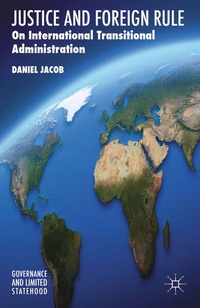
Justice and Foreign Rule
On International Transitional Administration
Published on 1. January 2014
Book
Paperback/Softback
VIII, 178 pages
978-1-349-49745-4 (ISBN)
Description
Can foreign rule be morally justified? Since the end of the First World War, international transitional administrations have replaced dysfunctional states to create the conditions for lasting peace and democracy. In response to extreme state failure, the author argues, this form of foreign rule is not only justified, but a requirement of justice.
More details
Series
Edition
1st ed. 2014
Language
English
Place of publication
London
United Kingdom
Target group
Professional and scholarly
Illustrations
VIII, 178 p.
Dimensions
Height: 216 mm
Width: 140 mm
Thickness: 11 mm
Weight
245 gr
ISBN-13
978-1-349-49745-4 (9781349497454)
DOI
10.1057/9781137452573
Schweitzer Classification
Other editions
Additional editions
Book
10/2014
Palgrave Macmillan
€53.49
Shipment within 10-20 days
Person
Daniel Jacob is Postdoctoral Research Associate at the Freie Universität Berlin, Germany. His research focuses on normative theories of international relations and the debates about the future of democracy.
Content
1. Introduction 1.1. International Transitional Administration 1.2. The Natural Duty of Justice 1.3. Outline of Chapters 1.4. Conclusion 2. Basic Human Interests 2.1. The Concept of Basic Human Interests 2.2. Physical Integrity 2.3. Autonomy 2.4. Interests and Capabilities 2.5. Conclusion 3. Human Rights, Collective Self-determination and Legitimacy 3.1. Human Rights 3.2. The Right to Collective Self-determination 3.3. The Natural Duty of Justice and the Legitimacy of States 3.4. Conclusion 4. Responding to Extreme State Failure 4.1. International Law and the Responsibility to Protect 4.2. State Failure and the Natural Duty of Justice 4.3. The Moral Urgency of Extreme State Failure 4.4. The Charge of Paternalism 4.5. The Practice of International Transitional Administration 4.6. Conclusion 5. Restoring Minimally Just Conditions 5.1. Just War Theory and Ius Post Bellum 5.2. The Limits of Feasibility 5.3. The Requirements of Minimal Justice 5.4. The Practice of International Transitional Administration 5.5. Conclusion 6. Respecting the Requirements of Justice 6.1. Respect for Human Rights and the Rule of Law 6.2. Accountability to the Local Population 6.3. Avoidance of Humiliation 6.4. The Practice of International Transitional Administration 6.5. Conclusion 7. Conclusion 7.1. Justice and Foreign Rule 7.2. The Idea of a Global Moral Division of Labor 8. References