

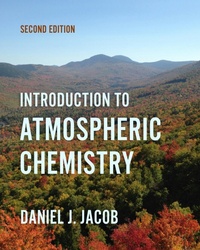
Introduction to Atmospheric Chemistry (Second Edition)
Will be published approx. on 9. March 2027
Book
Hardback
336 pages
978-0-691-27551-2 (ISBN)
Description
An expanded and fully revised edition of the leading introductory textbook on atmospheric chemistry, designed for a one-semester course
Atmospheric chemistry studies the factors controlling the composition of the atmosphere and their implications for life on Earth. This book is structured as a one-semester course, progressively introducing the concepts and methods of atmospheric chemistry at a level easily accessible to students in the sciences and engineering. Exercises with answers allow students to apply what they've learned along the way, and there are questions and problems at the end of each chapter that draw on the latest findings while telling insightful stories. Completely updated with extensive new material, Introduction to Atmospheric Chemistry grounds students in the fundamentals of a fast-growing discipline of real-world importance and enables them to launch research projects of their own.
Now features an entirely new chapter on environmental mercury, primers on core concepts, and scores of new exercises
Discusses all areas of atmospheric chemistry, including connections to related disciplines
Topics include measures of atmospheric composition, atmospheric pressure, simple models, atmospheric transport, global biogeochemical cycles, chemical kinetics, stratospheric chemistry, tropospheric oxidant chemistry, aerosol chemistry, and atmospheric mercury
Covers issues of major importance to society, such as climate change, air pollution, and stratospheric ozone
Written by a leading researcher and educator in the field
An ideal textbook for undergraduate students, graduate students, and professionals
Lecture slides and solutions available to instructors
Atmospheric chemistry studies the factors controlling the composition of the atmosphere and their implications for life on Earth. This book is structured as a one-semester course, progressively introducing the concepts and methods of atmospheric chemistry at a level easily accessible to students in the sciences and engineering. Exercises with answers allow students to apply what they've learned along the way, and there are questions and problems at the end of each chapter that draw on the latest findings while telling insightful stories. Completely updated with extensive new material, Introduction to Atmospheric Chemistry grounds students in the fundamentals of a fast-growing discipline of real-world importance and enables them to launch research projects of their own.
Now features an entirely new chapter on environmental mercury, primers on core concepts, and scores of new exercises
Discusses all areas of atmospheric chemistry, including connections to related disciplines
Topics include measures of atmospheric composition, atmospheric pressure, simple models, atmospheric transport, global biogeochemical cycles, chemical kinetics, stratospheric chemistry, tropospheric oxidant chemistry, aerosol chemistry, and atmospheric mercury
Covers issues of major importance to society, such as climate change, air pollution, and stratospheric ozone
Written by a leading researcher and educator in the field
An ideal textbook for undergraduate students, graduate students, and professionals
Lecture slides and solutions available to instructors
More details
Language
English
Place of publication
New Jersey
United States
Target group
College/higher education
Professional and scholarly
Product notice
Trade binding
Illustrations
101 color + 31 b/w illus. 8 tables.
Dimensions
Height: 254 mm
Width: 203 mm
ISBN-13
978-0-691-27551-2 (9780691275512)
Copyright in bibliographic data and cover images is held by Nielsen Book Services Limited or by the publishers or by their respective licensors: all rights reserved.
Schweitzer Classification
Person
Daniel J. Jacob is the Vasco McCoy Family Professor of Atmospheric Chemistry and Environmental Engineering at Harvard University. He is the author (with Guy P. Brasseur) of Modeling of Atmospheric Chemistry.