

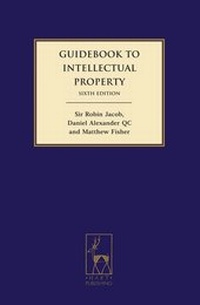
Guidebook to Intellectual Property
6th Edition
Published on 12. September 2013
Book
Paperback/Softback
272 pages
978-1-84946-325-6 (ISBN)
Description
This is a unique book about Intellectual Property. It is aimed not only at law students studying the subject but also at interested users of IP - business people, inventors, scientists, designers and the like. It provides an outline of the basic legal principles which underpin and reguilate the subject, educatuing the reader as to the shape of the law. However, critically, it also gives insight into how the system actually works. You cannot understand chess by merely learning the rules - you also have to know how the game is played: so too with Intellectual Property.
To achieve its object the authors deliberately avoid technicalities: keeping things simple, yet direct. There are no footnotes to distract. Although cases are, inevitably, referred to, they are explained in a pithy, accessible manner. The authors try wherever possible to be both serious and light-hearted at the same time.
All major areas of IP - patents, trade marks, copyright and designs - are covered, along with briefer treatment of other rights and subjects such as breach of confidence, plant varieties and databases.
A novice reader of this book should come away both with a clear outline of IP law and a feeling for how it works. Students will be able to put their more detailed study into perspective. Users will be able to understand better how IP affects them and their businesses.
To achieve its object the authors deliberately avoid technicalities: keeping things simple, yet direct. There are no footnotes to distract. Although cases are, inevitably, referred to, they are explained in a pithy, accessible manner. The authors try wherever possible to be both serious and light-hearted at the same time.
All major areas of IP - patents, trade marks, copyright and designs - are covered, along with briefer treatment of other rights and subjects such as breach of confidence, plant varieties and databases.
A novice reader of this book should come away both with a clear outline of IP law and a feeling for how it works. Students will be able to put their more detailed study into perspective. Users will be able to understand better how IP affects them and their businesses.
Reviews / Votes
... both accessible and user-friendly. Despite its brevity, especially when compared with the corresponding introductory texts in each respective IP field, the substantive quality of its content is not compromised. It is likely to be of use to brand owners, designers and inventors, as well as students and IP practitioners, given its avoidance of unnecessary technical jargon, which, as can be appreciated, can act as a deterrent to would-be dabblers in IP law. In summary, the authors have compiled a complete, as well as manageable, guide to the basics of IP law. * Institute of Trade Mark Attorneys Review * This book is a classic. If such an epithet can be applied to an IP law book...its style and content remain invaluable. -- Simon Stokes * Entertainment Law Review, Volume 25, Issue 6 * An excellent introduction to IP, well-written, interesting and insightful, and several steps above the typical student textbook. -- Mark Anderson, Anderson Law LLP * Law Society Gazette *More details
Edition
6th edition
Language
English
Place of publication
Oxford
United Kingdom
Publishing group
Bloomsbury Publishing PLC
Target group
College/higher education
Professional and scholarly
A novice reader of this book should come away both with a clear outline of IP law and a feeling for how it works. Students will be able to put their more detailed study into perspective. Users will be able to understand better how IP affects them and their businesses.
Dimensions
Height: 234 mm
Width: 156 mm
Thickness: 10 mm
Weight
386 gr
ISBN-13
978-1-84946-325-6 (9781849463256)
Copyright in bibliographic data and cover images is held by Nielsen Book Services Limited or by the publishers or by their respective licensors: all rights reserved.
Schweitzer Classification
Persons
Sir Robin Jacob is currently the Hugh Laddie Professor of Intellectual Property Law at University College London, having left the Court of Appeal of England and Wales in May 2011. Sir Robin was appointed a High Court Judge in 1993. He was appointed a Lord Justice of Appeal in October 2003 and continues to sit from time to time in the Court of Appeal and sometimes acts as an arbitrator or mediator.
Daniel Alexander KC is a barrister at 8 New Square Chambers and a Visiting Professor at University College London. His practice covers litigation in intellectual property cases, including IT and media/entertainment cases, competition, EC, commercial and administrative law.
Matthew Fisher is a Senior Lecturer at University College London, where he teaches and researches in intellectual property law. He has a special interest in patents, but stresses that this should not be held against him. He is the author of Fundamentals of Patent Law: Interpretation and Scope of Protection (Hart, 2007), which won the inaugural Inner Temple Young Author's Book Prize.
Daniel Alexander KC is a barrister at 8 New Square Chambers and a Visiting Professor at University College London. His practice covers litigation in intellectual property cases, including IT and media/entertainment cases, competition, EC, commercial and administrative law.
Matthew Fisher is a Senior Lecturer at University College London, where he teaches and researches in intellectual property law. He has a special interest in patents, but stresses that this should not be held against him. He is the author of Fundamentals of Patent Law: Interpretation and Scope of Protection (Hart, 2007), which won the inaugural Inner Temple Young Author's Book Prize.
Content
Part I Introduction
1 Imitation, Monopoly and Control
2 Courts, Remedies and Legal Actions
3 Patent, Copyright or Design?
Part II Protecting the Product
4 Patents and How to Get Them
5 Important Inventions
6 More About Patents
7 Industrial Designs
Part III Trade Marks, Passing-Off and Unfair Competition
8 Trade Marks and Passing-Off
9 Trade Mark Registration
10 Trade Mark Infringement
11 Exceptions to Trade Mark Infringement
12 Removal from the Register- Revocation and Invalidity
13 Community Marks, International Registration of Marks and Well-Known Marks
14 Collective and Certification Mars
15 Passing-Off
16 Malicious Falsehood
Part IV Copyright and Related Rights
17 Introduction to Copyright
18 Works the Subject of Copyright
19 Ownership of Copyright
20 What is Infringement of Copyright?
21 What is not Infringement?
22 Dealings in Copyright
23 Moral and Other Related Rights
Part V Miscellaneous Matters
24 The Criminal Law
25 Confidence and Privacy
26 Database Right
27 The European Community - Free Movement and Competition
28 Some Aspects of the International Law of Intellectual Property
1 Imitation, Monopoly and Control
2 Courts, Remedies and Legal Actions
3 Patent, Copyright or Design?
Part II Protecting the Product
4 Patents and How to Get Them
5 Important Inventions
6 More About Patents
7 Industrial Designs
Part III Trade Marks, Passing-Off and Unfair Competition
8 Trade Marks and Passing-Off
9 Trade Mark Registration
10 Trade Mark Infringement
11 Exceptions to Trade Mark Infringement
12 Removal from the Register- Revocation and Invalidity
13 Community Marks, International Registration of Marks and Well-Known Marks
14 Collective and Certification Mars
15 Passing-Off
16 Malicious Falsehood
Part IV Copyright and Related Rights
17 Introduction to Copyright
18 Works the Subject of Copyright
19 Ownership of Copyright
20 What is Infringement of Copyright?
21 What is not Infringement?
22 Dealings in Copyright
23 Moral and Other Related Rights
Part V Miscellaneous Matters
24 The Criminal Law
25 Confidence and Privacy
26 Database Right
27 The European Community - Free Movement and Competition
28 Some Aspects of the International Law of Intellectual Property