

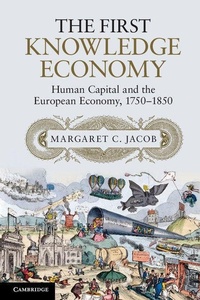
The First Knowledge Economy
Human Capital and the European Economy, 1750-1850
Published on 9. January 2014
Book
Paperback/Softback
265 pages
978-1-107-61983-8 (ISBN)
Description
Ever since the Industrial Revolution debate has raged about the sources of the new, sustained western prosperity. Margaret Jacob here argues persuasively for the critical importance of knowledge in Europe's economic transformation during the period from 1750 to 1850, first in Britain and then in selected parts of northern and western Europe. This is a new history of economic development in which minds, books, lectures and education become central. She shows how, armed with knowledge and know-how and inspired by the desire to get rich, entrepreneurs emerged within an industrial culture wedded to scientific knowledge and technology. She charts how, across a series of industries and nations, innovative engineers and entrepreneurs sought to make sense and a profit out of the world around them. Skilled hands matched minds steeped in the knowledge systems new to the eighteenth century to transform the economic destiny of western Europe.
Reviews / Votes
'... there is every reason to recommend this book and over its Jacob predecessors and indeed to delight in the research it contains. This is undoubtedly part of the story of industrialization.' Pat Hudson, The Journal of Modern History 'A significant strength is the elimination of economic determinism and the inclusion of knowledge of science into the public equation. Jacob's coherent argument, premised on solid evidence ... unequivocally shows that the first knowledge economy in the world emerged in parallel with the Industrial Revolution.' Fedir V. Razumenko, Canadian Journal of History 'This is a compact and tightly argued book, at its best when refuting Robert Allen's claim that coal and high wages gave Great Britain its edge (see Robert Allen, Industrial Revolution in Global Perspective [Cambridge, 2009]). It is also a provocative read, liable to raise more questions than it answers.' Lissa Roberts, IsisMore details
Language
English
Place of publication
Cambridge
United Kingdom
Target group
Professional and scholarly
Product notice
Paperback (trade)
Illustrations
2 Maps; 10 Halftones, unspecified; 1 Line drawings, unspecified
Dimensions
Height: 229 mm
Width: 152 mm
Thickness: 15 mm
Weight
393 gr
ISBN-13
978-1-107-61983-8 (9781107619838)
Copyright in bibliographic data and cover images is held by Nielsen Book Services Limited or by the publishers or by their respective licensors: all rights reserved.
Schweitzer Classification
Other editions
Additional editions
Book
01/2014
Cambridge University Press
€99.20
Shipment within 15-20 days
Person
Margaret C. Jacob holds an honorary doctoral from the University of Utrecht and has had a session devoted to her work at the American Historical Association's annual convention in 2012. She has worked in archives in four countries and has published thirteen books. The range of her expertise begins with the meaning and impact of the Newtonian synthesis and extends to the Enlightenment more generally, to the Revolution of 1688, the Dutch Revolution of 1747-48, and most recently, the Industrial Revolution seen comparatively. She has taught in American, British and Dutch universities, received the Gottschalk Prize for her first book on the Newtonians and the English Revolution, and is a member of the American Philosophical Society.
Content
Introduction: knowledge and industrial development: the stakes; 1. A portrait of early industrial lives: the Watts and Boultons, science and entrepreneurship; 2. The knowledge economy and coal: how technological change happened; 3. Technical knowledge and making cotton king; 4. Textiles in Leeds: mechanical science on the factory floor; 5. The puzzle of French retardation: reform and its antecedents; 6. The puzzle of French retardation: restoration and reaction; 7. Education and the inculcation of industrial knowledge: the Low Countries, 1750-1830.