

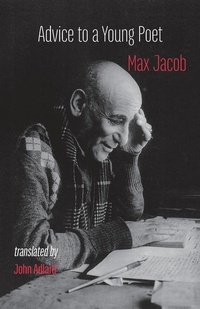
Advice to a Young Poet
Conseils a un jeune poete
2nd Edition
Published on 6. January 2023
Book
Paperback/Softback
86 pages
978-1-84861-862-6 (ISBN)
Description
'Advice to a Young Poet' is an English translation, first published on the centenary of the author's birth in 1967, of Max Jacob's posthumous 'Conseils a un jeune poete'. This was Jacob's last major statement on poetry, the culmination of a lifetime's reflection on and practice of the art. This book makes his great personal as well as literary influence on many poets and writers easier to understand. The translator, John Adlard, supplies an introduction which is a valuable contribution to the understanding of Jacob. The book is completed by a deeply personal preface from the pen of Edmond Jabes, and a historically important afterword by the "young poet" himself, Jacques Evrard, the first time he had expressed himself on the subject.
"In 'Advice to a Young Poet' Max sets out to answer a question posed by the young man's father: 'What is a lyrical line?' It is his last major statement on poetry, the final development of the thinking of twenty-five years. 'Men used to believe,' he wrote in the 1916 preface to 'Le Cornet a Des', 'that artists are inspired by angels and that there are different categories of angels.' By 1941, after the years of prayer and contemplation at Saint-Benoit-sur-Loire, this is no longer what 'men used to believe', but a fact in the interior life of a poet, the interior life without which a poet cannot be permeable. Only in a mind that is permeable is that conflagration possible ('the conflagration,' he called it in his 'Art Poetique' of 1922, 'after the encounter of a harmonious man with himself') which produces the lyrical line, the 'consecrated line' identified by its euphoria and its euphony." -from John Adlard's introduction
"In 'Advice to a Young Poet' Max sets out to answer a question posed by the young man's father: 'What is a lyrical line?' It is his last major statement on poetry, the final development of the thinking of twenty-five years. 'Men used to believe,' he wrote in the 1916 preface to 'Le Cornet a Des', 'that artists are inspired by angels and that there are different categories of angels.' By 1941, after the years of prayer and contemplation at Saint-Benoit-sur-Loire, this is no longer what 'men used to believe', but a fact in the interior life of a poet, the interior life without which a poet cannot be permeable. Only in a mind that is permeable is that conflagration possible ('the conflagration,' he called it in his 'Art Poetique' of 1922, 'after the encounter of a harmonious man with himself') which produces the lyrical line, the 'consecrated line' identified by its euphoria and its euphony." -from John Adlard's introduction
More details
Edition
2nd Bilingual edition
Language
English
French
Place of publication
Exeter
United Kingdom
Edition type
Bilingual edition
Product notice
Paperback (trade)
Unsewn / adhesive bound
Dimensions
Height: 216 mm
Width: 140 mm
Thickness: 6 mm
Weight
100 gr
ISBN-13
978-1-84861-862-6 (9781848618626)
Copyright in bibliographic data and cover images is held by Nielsen Book Services Limited or by the publishers or by their respective licensors: all rights reserved.
Schweitzer Classification
Other editions
Previous edition

Max Jacob
Advice to a Young Poet
Book
07/1976
The Menard Press
€20.93
Article exhausted; check for reprint
Persons
Max Jacob was born a Jew, in Quimper, Brittany in 1876. He made his home in Paris and was deeply involved in the literary, artistic and cultural revolution of his time. He is one of the most important and influential French writers and poets of the century and a great master of the prose poem, notably in Le Cornet a des, 1917. Among his closest friends and colleagues in the early years were Picasso and Apollinaire. His published works also include novels and essays and many posthumous volumes of correspondence. In the later part of his life Jacob retired to the monastery at Saint-Benoit-sur-Loire: he had converted lo Catholicism in 1915. He died, wearing the yellow star, at Drancy concentration camp, in 1944, but he retained his faith to the end, his last words being 'Je suis avec Dieu'.