

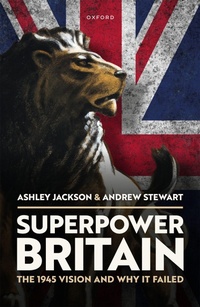
Superpower Britain
The 1945 Vision and Why it Failed
Published on 13. February 2025
Book
Hardback
480 pages
978-0-19-286370-6 (ISBN)
Description
History tells us that the Second World War broke Britain as a great power, diminishing its military strength, ruining its economy, and precipitating a striking wave of decolonization. Nationalists and new superpowers dominated the post-war landscape, and the country was on the slide. But no one knew this in 1945 - the leading politicians, the top civil servants, and the most knowledgeable experts, all expected the British Empire to remain intact long into the future. There was no hint of imminent collapse, and the governing elite and key opinion-shapers weren't considering decline and decolonization, evincing instead a new zeal for imperial renovation and a belief that an empire which had just survived another global conflict was vital for the peace and security of all humankind. They were even looking to expansion, securing the spoils of victory as they had done at the end of the First World War. Fully expecting to continue leading a great empire as well as a bloc of European nations recovering from war, the British had their own vision of the new world order. Furthermore, and astonishingly given what actually happened, British leaders were convinced that parity could be gained with the Americans and the Soviets: Britain was to remain a superpower in its own right.
What actually happened differed radically from these expectations. The question is, how do we account for the difference between what it was thought would happen and the actual course of events? Superpower Britain is the first book to focus in depth on this fascinating counterpoint and to fully integrate the history of Britain and the effects of the Second World War with the history of the British Empire. It explains what the British planned to do in the post-war world, why they thought their plans for regeneration and the future world order were viable, and what the war had actually done to British world power and its imperial foundations.
What actually happened differed radically from these expectations. The question is, how do we account for the difference between what it was thought would happen and the actual course of events? Superpower Britain is the first book to focus in depth on this fascinating counterpoint and to fully integrate the history of Britain and the effects of the Second World War with the history of the British Empire. It explains what the British planned to do in the post-war world, why they thought their plans for regeneration and the future world order were viable, and what the war had actually done to British world power and its imperial foundations.
Reviews / Votes
This important work deserves notice. It is certainly instructive. * Jeremy Black, NYMAS Review *More details
Language
English
Place of publication
Oxford
United Kingdom
Target group
Professional and scholarly
Product notice
sewn/stitched
Cloth over boards
Dimensions
Height: 234 mm
Width: 164 mm
Thickness: 30 mm
Weight
853 gr
ISBN-13
978-0-19-286370-6 (9780192863706)
Copyright in bibliographic data and cover images is held by Nielsen Book Services Limited or by the publishers or by their respective licensors: all rights reserved.
Schweitzer Classification
Other editions
Additional editions
E-Book
01/2025
OUP eBook
€32.99
Available for download
E-Book
01/2025
OUP eBook
€32.99
Available for download
Persons
Ashley Jackson is Professor of Imperial and Military History at King's College London and a Visiting Fellow at Kellogg College, Oxford. He studied for postgraduate degrees at New College, Oxford, and spent eight years as a research fellow at Mansfield College, Oxford and a year as a lecturer at Oxford Brookes University.
Andrew Stewart is an Honorary Professor at the Australian National University and Visiting Professor at King's College London. His previous roles have included Director of Academic Studies at the Royal College of Defence Studies and Principal at the Australian War College. A Fellow of the Royal Historical Society and the Higher Education Academy, he is also a trustee of the Liddell Hart Centre for Military Archives and the Society for Military History. His research covers conflict, diplomacy, and international relations, and his writing focuses on the Second World War. He is currently Director of Conflict Research at the Centre for Historical Analysis and Conflict Research, the British Army's think-tank.
Andrew Stewart is an Honorary Professor at the Australian National University and Visiting Professor at King's College London. His previous roles have included Director of Academic Studies at the Royal College of Defence Studies and Principal at the Australian War College. A Fellow of the Royal Historical Society and the Higher Education Academy, he is also a trustee of the Liddell Hart Centre for Military Archives and the Society for Military History. His research covers conflict, diplomacy, and international relations, and his writing focuses on the Second World War. He is currently Director of Conflict Research at the Centre for Historical Analysis and Conflict Research, the British Army's think-tank.
Content
Preface
Introduction: The dilemmas of 1945 and the received historical narrative
Part One: The vision and the challenge
1: Foundations of the superpower vision
2: Empire, unity, peace, and expansion
3: Alternative futures and a future unknown
4: Coloniality and condescension continued
5: The plan
Part Two: The problem with America
6: Atlantic entanglements: The American challenge
7: 'Hands off!': The British response
Part Three: What the war did to the British Empire
8: The perils of war imperialism, I: South Asia
9: The perils of war imperialism, II: The Middle East
10: The colonial empire, British thinking, and international debate
11: The colonial empire at the local level
12: United, but not a unit: Britain and the dominions
Conclusion Why the vision faded: Unravelling expectations in a changing world
Epilogue
Introduction: The dilemmas of 1945 and the received historical narrative
Part One: The vision and the challenge
1: Foundations of the superpower vision
2: Empire, unity, peace, and expansion
3: Alternative futures and a future unknown
4: Coloniality and condescension continued
5: The plan
Part Two: The problem with America
6: Atlantic entanglements: The American challenge
7: 'Hands off!': The British response
Part Three: What the war did to the British Empire
8: The perils of war imperialism, I: South Asia
9: The perils of war imperialism, II: The Middle East
10: The colonial empire, British thinking, and international debate
11: The colonial empire at the local level
12: United, but not a unit: Britain and the dominions
Conclusion Why the vision faded: Unravelling expectations in a changing world
Epilogue