

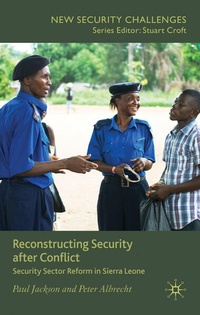
Reconstructing Security after Conflict
Security Sector Reform in Sierra Leone
Published on 17. November 2010
Book
Hardback
XIII, 236 pages
978-0-230-23900-5 (ISBN)
Description
A long-term evaluation and analysis of the UK's involvement in Sierra Leone before and after the conflict which ended in 2002. This book looks at how UK intervention moved from initial involvement through to war fighting and then post-conflict reconstruction, specifically of the security infrastructure.
Reviews / Votes
'Drawing on truly impressive source material collected over years, the authors document brilliantly not only how SSR was pioneered in Sierra Leone, but also the bureaucratic politics that saw the Department for International Development move into traditional security work, and later back to more 'suitable' activities like legal reform, prison reform, and access to justice.' - African Affairs
More details
Series
Edition
2011 edition
Language
English
Place of publication
London
United Kingdom
Target group
Professional and scholarly
Product notice
Unsewn / adhesive bound
Paper over boards
Illustrations
XIII, 236 p.
Dimensions
Height: 216 mm
Width: 140 mm
Thickness: 20 mm
Weight
417 gr
ISBN-13
978-0-230-23900-5 (9780230239005)
DOI
10.1057/9780230302471
Schweitzer Classification
Other editions
Additional editions
P. Jackson | P. Albrecht
Reconstructing Security after Conflict
Security Sector Reform in Sierra Leone
Book
01/2011
Palgrave Macmillan
€53.49
Shipment within 15-20 days
P. Jackson | P. Albrecht
Reconstructing Security after Conflict
Security Sector Reform in Sierra Leone
E-Book
11/2010
1st Edition
Palgrave Macmillan
€53.49
Available for download
Persons
PAUL JACKSON is Head of the School of Government and Society at the University of Birmingham, UK, where he teaches and researches contemporary African politics and security and has been the Director of the Global Facilitation Network for Security Sector Reform. He was part of the reform efforts in Sierra Leone immediately following the conflict, working on issues of security and decentralisation and the rejuvenation of local government. He has many years experience of working in developing countries, particularly in Africa. He has worked within the area of politics and security for several Governments, the UN, the EU and the World Bank. He sits on the Geneva DCAF Advisory Board, is a member of the Folke Bernadotte Institute working group on Security Sector Reform and directs the International Development Department's postgraduate programme in Conflict, Security and Development
PETER ALBRECHT is a PhD researcher at the Danish Institute for International Studies (DIIS) and Copenhagen Business School, focusing on local level implementation of security sector reform (SSR) in Sierra Leone. He was previously Governance and Conflict Adviser in the UK's Stabilisation Unit and Senior Programme Officer in International Alert's Peacebuilding Issues Programme.
PETER ALBRECHT is a PhD researcher at the Danish Institute for International Studies (DIIS) and Copenhagen Business School, focusing on local level implementation of security sector reform (SSR) in Sierra Leone. He was previously Governance and Conflict Adviser in the UK's Stabilisation Unit and Senior Programme Officer in International Alert's Peacebuilding Issues Programme.
Content
Introduction How did SSR in Sierra Leone Impact on International Policy Making on SSR? Security and Sierra Leone Up Until the End of the Conflict The Development of the Concept of SSR 2002-2005 Consolidation and Development, 2005-2007 Cross-cutting Themes Throughout the Period in Sierra Leone and Beyond Conclusions