

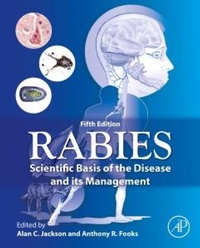
Rabies
Scientific Basis of the Disease and Its Management
5th Edition
Published on 5. August 2025
Book
Hardback
830 pages
978-0-443-29979-7 (ISBN)
Description
Rabies: Scientific Basis of the Disease and its Management, Fifth Edition is an authoritative reference that delves into the virological, clinical, and public health facets of rabies. This new edition provides insights into the molecular virology, pathogenesis, diagnosis, immunology, treatment, epidemiology, and public health strategies for managing rabies. It also includes discussions on the One Health approach to rabies, global implications, and setbacks due to the COVID-19 pandemic. Furthermore, the book serves as an essential resource for physicians, veterinarians, public health advisors, epidemiologists, and research scientists, offering current information on diagnosing, treating, controlling, and preventing this deadly infectious disease.
More details
Edition
5th edition
Language
English
Place of publication
San Diego
United States
Publishing group
Elsevier Science Publishing Co Inc
Target group
Professional and scholarly
Product notice
sewn/stitched
Cloth over boards
Dimensions
Height: 239 mm
Width: 193 mm
Thickness: 46 mm
Weight
1837 gr
ISBN-13
978-0-443-29979-7 (9780443299797)
Copyright in bibliographic data and cover images is held by Nielsen Book Services Limited or by the publishers or by their respective licensors: all rights reserved.
Schweitzer Classification
Other editions
Additional editions
E-Book
07/2025
5th Edition
Academic Press
€172.99
Available for download
Previous edition
Book
05/2020
4th Edition
Academic Press
€161.50
Shipment within 15-20 days
Persons
Dr. Alan C. Jackson is Adjunct Clinical Professor in the Department of Clinical Neurosciences (Neurology) at the University of Calgary in Calgary, Alberta, Canada. Previously, he was Professor of Medicine (Neurology) at Queen's University (Kingston, Ontario, Canada) and later at the University of Manitoba (Winnipeg, Manitoba, Canada). He graduated from Queen's University with BA and MD degrees. He completed an internship in internal medicine at University of Southern California, residencies in internal medicine at Queen's University and in neurology at the University of Western Ontario, and a fellowship in neurovirology at The Johns Hopkins University with Drs. Richard Johnson and Diane Griffin. Dr. Jackson has been active in rabies research for over 30 years. Dr. Anthony Fooks is a Virologist and the Lead Scientist for International Development at The Animal and Plant Health Agency in the UK. He is an Honorary Visiting Professor in the Faculty of Health and Life Sciences, University of Liverpool, UK and at the Institute for Infection and Immunity at St George's Medical School, University of London, UK. His research focuses on rabies pathogenesis and immunity.
Content
1. Rabies Prevention Through the Ages
2. Taxonomy
3. Rabies Virus
4. Epidemiology
5.Molecular Epidemiology
6. Rabies in Terrestrial Animals
7. Rabies in Livestock
8. Bat Rabies
9.Human Disease
10. Pathogenesis
11. Pathology
12. Immunology
13. Laboratory Diagnosis of Rabies
14. Measures of Rabies Immunity
15. Vaccines
16. Public Health Management of Humans at Risk
17. Therapy of Human Rabies
18. Dog Rabies and its Control
19. Rabies Control in Wild Carnivores
20. Elimination of Human Rabies Mediated by Dogs
21. Future Developments and Challenges
2. Taxonomy
3. Rabies Virus
4. Epidemiology
5.Molecular Epidemiology
6. Rabies in Terrestrial Animals
7. Rabies in Livestock
8. Bat Rabies
9.Human Disease
10. Pathogenesis
11. Pathology
12. Immunology
13. Laboratory Diagnosis of Rabies
14. Measures of Rabies Immunity
15. Vaccines
16. Public Health Management of Humans at Risk
17. Therapy of Human Rabies
18. Dog Rabies and its Control
19. Rabies Control in Wild Carnivores
20. Elimination of Human Rabies Mediated by Dogs
21. Future Developments and Challenges