

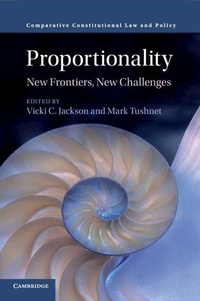
Proportionality
New Frontiers, New Challenges
Published on 20. December 2018
Book
Paperback/Softback
351 pages
978-1-316-61700-7 (ISBN)
Description
With contributions from leading scholars in constitutional law, this volume examines how carefully designed and limited doctrines of proportionality can improve judicial decision-making, how it is applied in different jurisdictions, its role on constitutionalism outside the courts, and whether the principle of proportionality actually advances or detracts from democracy. Contributions from some of the seminal thinkers on the development of scholarship on proportionality (e.g. Alexy, Barak, and Beatty) extend their prior work and engage in an important dialogue on the topic. Some offer substantial critiques, others defend the doctrine and offer important clarifications and extensions of their prior work. Throughout, the authors engage not only with case law from around the world but also with existing scholarly treatments of the subject. Mathematical treatments are avoided, making the book accessible to readers from both 'soft' and hard' social science backgrounds.
More details
Series
Language
English
Place of publication
Cambridge
United Kingdom
Target group
Professional and scholarly
Product notice
Paperback (trade)
Dimensions
Height: 229 mm
Width: 152 mm
Thickness: 20 mm
Weight
510 gr
ISBN-13
978-1-316-61700-7 (9781316617007)
Copyright in bibliographic data and cover images is held by Nielsen Book Services Limited or by the publishers or by their respective licensors: all rights reserved.
Schweitzer Classification
Other editions
Additional editions
Book
09/2017
Cambridge University Press
€162.10
Shipment within 15-20 days
Persons
Vicki C. Jackson is Thurgood Marshall Professor of Constitutional Law at Harvard Law School, Massachusetts. She is the author of Constitutional Engagement in a Transnational Era (2010), and co-author, with Mark Tushnet, of Comparative Constitutional Law (3rd edition, 2014) and Defining the Field of Comparative Constitutional Law (2002). She has served on the Advisory Board of Trustees, International Association of Women Judges and on the Executive Committee, International Association of Constitutional Law. Mark Tushnet is the William Nelson Cromwell Professor of Law at Harvard Law School, Massachusetts. He has served as a law clerk to Justice Thurgood Marshall of the US Supreme Court. His book on the National Association for the Advancement of Colored People's (NAACP) campaign against segregated education won the Littleton-Griswold Prize from the American Historical Association. He was president of the Association of American Law Schools in 2003, and is a member of the American Academy of Arts and Sciences and the American Law Institute.
Content
Introduction Vicki C. Jackson and Mark Tushnet; Part l. Paradigms of Proportionality: 1. Proportionality and rationality Robert Alexy; 2. Proportionality outside the courts, with special reference to popular and political constitutionalism Frank I. Michelman; 3. Is the structure of human rights practice defensible? Three puzzles and their solution Mattias Kumm; 4. Proportionality and absolute rights Gregoire Webber; Part ll. Proportionality and the United States: 5. Constitutional law and proportionality: the administrative origins of constitutional rights and how they shaped global constitutionalism Moshe Cohen-Eliya and Iddo Porat; 6. US constitutional law, proportionality, and the global model Kai Moller; 7. Beyond proportionality: thinking comparatively about constitutional review and punitiveness Jacco Bomhoff; 8. Proportionality and equality Vicki C. Jackson; 9. Proportionality and stare decisis - proposal for a new structure Vlad Perju; Part lll. Extending the Reach of Proportionality and Equality: 10. Positive and horizontal rights: proportionality's next frontier or a bridge too far? Stephen Gardbaum; 11. Proportionality, reasonableness, and economic and social rights Katherine G. Young; 12. In praise of casuistry: making hard cases easier David Beatty; Part lV. Thoughts for the Future: Of Scepticism and Research Agendas: 13. Making easy cases harder Mark Tushnet; 14. A research agenda for the future Aharon Barak.