

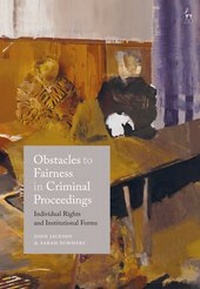
Obstacles to Fairness in Criminal Proceedings
Individual Rights and Institutional Forms
Published on 23. July 2020
Book
Paperback/Softback
344 pages
978-1-5099-4023-3 (ISBN)
Description
This volume considers the way in which the focus on individual rights may constitute an obstacle to ensuring fairness in criminal proceedings.
The increasingly cosmopolitan nature of criminal justice, forcing legal systems with different institutional forms and practices to interact with each other as they attempt to combat crime beyond national borders, has accentuated the need for systems to seek legitimacy beyond their domestic traditions. Fairness, expressed in terms of the right to a fair trial in provisions such as Article 6 of the European Convention on Human Rights, has emerged across Europe as the principal means of guaranteeing the legitimacy of criminal proceedings. The consequence of this is that criminal procedure doctrines are framed overwhelmingly in 'constitutional' terms - the protection of defence rights is necessary to restrict and legitimate the state's mandate to prosecute crime. Yet there are various problems with relying solely or predominantly on defence rights as a means of ensuring that proceedings are 'fair' or legitimate and these issues are rarely discussed in the academic literature. In this volume, scholars from the disciplines of law, philosophy and sociology challenge various normative assumptions underpinning our understanding of fairness in criminal proceedings.
The increasingly cosmopolitan nature of criminal justice, forcing legal systems with different institutional forms and practices to interact with each other as they attempt to combat crime beyond national borders, has accentuated the need for systems to seek legitimacy beyond their domestic traditions. Fairness, expressed in terms of the right to a fair trial in provisions such as Article 6 of the European Convention on Human Rights, has emerged across Europe as the principal means of guaranteeing the legitimacy of criminal proceedings. The consequence of this is that criminal procedure doctrines are framed overwhelmingly in 'constitutional' terms - the protection of defence rights is necessary to restrict and legitimate the state's mandate to prosecute crime. Yet there are various problems with relying solely or predominantly on defence rights as a means of ensuring that proceedings are 'fair' or legitimate and these issues are rarely discussed in the academic literature. In this volume, scholars from the disciplines of law, philosophy and sociology challenge various normative assumptions underpinning our understanding of fairness in criminal proceedings.
More details
Language
English
Place of publication
Oxford
United Kingdom
Publishing group
Bloomsbury Publishing PLC
Target group
College/higher education
Dimensions
Height: 242 mm
Width: 168 mm
Thickness: 20 mm
Weight
600 gr
ISBN-13
978-1-5099-4023-3 (9781509940233)
Copyright in bibliographic data and cover images is held by Nielsen Book Services Limited or by the publishers or by their respective licensors: all rights reserved.
Schweitzer Classification
Other editions
Additional editions
John D. Jackson | Sarah J. Summers
Obstacles to Fairness in Criminal Proceedings
Individual Rights and Institutional Forms
E-Book
03/2018
1st Edition
Hart Publishing
€66.49
Available for download
John D. Jackson | Sarah J. Summers
Obstacles to Fairness in Criminal Proceedings
Individual Rights and Institutional Forms
E-Book
03/2018
1st Edition
Hart Publishing
€66.49
Available for download
Persons
John D Jackson is Professor of Comparative Criminal Law and Procedure, School of Law, University of Nottingham.
Sarah J Summers is Professor of Criminal Law, Criminal Procedure and Criminology, Faculty of Law, University of Zurich.
Sarah J Summers is Professor of Criminal Law, Criminal Procedure and Criminology, Faculty of Law, University of Zurich.
Content
1. Introduction
John D Jackson and Sarah J Summers
2. The Character of the Right to a Fair Trial
Stefan Trechsel
3. Autonomy and Agency in American Criminal Process
David Alan Sklansky
4. Innocence, the Burden of Proof and Fairness in the Criminal Trial: Revisiting Woolmington v DPP (1935)
Lindsay Farmer
5. The Right of Silence in England and Wales: Sacred Cow, Sacrifi cial Lamb or Trojan Horse?
Hannah Quirk
6. Seeking Core Fair Trial Standards across National Boundaries: Judicial Impartiality, the Prosecutorial Role and the Right to Counsel
John D Jackson and Sarah J Summers
7. The Role of Counsel in Criminal Proceedings 7
Wolfgang Wohlers
8. 'Falling on Deaf Ears': Looking for the Salduz Jurisprudence in Greece
Dimitrios Giannoulopoulos
9. Fairness and Expediency in International Criminal Procedure
Kai Ambos
10. International Criminal Procedure and the False Promise of an Ideal Model of Fairness
Yvonne McDermott
11. Written Records of Statements and Fairness
Nadja Capus
12. Regulating and Limiting Plea Concessions: Towards Fairness in Charge Adjudication
Richard L Lippke
13. A Fair Cop and a Fair Trial
Eric J Miller
14. Rights-Analysis in Addressing Pre-Trial Impropriety: An Obstacle to Fairness
Kelly M Pitcher
15. Fairness in Criminal Proceedings: Concluding Thoughts and Further Questions
RA Duff
John D Jackson and Sarah J Summers
2. The Character of the Right to a Fair Trial
Stefan Trechsel
3. Autonomy and Agency in American Criminal Process
David Alan Sklansky
4. Innocence, the Burden of Proof and Fairness in the Criminal Trial: Revisiting Woolmington v DPP (1935)
Lindsay Farmer
5. The Right of Silence in England and Wales: Sacred Cow, Sacrifi cial Lamb or Trojan Horse?
Hannah Quirk
6. Seeking Core Fair Trial Standards across National Boundaries: Judicial Impartiality, the Prosecutorial Role and the Right to Counsel
John D Jackson and Sarah J Summers
7. The Role of Counsel in Criminal Proceedings 7
Wolfgang Wohlers
8. 'Falling on Deaf Ears': Looking for the Salduz Jurisprudence in Greece
Dimitrios Giannoulopoulos
9. Fairness and Expediency in International Criminal Procedure
Kai Ambos
10. International Criminal Procedure and the False Promise of an Ideal Model of Fairness
Yvonne McDermott
11. Written Records of Statements and Fairness
Nadja Capus
12. Regulating and Limiting Plea Concessions: Towards Fairness in Charge Adjudication
Richard L Lippke
13. A Fair Cop and a Fair Trial
Eric J Miller
14. Rights-Analysis in Addressing Pre-Trial Impropriety: An Obstacle to Fairness
Kelly M Pitcher
15. Fairness in Criminal Proceedings: Concluding Thoughts and Further Questions
RA Duff