

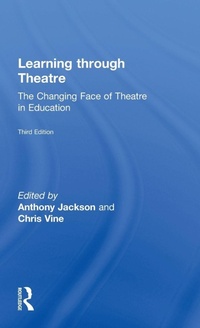
Learning Through Theatre
The Changing Face of Theatre in Education
3rd Edition
Published on 27. June 2013
Book
Hardback
352 pages
978-0-415-53070-5 (ISBN)
Description
In the two decades since the publication of the second edition, Learning Through Theatre has further established itself as an indispensable resource for scholars, practitioners and educators interested in the complex interrelations between teaching and learning, the performing arts, and society at large. Theatre in Education (TIE) has consistently been at the cutting edge of the ever-growing field of Applied Theatre; this comprehensively revised new edition makes an international case for why, and how, it will continue to shape ways in which the participatory arts contribute to the learning of young people (and increasingly, adults) in the 21st century.
Drawing on the experiences and insights of theorists and practitioners from across the world, Learning Through Theatre shows how theatre can, and does, promote:
participatory engagement;
the use of innovative theatrical form;
work with young people and adults in a range of educational settings; and
social and personal change.
Now transatlantically edited by Anthony Jackson and Chris Vine, Learning Through Theatre offers exhilarating new reflections on the book's original aim: to define, describe and debate the salient features, and wider political context, of one of the most important - and radical - developments in contemporary theatre.
Drawing on the experiences and insights of theorists and practitioners from across the world, Learning Through Theatre shows how theatre can, and does, promote:
participatory engagement;
the use of innovative theatrical form;
work with young people and adults in a range of educational settings; and
social and personal change.
Now transatlantically edited by Anthony Jackson and Chris Vine, Learning Through Theatre offers exhilarating new reflections on the book's original aim: to define, describe and debate the salient features, and wider political context, of one of the most important - and radical - developments in contemporary theatre.
More details
Edition
3rd edition
Language
English
Place of publication
London
United Kingdom
Publishing group
Taylor & Francis Ltd
Target group
College/higher education
Professional and scholarly
Illustrations
19 s/w Photographien bzw. Rasterbilder
19 Halftones, black and white
Dimensions
Height: 222 mm
Width: 145 mm
Thickness: 22 mm
Weight
574 gr
ISBN-13
978-0-415-53070-5 (9780415530705)
Copyright in bibliographic data and cover images is held by Nielsen Book Services Limited or by the publishers or by their respective licensors: all rights reserved.
Schweitzer Classification
Other editions
Additional editions
E-Book
07/2013
3rd Edition
Routledge
€64.49
Available for download
E-Book
07/2013
3rd Edition
Routledge
€64.49
Available for download
Book
06/2013
3rd Edition
Routledge
€71.60
Shipment within 15-20 days
Previous edition
Book
10/1993
2nd Edition
Routledge
€126.28
Article exhausted; check for reprint
Persons
Anthony Jackson is Emeritus Professor of Educational Theatre at the University of Manchester, editor of the two previous editions of Learning through Theatre, editor (with Jenny Kidd) of Performing Heritage (MUP 2011), and author of Theatre, Education and the Making of Meanings (MUP 2007).
Chris Vine is Academic Director of the M.A. in Applied Theatre, The City University of New York. He is a former Artistic Director of Greenwich Young People's Theatre, London, and the Creative Arts Team, New York. His specialities include TIE and Theatre of the Oppressed.
Chris Vine is Academic Director of the M.A. in Applied Theatre, The City University of New York. He is a former Artistic Director of Greenwich Young People's Theatre, London, and the Creative Arts Team, New York. His specialities include TIE and Theatre of the Oppressed.
Content
Introduction Part 1. Identifying TIE 1. Education or Theatre? - Development of TIE in the UK 2. Process Drama and TIE Part 2. Ways of Working 3. Devising 4. Playwriting 5. The 'Teaching Artist' 6. TIE and Theatre of the Oppressed Part 3. International Perspectives 7. TIE in Australia and New Zealand 8. Two Canadian Models 9. Potential of TIE in Nigeria 10. TIE in Scandinavia 11. CAT in the USA Part 4. TIE Now - Issues and Challenges 12. Learning through Building-Based Regional Theatre 13. Evaluating TIE 14. Conclusion