

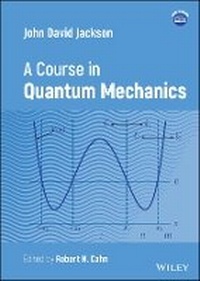
John D. Jackson
Description
Jackson's posthumously published textbook, A Course on Quantum Mechanics, covers quantum mechanics at an advanced level, presenting fundamental principles and techniques including the Schroedinger and Heisenberg representations, angular momentum, perturbation theory, scattering, quantum theory of radiation, and relativistic quantum mechanics. Particular attention is devoted to the WKB and eikonal approximations, which can be applied to a broad range of physical circumstances. An especially thorough treatment is given to atomic physics. The principles of quantum mechanics are illustrated in applications to atomic, nuclear, particle, and condensed matter physics, demonstrating that quantum mechanics provides a quantitative understanding of matter and light.
The book is drawn directly from Jackson's detailed lecture notes and problem sets. It is edited by colleague and former student Robert N. Cahn, who has taken care to preserve Jackson's unique style. The textbook is notable for its original problems focused on real applications, with many addressing published data in accompanying tables and figures. Solutions are provided for problems whose content is critical for understanding the material and whose physical consequences are the most important.
Overall, the text is comprehensive and comprehensible. Particular care is taken to present in detailed the steps in each derivation or calculation. More than 120 figures are included to illustrate both underlying principles, experimental apparatus, and data.
In A Course on Quantum Mechanics, readers can expect to find detailed information on:
Wave mechanics of De Broglie and Schroedinger, the Klein-Gordon equation, non-relativistic approximation, free particle probability current, and expectation values
Schroedinger Equation in momentum space, spread in time of a free-particle wave packet, density matrix, and Sturm-Liouville Eigenvalue problem
WKB formula for bound states, example of WKB with a power law potential, normalization of WKB bound state wave functions, and barrier penetration with WKB.
Rotations and angular momentum, representations, Wigner d-functions, addition of angular momenta, and the Wigner-Eckart theorem.
Time-independent perturbation theory, Stark, Zeeman, Paschen-Back effects, time-dependent perturbation theory, and Fermi's Golden Rule.
Atomic structure, helium, multiplet structure, Russell-Saunders coupling, spin-orbit interaction, Thomas-Fermi model, and the Hartree-Fock approximation.
Scattering amplitude, Born approximation, allowing internal structure, inelastic scattering, optical theorem, and validity criterion for the first Born approximation, partial wave analysis, eikonal approximation, resonance.
Semi-classical and quantum electromagnetism, Aharonov-Bohm effect, Lagrangian and Hamiltonian formulations, gauge invariance, quantization of the electromagnetic field, and coherent states.
Emission and absorption of radiation, dipole transitions, selection rules, Weisskopf-Wigner treatment of line breadth and level shift, and the Lamb shift.
Relativistic quantum mechanics, Klein-Gordon equation, Dirac equation, two-component reduction, hole theory, Foldy-Wouthuysen transformation, Lorentz covariance, discrete symmetries, and non-relativistic and relativistic Compton scattering. The textbook follows the unique-demanding!- style of Jackson's Classical Electrodynamics, A Course on Quantum Mechanics is an advanced level textbook, highly suitable for ambitious graduate students and their instructors, and containing novel problems with detailed solutions to aid in gaining a solid understanding of the subject.
<b> Unique graduate level textbook on quantum mechanics by the John David Jackson, author of the bestselling Classical Electrodynamics</b>
Jackson's posthumously published textbook, <i>A Course on Quantum Mechanics</i>, covers quantum mechanics at an advanced level, presenting fundamental principles and techniques including the Schroedinger and Heisenberg representations, angular momentum, perturbation theory, scattering, quantum theory of radiation, and relativistic quantum mechanics. Particular attention is devoted to the WKB and eikonal approximations, which can be applied to a broad range of physical circumstances. An especially thorough treatment is given to atomic physics. The principles of quantum mechanics are illustrated in applications to atomic, nuclear, particle, and condensed matter physics, demonstrating that quantum mechanics provides a quantitative understanding of matter and light.
The book is drawn directly from Jackson's detailed lecture notes and problem sets. It is edited by colleague and former student Robert N. Cahn, who has taken care to preserve Jackson's unique style. The textbook is notable for its original problems focused on real applications, with many addressing published data in accompanying tables and figures. Solutions are provided for problems whose content is critical for understanding the material and whose physical consequences are the most important.
Overall, the text is comprehensive and comprehensible. Particular care is taken to present in detailed the steps in each derivation or calculation. More than 120 figures are included to illustrate both underlying principles, experimental apparatus, and data.
In <i>A Course on Quantum Mechanics</i>, readers can expect to find detailed information on:
<ol><li>Wave mechanics of De Broglie and Schroedinger, the Klein-Gordon equation, non-relativistic approximation, free particle probability current, and expectation values </li><li>Schroedinger Equation in momentum space, spread in time of a free-particle wave packet, density matrix, and Sturm-Liouville Eigenvalue problem</li><li>WKB formula for bound states, example of WKB with a power law potential, normalization of WKB bound state wave functions, and barrier penetration with WKB.</li><li>Rotations and angular momentum, representations, Wigner d-functions, addition of angular momenta, and the Wigner-Eckart theorem.</li><li>Time-independent perturbation theory, Stark, Zeeman, Paschen-Back effects, time-dependent perturbation theory, and Fermi's Golden Rule.</li><li>Atomic structure, helium, multiplet structure, Russell-Saunders coupling, spin-orbit interaction, Thomas-Fermi model, and the Hartree-Fock approximation.</li><li>Scattering amplitude, Born approximation, allowing internal structure, inelastic scattering, optical theorem, and validity criterion for the first Born approximation, partial wave analysis, eikonal approximation, resonance.</li><li>Semi-classical and quantum electromagnetism, Aharonov-Bohm effect, Lagrangian and Hamiltonian formulations, gauge invariance, quantization of the electromagnetic field, and coherent states.</li><li>Emission and absorption of radiation, dipole transitions, selection rules, Weisskopf-Wigner treatment of line breadth and level shift, and the Lamb shift.</li><li>Relativistic quantum mechanics, Klein-Gordon equation, Dirac equation, two-component reduction, hole theory, Foldy-Wouthuysen transformation, Lorentz covariance, discrete symmetries, and non-relativistic and relativistic Compton scattering. The textbook follows the unique-demanding!- style of Jackson's <i>Classical Electrodynamics</i>, <i>A Course on Quantum Mechanics</i> is an advanced level textbook, highly suitable for ambitious graduate students and their instructors, and containing novel problems with detailed solutions to aid in gaining a solid understanding of the subject.</li></ol>More details
Other editions
Additional editions
Persons
Robert Cahn is recently retired from the Lawrence Berkeley National Laboratory and has taken up the task of editing John D. Jackson's handwritten lecture notes on quantum mechanics for publication.
<b>John D. Jackson</b> (1925-2016) was a Canadian-American physics professor at the University of California, Berkeley and a faculty senior scientist emeritus at Lawrence Berkeley National Laboratory. A theoretical physicist, he is well known for numerous publications and summer-school lectures in nuclear and particle physics.
<b>Robert Cahn </b>is recently retired from the Lawrence Berkeley National Laboratory and has taken up the task of editing John D. Jackson's handwritten lecture notes on quantum mechanics for publication.
Content
1 Basics
1.1 Wave Mechanics of De Broglie and Schroedinger
1.2 Klein-Gordon Equation
1.3 Non-Relativistic Approximation
1.4 Free Particle Probability Current
1.5 Expectation Values
1.6 Particle in a Static, Conservative Force Field
1.7 Ehrenfest's Theorem
1.8 Schroedinger Equation in Momentum Space
1.9 Spread in Time of a Free-Particle Wave Packet
1.10 Interpretation and Application
1.11 Sturm-Liouville Eigenvalue Problem
1.12 Linear Operators on Functions
1.13 Eigenvalue Problem for a Hermitian Operator
1.14 Time-Independent Schroedinger Equation
2 General Principles of Quantum Mechanics
3 Problems in One Dimension
4 Wentzel-Kramers-Brillouin (WKB) Approximation
4.1 Solution in One Dimension
4.2 Schroedinger Equation for the Linear Potential
4.3 Connection Formulae for WKB
4.4 WKB Formula for Bound States
4.5 Example of WKB with a Power Law Potential
4.6 Normalization of WKB Bound State Wave Functions
4.7 Barrier Penetration With WKB
5 Problems in Three Dimensions
6 Rotations and Angular Momentum
7 Perturbation Methods and Applications
8 Time-Dependent Perturbation Theory
9 Atomic Structure
10 Scattering
10.1 Scattering Amplitude
10.2 Born Approximation
10.3 Allowing Internal Structure
10.4 Inelastic Scattering
10.5 Optical Theorem
10.6 Validity Criterion for the First Born Approximation
10.7 Method of Partial Waves
10.8 Behavior of the Cross Section and the Argand Diagram
10.9 Hard Sphere Scattering
10.10 Strongly Attractive Potentials and Resonance
11 Semi-Classical and Quantum Electromagnetic Field
11.1 Aharanov-Bohm Effect
11.2 Semi-Classical Radiation Theory
11.3 Scalar Field Quantization
11.4 Quantization of the Radiation Field
11.5 States of the Electromagnetic Field
11.6 Vacuum Expectation Values of E, E Times E Over Finite Volume
11.7 Classical vs Quantum Radiation
11.8 Quasi-Classical Fields and Coherent States
12 Emission and Absorption of Radiation
12.1 Matrix Elements and Rates
12.2 Dipole Transitions
12.3 Charged Particle in Central Field
12.4 Including Spin
12.5 Line Breadth and Level Shift
13 Relativistic Electron Theory
A Mathematical Tools
A.1 Integration by Parts with the Divergence Theorem
A.2 Contour Integration
A.3 Green Function for Helmholtz Equation
B Problems
C Selected Solutions