

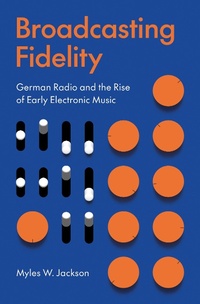
Broadcasting Fidelity
German Radio and the Rise of Early Electronic Music
Published on 17. September 2024
Book
Hardback
344 pages
978-0-691-26072-3 (ISBN)
Description
A landmark history of early radio in Germany and the quest for broadcast fidelity
When we turn on a radio or stream a playlist, we can usually recognize the instrument we hear, whether it's a cello, a guitar, or an operatic voice. Such fidelity was not always true of radio. Broadcasting Fidelity shows how the problem of broadcast fidelity pushed German scientists beyond the traditional bounds of their disciplines and led to the creation of one of the most important electronic instruments of the twentieth century.
In the early days of radio, acoustical distortions made it hard for even the most discerning musical ears to differentiate instruments and voices. The physicists and engineers of interwar Germany, with the assistance of leading composers and musicians, tackled this daunting technical challenge. Research led to the invention in 1930 of the trautonium, an early electronic instrument capable of imitating the timbres of numerous acoustical instruments and generating novel sounds for many musical genres. Myles Jackson charts the broader political and artistic trajectories of this instrument, tracing how it was embraced by the Nazis and subsequently used to subvert Nazi aesthetics after the war and describing how Alfred Hitchcock commissioned a later version of the trautonium to provide the sounds of birds squawking and flapping their wings in his 1963 thriller The Birds.
A splendid work of scholarship by an acclaimed historian of science, Broadcasting Fidelity reveals how the interplay of science, technology, politics, and culture gave rise to new aesthetic concepts, innovative musical genres, and the modern discipline of electroacoustics.
When we turn on a radio or stream a playlist, we can usually recognize the instrument we hear, whether it's a cello, a guitar, or an operatic voice. Such fidelity was not always true of radio. Broadcasting Fidelity shows how the problem of broadcast fidelity pushed German scientists beyond the traditional bounds of their disciplines and led to the creation of one of the most important electronic instruments of the twentieth century.
In the early days of radio, acoustical distortions made it hard for even the most discerning musical ears to differentiate instruments and voices. The physicists and engineers of interwar Germany, with the assistance of leading composers and musicians, tackled this daunting technical challenge. Research led to the invention in 1930 of the trautonium, an early electronic instrument capable of imitating the timbres of numerous acoustical instruments and generating novel sounds for many musical genres. Myles Jackson charts the broader political and artistic trajectories of this instrument, tracing how it was embraced by the Nazis and subsequently used to subvert Nazi aesthetics after the war and describing how Alfred Hitchcock commissioned a later version of the trautonium to provide the sounds of birds squawking and flapping their wings in his 1963 thriller The Birds.
A splendid work of scholarship by an acclaimed historian of science, Broadcasting Fidelity reveals how the interplay of science, technology, politics, and culture gave rise to new aesthetic concepts, innovative musical genres, and the modern discipline of electroacoustics.
Reviews / Votes
"A beautiful academic study on the genesis and life of a complex technical object, well located in the interweaving of its scientific, technical, social, cultural and political contexts and attentive to the play of its various actors."---Jean-Marc Wolff, MetascienceMore details
Language
English
Place of publication
New Jersey
United States
Target group
College/higher education
Professional and scholarly
Product notice
Trade binding
Illustrations
33 b/w illus.
Dimensions
Height: 243 mm
Width: 167 mm
Thickness: 30 mm
Weight
667 gr
ISBN-13
978-0-691-26072-3 (9780691260723)
Copyright in bibliographic data and cover images is held by Nielsen Book Services Limited or by the publishers or by their respective licensors: all rights reserved.
Schweitzer Classification
Other editions
Additional editions
E-Book
09/2024
1st Edition
Princeton University Press
€43.99
Available for download
Person
Myles W. Jackson is the Albers-Schoenberg Professor in the History of Science at the Institute for Advanced Study in Princeton. He is the author of The Genealogy of a Gene: Patents, HIV/AIDS, and Race; Harmonious Triads: Physicists, Musicians, and Instrument Makers in Nineteenth-Century Germany; and Spectrum of Belief: Joseph von Fraunhofer and the Craft of Precision Optics.