

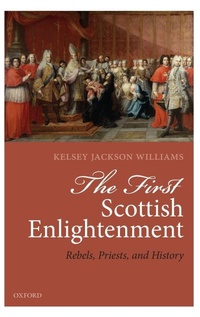
The First Scottish Enlightenment
Rebels, Priests, and History
Published on 5. March 2020
Book
Hardback
368 pages
978-0-19-880969-2 (ISBN)
Description
Traditional accounts of the Scottish Enlightenment present the half-century or so before 1750 as, at best, a not-yet fully realised precursor to the era of Hume and Smith, at worst, a period of superstition and religious bigotry. This is the first book-length study to systematically challenge that notion. Instead, it argues that the era between approximately 1680 and 1745 was a 'First' Scottish Enlightenment, part of the continent-wide phenomenon of early Enlightenment and led by the Jacobites, Episcopalians, and Catholics of north-eastern Scotland. It makes this argument through an intensive study of the dramatic changes in historiographical practice which took place in Scotland during this era, showing how the documentary scholarship of Jean Mabillon and the Maurists was eagerly received and rapidly developed in Scottish historical circles, resulting in the wholesale demolition of the older, Humanist myths of Scottish origins and their replacement with the foundations of our modern understanding of early Scottish history.
This volume accordingly challenges many of the truisms surrounding seventeenth- and eighteenth-century Scottish history, pushing back against notions of pre-Enlightenment Scotland as backward, insular, and intellectually impoverished and mapping a richly polymathic, erudite, and transnational web of scholars, readers, and polemicists. It highlights the enduring cultural links with France and argues for the central importance of Scotland's two principal religious minorities--Episcopalians and Catholics--in the growth of Enlightenment thinking. As such, it makes a major intervention in the intellectual and cultural histories of Scotland, early modern Europe, and the Enlightenment itself.
This volume accordingly challenges many of the truisms surrounding seventeenth- and eighteenth-century Scottish history, pushing back against notions of pre-Enlightenment Scotland as backward, insular, and intellectually impoverished and mapping a richly polymathic, erudite, and transnational web of scholars, readers, and polemicists. It highlights the enduring cultural links with France and argues for the central importance of Scotland's two principal religious minorities--Episcopalians and Catholics--in the growth of Enlightenment thinking. As such, it makes a major intervention in the intellectual and cultural histories of Scotland, early modern Europe, and the Enlightenment itself.
Reviews / Votes
An excellent study, enriched by the often-brilliant use of myriad sources * R.J.W. Mills, The Seventeenth Century * Erudite and attractively written, The First Scottish Enlightenment is a compelling reconstruction of historical culture in the first half of the eighteenth century. Connecting the familiar with the overlooked, alive to cosmopolitan links and local peculiarities, it deserves to be widely read. * Alasdair Raffe, Eighteenth-Century Scotland: The Newsletter of the Eighteenth-Century Scottish Studies Society * The book as a whole brings an important intellectual movement out of the shadows of previous neglect. It also reminds us that the story of English antiquaries (and Antiquaries) was not without parallels in Scotland and on the European continent. * Neil Guthrie, The Antiquaries Journal * Jackson Williams... carefully casts the 'city guard' and 'crowd of citizens' of an older Enlightenment drama in new roles. This new character set inspires comparisons beyond Scotland's north-east and it builds much-needed bridges between British and European political and intellectual histories. * Tom Toelle, British Catholic History * In this remarkable and engaging book, Kelsey Jackson Williams convincingly makes the case for the existence of an early Enlightenment in Scotland, which spanned the 1680s to the 1740s and achieved a dramatic and lasting transformation in the practice and conception of Scottish history. * Felicity Loughlin, Scottish Church History * a text that contributes wonderfully to our understanding of our past as we continue to struggle over how to imagine the future. * Paul Gilfillan, The Innes Review * First Scottish Enlightenment has many virtues...Overall, this a tremendous contribution to the history of Scottish scholarship and Scottish intellectual history generally. * R.J.W. Mills, Queen Mary University of London, The Seventeenth Century * An excellent study, enriched by the often-brilliant use of myriad sources * R.J.W. Mills, The Seventeenth Century * Erudite and attractively written, The First Scottish Enlightenment is a compelling reconstruction of historical culture in the first half of the eighteenth century. Connecting the familiar with the overlooked, alive to cosmopolitan links and local peculiarities, it deserves to be widely read. * Alasdair Raffe, Eighteenth-Century Scotland: The Newsletter of the Eighteenth-Century Scottish Studies Society * The book as a whole brings an important intellectual movement out of the shadows of previous neglect. It also reminds us that the story of English antiquaries (and Antiquaries) was not without parallels in Scotland and on the European continent. * Neil Guthrie, The Antiquaries Journal * Jackson Williams... carefully casts the 'city guard' and 'crowd of citizens' of an older Enlightenment drama in new roles. This new character set inspires comparisons beyond Scotland's north-east and it builds much-needed bridges between British and European political and intellectual histories. * Tom Toelle, British Catholic History * In this remarkable and engaging book, Kelsey Jackson Williams convincingly makes the case for the existence of an early Enlightenment in Scotland, which spanned the 1680s to the 1740s and achieved a dramatic and lasting transformation in the practice and conception of Scottish history. * Felicity Loughlin, Scottish Church History * a text that contributes wonderfully to our understanding of our past as we continue to struggle over how to imagine the future. * Paul Gilfillan, The Innes Review *More details
Language
English
Place of publication
Oxford
United Kingdom
Target group
Professional and scholarly
Illustrations
10 Illustrations
Dimensions
Height: 240 mm
Width: 161 mm
Thickness: 24 mm
Weight
716 gr
ISBN-13
978-0-19-880969-2 (9780198809692)
Copyright in bibliographic data and cover images is held by Nielsen Book Services Limited or by the publishers or by their respective licensors: all rights reserved.
Schweitzer Classification
Other editions
Additional editions
E-Book
02/2020
1st Edition
OUP eBook
€62.99
Available for download
E-Book
02/2020
1st Edition
OUP eBook
€70.99
Available for download
Person
Kelsey Jackson Williams is Lecturer in Early Modern Literature at the University of Stirling and his research focuses on the intellectual, cultural, and material histories of Scotland, England, and continental Northern Europe. He was educated at Balliol College, University of Oxford, and held posts at Jesus College, University of Oxford, and the University of St Andrews before taking up his present lectureship.
Content
Introduction: Scotland and Enlightenment
Enlightenment Origins
Northern World: The Growth of a Regional Culture
The Fall of the Ancient Monarchy: Demolishing Humanist History
Thomas Innes: Rewriting Scotland
Stupendous Fabricks: Archaeology and Material Culture
Enlightenment in the Archive: Reclaiming the Medieval Past
Scotland Illustrated: National and Local Geographies
Pedigrees and Proof: Preserving the Old Nobility
Fighting with Canon: Building a Literary Heritage
Such Honourable and Worthy Persons: The Enlightenment's Readers
Conclusion
Enlightenment Origins
Northern World: The Growth of a Regional Culture
The Fall of the Ancient Monarchy: Demolishing Humanist History
Thomas Innes: Rewriting Scotland
Stupendous Fabricks: Archaeology and Material Culture
Enlightenment in the Archive: Reclaiming the Medieval Past
Scotland Illustrated: National and Local Geographies
Pedigrees and Proof: Preserving the Old Nobility
Fighting with Canon: Building a Literary Heritage
Such Honourable and Worthy Persons: The Enlightenment's Readers
Conclusion