

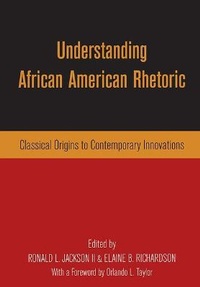
Understanding African American Rhetoric
Classical Origins to Contemporary Innovations
Published on 11. April 2003
Book
Hardback
346 pages
978-0-415-94386-4 (ISBN)
Description
First Published in 2003. Routledge is an imprint of Taylor & Francis, an informa company.
More details
Language
English
Place of publication
London
United Kingdom
Publishing group
Taylor & Francis Ltd
Target group
College/higher education
Dimensions
Height: 254 mm
Width: 178 mm
Weight
930 gr
ISBN-13
978-0-415-94386-4 (9780415943864)
Copyright in bibliographic data and cover images is held by Nielsen Book Services Limited or by the publishers or by their respective licensors: all rights reserved.
Schweitzer Classification
Other editions
Additional editions
Ronald L. Jackson II | Elaine B. Richardson
Understanding African American Rhetoric
Classical Origins to Contemporary Innovations
E-Book
05/2014
1st Edition
Routledge
€67.49
Available for download
Ronald L. Jackson II | Elaine B. Richardson
Understanding African American Rhetoric
Classical Origins to Contemporary Innovations
E-Book
05/2014
1st Edition
Routledge
€67.49
Available for download
Ronald L. Jackson II | Elaine B. Richardson
Understanding African American Rhetoric
Classical Origins to Contemporary Innovations
Book
04/2003
Routledge
€71.70
Shipment within 15-20 days
Persons
Ronald L. Jackson II is Associate Professor of Culture and Communication Theory at Pennsylvania State University. He is the author of The Negotiation of Cultural Identity (1999). Elaine B. Richardson is Assistant Professor of English and by courtesy, Applied Linguistics at Pennsylvania State University. She is the author of African-American Literacies (Routledge, 2002).
Content
Dedication Foreword Introduction Acknowedgements SECTION ONE: Classical Egyptian Origins of African American Rhetoric 1 Nommo, Kawaida and Communicative Practice: Bringing Good Into the World 2. The Spiritual Essence of African American Rhetoric SECTION TWO: Manifestations of African American Rhetoric and Orality 3. African American Orality: Expanding Rhetoric 4. Jesus is a Rock: Spirituals as Lived Experiences 5. The Use of Public Space as Cultural Communicator: How Museums Reconstruct and Reconnect Cultural Memory SECTION THREE: Politics of Defining African American Rhetoric 6. The Word at Work: Ideological and Epistemological Dynamics in Reality Construction 7. The Politics of (In)visibility in African American Rhetorical Scholarship: A (Re) Quest for an African World View 8. Afrocentricity as Metatheory: A dialogic exploration of its principles SECTION FOUR: African American Rhetorical Analyses of Struggle and Resistance 9. Africological Theory and Criticism: Reconceptualizing Communication Constructs 10. Every Man Fights for His Freedom: The Rhetoric of African American Resistance in the Mid-19th Century 11. The Duty of the Civilized is to Civilise the Uncivilised: Tropes of Black Nationalism in the Messages of Five Percent Rappers 12. Death Narratives from the Killing Fields: Narrative Criticism and the Case of Tupac Shakur SECTION FIVE: Trends and Innovations in Analyzing Contemporary African American Rhetoric 13. Lauryn Hill As Lyricist and Womanist 14. The Kink Factor: A Womanist Discourse Analysis of African American Mother/Daughter Perspectives on Negotiating Black Hair/Body Politics 15. An Afrocentric Rhetorical Analysis of Johnnie Cochran's Closing Arguments in the OJ Simpson Trial 16. Afrocentric Rhetoric Transcending Audiences and Contexts: A Case Study of Preacher, Politician Emanuel Cleaver II SECTION SIX: Visions for Research in African American Rhetoric 17. The Future of African American Rhetoric 18. The Discourse of African American Women: A Case for Extended Paradigms About the Contributors