

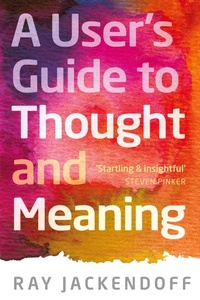
A User's Guide to Thought and Meaning
Published on 2. April 2015
Book
Paperback/Softback
288 pages
978-0-19-873645-5 (ISBN)
Description
A User's Guide to Thought and Meaning presents a profound and arresting integration of the faculties of the mind - of how we think, speak, and see the world.
Ray Jackendoff starts out by looking at languages and what the meanings of words and sentences actually do. He shows that meanings are more adaptive and complicated than they're commonly given credit for, and he is led to some basic questions: How do we perceive and act in the world? How do we talk about it? And how can the collection of neurons in the brain give rise to conscious experience? As it turns out, the organization of language, thought, and perception does not look much like the way we experience things, and only a small part of what the brain does is conscious. Jackendoff concludes that thought and meaning must be almost completely unconscious. What we experience as rational conscious thought - which we prize as setting us apart from the animals - in fact rides on a foundation of unconscious intuition. Rationality amounts to intuition enhanced by language.
Written with an informality that belies both the originality of its insights and the radical nature of its conclusions, A User's Guide to Thought and Meaning is the author's most important book since the groundbreaking Foundations of Language in 2002.
Ray Jackendoff starts out by looking at languages and what the meanings of words and sentences actually do. He shows that meanings are more adaptive and complicated than they're commonly given credit for, and he is led to some basic questions: How do we perceive and act in the world? How do we talk about it? And how can the collection of neurons in the brain give rise to conscious experience? As it turns out, the organization of language, thought, and perception does not look much like the way we experience things, and only a small part of what the brain does is conscious. Jackendoff concludes that thought and meaning must be almost completely unconscious. What we experience as rational conscious thought - which we prize as setting us apart from the animals - in fact rides on a foundation of unconscious intuition. Rationality amounts to intuition enhanced by language.
Written with an informality that belies both the originality of its insights and the radical nature of its conclusions, A User's Guide to Thought and Meaning is the author's most important book since the groundbreaking Foundations of Language in 2002.
Reviews / Votes
Ray Jackendoff is a monumental scholar in linguistics who, more than any scholar alive today, has shown how language can serve as a window into human nature. Combining theoretical depth with a love of revealing detail, Jackendoff illuminates human reason and consciousness in startling and insightful ways. * Steven Pinker * Ray Jackendoff has an uncanny ability to ask interesting and pressing questions. Anyone interested in language and thought should ask such questions. The asking itself is the primary intellectual act - that, and of course the ordering of the asking, which is by no means obvious and constantly problematical, as he well knows and kindly informs the reader. As for providing answers, pivotal questions may have answers, but they are complex and never simple and thus require extremely careful expression. In his effort to treat his readers in a way that is warm and friendly, he sometimes employs phrases ("kind of," "sort of," "well, like," and other things relaxed speakers tend to say) which I do not find essential, but which for others will surely have the effect of making the issues clear and comprehensible. * Peter Bloom, Professor of Humanities, Smith College * Clear and concise. The pace is perfect: very short chapters making for a very enjoyable read ... As an introduction to a cognitivist perspective on linguistic meaning and thought, this is an extremely helpful book in both tone and content. * Tadeusz Zawidzki, Notre Dame Philosophical Reviews *More details
Language
English
Place of publication
Oxford
United Kingdom
Target group
College/higher education
Dimensions
Height: 234 mm
Width: 156 mm
Thickness: 16 mm
Weight
442 gr
ISBN-13
978-0-19-873645-5 (9780198736455)
Copyright in bibliographic data and cover images is held by Nielsen Book Services Limited or by the publishers or by their respective licensors: all rights reserved.
Schweitzer Classification
Other editions
Additional editions
Ray Jackendoff
A User's Guide to Thought and Meaning
Book
02/2012
Oxford University Press
€38.50
Shipment within 15-20 days
Person
Ray Jackendoff is Seth Merrin Professor of Philosophy and Co-Director of the Center for Cognitive Studies at Tufts University. His books include Semantics and Cognition (MIT 1983), Consciousness and the Computational Mind (MIT 1987), The Architecture of the Language Faculty (MIT 1997), Foundations of Language (OUP 2002), Simpler Syntax (with Peter Culicover, OUP 2005), Language, Consciousness, Culture: Essays on Mental Structure (MIT 2007), and Meaning and the Lexicon: The Parallel Architecture, 1975-2010 (OUP, 2010). He is the 2014 recipient of the David E. Rumelhart Prize, the premier award in the field of cognitive science.
Content
PART ONE: LANGUAGE, WORDS, AND MEANING; PART TWO: CONSCIOUSNESS AND PERCEPTION; PART THREE: REFERENCE, TRUTH, AND THOUGHT; PART IV: A LARGER VIEW