

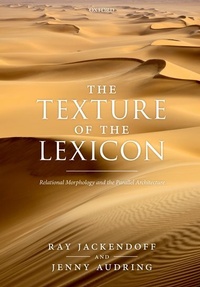
The Texture of the Lexicon
Relational Morphology and the Parallel Architecture
Published on 28. October 2021
Book
Paperback/Softback
384 pages
978-0-19-882791-7 (ISBN)
Description
In this volume, Ray Jackendoff and Jenny Audring embark on a major reconceptualization of linguistic theory as seen through the lens of morphology. Their approach, Relational Morphology, extends the Parallel Architecture developed by Jackendoff in Foundations of Language (2002), Simpler Syntax (2005), and Meaning and the Lexicon (2010). The framework integrates morphology into the overall architecture of language, enabling it to interact insightfully with phonology, syntax, semantics, and above all, the lexicon.
The first part of the book situates morphology in the language faculty, and introduces a novel formalism that unifies the treatment of all morphological patterns, inflectional or derivational, systematic or marginal. Central to the theory is the lexicon, which both incorporates the rules of grammar and explicitly encodes relationships among words and among grammatical patterns. Part II puts the theory to the test, applying it to a wide range of familiar and less familiar morphological phenomena. Part III connects Relational Morphology with issues of language processing and language acquisition, and shows how its formal tools can be extended to a variety of linguistic and nonlinguistic phenomena outside morphology. The value of Relational Morphology thus lies not only in the fact that it can account for a range of morphological phenomena, but also in how it integrates linguistic theory, psycholinguistics, and human cognition.
The first part of the book situates morphology in the language faculty, and introduces a novel formalism that unifies the treatment of all morphological patterns, inflectional or derivational, systematic or marginal. Central to the theory is the lexicon, which both incorporates the rules of grammar and explicitly encodes relationships among words and among grammatical patterns. Part II puts the theory to the test, applying it to a wide range of familiar and less familiar morphological phenomena. Part III connects Relational Morphology with issues of language processing and language acquisition, and shows how its formal tools can be extended to a variety of linguistic and nonlinguistic phenomena outside morphology. The value of Relational Morphology thus lies not only in the fact that it can account for a range of morphological phenomena, but also in how it integrates linguistic theory, psycholinguistics, and human cognition.
Reviews / Votes
The Texture of the Lexicon is a reader-friendly introduction to the framework of Relational Morphology that complements the Parallel Architecture approach. I believe that readers interested in morphology at large will find something interesting in this read. * David M. Karaj, Linguist * Review from previous edition This is the best linguistics book of 2020: A comprehensive view of morphological patterns that does not struggle with, but comfortably explains, the frequently observed continuity between regular grammatical patterns and memorized/idiosyncratic forms. * Martin Haspelmath * Through extending Jackendoff's Parallel Architecture by a sophisticated system of co-indexing, the authors develop a surprising perspective on language as a whole. They overcome the separation of grammar and lexicon, the contrast of regular and idiosyncratic items, of productive and unproductive patterns, of core and periphery. Relational Morphology brings with it a new and exciting picture of language as an integrated mental capacity. * Manfred Bierwisch, Humboldt University of Berlin * Jackendoff and Audring unravel the illusory divide between the lexicon and grammar to weave together, with enduring insights, a vast range of semi-regular and fully engaging phenomena. * Adele Goldberg, Princeton University * Jackendoff and Audring combine the models of Parallel Architecture and Construction Morphology to propose an innovative perspective on the lexicon, morphology, phonology, syntax, semantics, and their interaction, centered around their simple, but far-reaching, Relational Hypothesis: all types of linguistic relatedness can be coded as static relational schemas over fully listed items, but a subset of those schemas also serve as productive, generative devices. The authors' wide-ranging exploration lays down the gauntlet for competing models. * Andrew Spencer, University of Essex * This is a lovely book that elaborates the elegant and simple functional linguistic perspective of Jackendoff's (2002) "Parallel Architecture" research program into a detailed attempt to explain what lexical items are. The answer that Jackendoff and Audring arrive at is surprising: there is no principled distinction between grammar and lexicon, contrary to what has standardly been assumed. There is a wealth of fascinating predictions to test here. * Ted Gibson, Massachusetts Institute of Technology *More details
Language
English
Place of publication
Oxford
United Kingdom
Target group
College/higher education
Dimensions
Height: 247 mm
Width: 173 mm
Thickness: 18 mm
Weight
580 gr
ISBN-13
978-0-19-882791-7 (9780198827917)
Copyright in bibliographic data and cover images is held by Nielsen Book Services Limited or by the publishers or by their respective licensors: all rights reserved.
Schweitzer Classification
Other editions
Additional editions
Ray Jackendoff | Jenny Audring
The Texture of the Lexicon
Relational Morphology and the Parallel Architecture
Book
12/2019
Oxford University Press
€98.90
Shipment within 15-20 days
Persons
Ray Jackendoff is Seth Merrin Professor Emeritus and former co-director of the Center for Cognitive Studies at Tufts University; he is currently a Research Affiliate in Brain and Cognitive Sciences at MIT. He has written widely on syntax, semantics, the architecture of grammar, the evolution of language, music cognition, and consciousness. He was the recipient of the 2003 Jean Nicod Prize and the 2014 David Rumelhart Prize, and has served as President of both the Linguistic Society of America and the Society for Philosophy and Psychology. He is the author of the OUP volumes Foundations of Language: Brain, Meaning, Grammar, Evolution (2002), Simpler Syntax (with Peter Culicover, 2005), Meaning and the Lexicon: The Parallel Architecture 1975-2010 (2010), and A User's Guide to Thought and Meaning (2012).
Jenny Audring is Assistant Professor of Linguistics at Leiden University. She specializes in morphology and has written extensively on grammatical gender. Her research interests range from linguistic complexity and Canonical Typology to Construction Morphology and morphological theory. She is the co-editor, with Francesca Masini, of The Oxford Handbook of Morphological Theory (OUP, 2018) and, with Sebastian Fedden and Greville G. Corbett, of Non-Canonical Gender Systems (OUP, 2018).
Jenny Audring is Assistant Professor of Linguistics at Leiden University. She specializes in morphology and has written extensively on grammatical gender. Her research interests range from linguistic complexity and Canonical Typology to Construction Morphology and morphological theory. She is the co-editor, with Francesca Masini, of The Oxford Handbook of Morphological Theory (OUP, 2018) and, with Sebastian Fedden and Greville G. Corbett, of Non-Canonical Gender Systems (OUP, 2018).
Content
Part I: The Theory 1: Situating morphology 2: The functions of schemas 3: Motivation in the lexicon Part II: Using and refining the tools 4: Formalizing morphological phenomena 5: Formalizing inflection 6: Morphologically conditioned phonological alternations Part III: Beyond morphological theory 7: Language processing and language acquisition through the lens of Relational Morphology 8: Applying the tools to other domains 9: Coda: What have we done? References Index of words and schemas Index of authors and subjects