

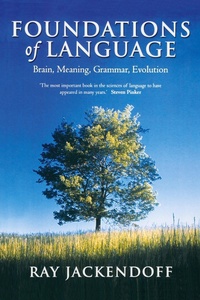
Foundations of Language
Brain, Meaning, Grammar, Evolution
Published on 4. September 2003
Book
Paperback/Softback
504 pages
978-0-19-926437-7 (ISBN)
Description
How does human language work? How do we put ideas into words that others can understand? Can linguistics shed light on the way the brain operates?
Foundations of Language puts linguistics back at the centre of the search to understand human consciousness. Ray Jackendoff begins by surveying the developments in linguistics over the years since Noam Chomsky's Aspects of the Theory of Syntax. He goes on to propose a radical re-conception of how the brain processes language. This opens up vivid new perspectives on every major aspect of language and communication, including grammar, vocabulary, learning, the origins of human language, and how language relates to the real world. Foundations of Language makes important connections with other disciplines which have been isolated from linguistics for many years. It sets a new agenda for close cooperation between the study of language, mind, the brain, behaviour, and evolution.
Foundations of Language puts linguistics back at the centre of the search to understand human consciousness. Ray Jackendoff begins by surveying the developments in linguistics over the years since Noam Chomsky's Aspects of the Theory of Syntax. He goes on to propose a radical re-conception of how the brain processes language. This opens up vivid new perspectives on every major aspect of language and communication, including grammar, vocabulary, learning, the origins of human language, and how language relates to the real world. Foundations of Language makes important connections with other disciplines which have been isolated from linguistics for many years. It sets a new agenda for close cooperation between the study of language, mind, the brain, behaviour, and evolution.
Reviews / Votes
The book is ... a fascinating introduction to the world of linguistics. ... I found the book extremely interesting, captivating and important. If you are not sure about certain basic facts in the research of natural language, read this book. It will provide you with quite an objective view of the development of the research of language on all aspects. * Linguist List * A masterpiece * Nature * I believe this book has the potential to reorient linguistics more decisively than any book since Syntactic Structures shook the discipline almost half a century ago. * Robbins Burling, Language in Society * An excellent overview of the complexities of language * New Scientist *More details
Language
English
Place of publication
Oxford
United Kingdom
Target group
Professional and scholarly
All linguists (particularly psycholinguists, neurolinguists, and computational linguists), neuroscientists, cognitive psychologists, evolutionary psychologists, philosophers of language, philosophers of mind, and all those interested in the role of language in human development, cognition, and communication.
Illustrations
numerous figures
Dimensions
Height: 234 mm
Width: 156 mm
Thickness: 27 mm
Weight
749 gr
ISBN-13
978-0-19-926437-7 (9780199264377)
Copyright in bibliographic data and cover images is held by Nielsen Book Services Limited or by the publishers or by their respective licensors: all rights reserved.
Schweitzer Classification
Other editions
Additional editions
Book
01/2002
Oxford University Press
€204.27
Shipment within 15-20 days
E-Book
01/2002
1st Edition
Oxford University Press
€259.50
Available for download
Person
Ray Jackendoff is the author of Semantics and Cognition, Consciousness and the Computational Mind, The Architecture of the Language Faculty, and (with Fred Lerdahl) A Generative Theory of Tonal Music. He has been Professor of Linguistics at Brandeis University since 1971. He is a Fellow of the American Academy of Arts and Sciences and a past president of the Society for Philosophy and Psychology.
Content
PART I: PSYCHOLOGICAL AND BIOLOGICAL FOUNDATIONS ; 1. The Complexity of Linguistic Structure ; 2. Language as a Mental Phenomenon ; 3. Combinatoriality ; 4. Universal Grammar ; PART II: ARCHITECTURAL FOUNDATIONS ; 5. The Parallel Architecture ; 6. Lexical Storage Versus Online Construction ; 7. Implications for Processing ; 8. An Evolutionary Perspective on the Architecture ; PART III: SEMANTIC AND CONCEPTUAL FOUNDATIONS ; 9. Semantics as a Mentalistic Enterprise ; 10. Reference and Truth ; 11. Lexical Semantics ; 12. Phrasal Semantics ; 13. Concluding Remarks