

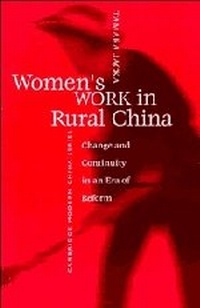
Women's Work in Rural China
Change and Continuity in an Era of Reform
Published on 13. February 1997
Book
Hardback
272 pages
978-0-521-56225-6 (ISBN)
Description
Since 1978, reform policies introduced in rural China have had a profound impact on women's work and gender divisions of labour. This book provides detailed information on shifts in women's work patterns. It explains how and why these shifts have come about, and how they relate to women's position in society. While other aspects of reform in rural China have been analysed extensively, this is one of very few, and to date the most comprehensive studies of the effects of reform on rural women.
Reviews / Votes
'Women's Work in Rural China is an accessible and informative book ... [which] provides a thorough and readable text for students and the general public interested in understanding the changing status of women in China's rural economy. Furthermore, it makes a valuable contribution to the broader literature on economic and social change in rural China ... and is thus an important addition to bookshelves on this subject.' Asian AffairsMore details
Series
Language
English
Place of publication
Cambridge
United Kingdom
Target group
Professional and scholarly
Illustrations
14 Tables, unspecified
Dimensions
Height: 228 mm
Width: 152 mm
Thickness: 24 mm
Weight
640 gr
ISBN-13
978-0-521-56225-6 (9780521562256)
Copyright in bibliographic data and cover images is held by Nielsen Book Services Limited or by the publishers or by their respective licensors: all rights reserved.
Schweitzer Classification
Other editions
New editions
Book
02/1997
Cambridge University Press
€45.30
Shipment within 15-20 days
Additional editions
Book
02/1997
Cambridge University Press
€45.30
Shipment within 15-20 days
Person
Content
Introduction; 1. Theoretical concerns; 2. Historical background; 3. Post-Mao reforms; 4. The family; 5. Education and politics; 6. Domestic work; 7. Agriculture; 8. Entrpreneurs on the farm; 9. Industry; 10. Conclusion; Appendix 1: Summary of information on sample families; Appendix 2: Employment in sample township enterprises.