

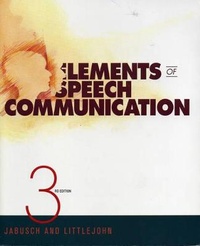
Elements of Speech Communication
3rd Edition
Published on 1. March 1996
Book
Paperback/Softback
372 pages
978-0-939693-37-5 (ISBN)
Description
Since its inception, The Elements of Speech Communication has been predicated on several beliefs about teaching and learning in communication. Good communication pedagogy combines insights gained from scholarship of all types as well as personal experience. Communication competence cannot be achieved by precept, it is a combination of understanding, sensitivity, skills, and ethical responsibility, and it is developed by a combination of theory, practice, and analysis. People understand and practice communication in many ways, and since the first edition of the book, the field of communication has expanded immensely its offering of useful concepts and ideas. This new edition has been affected by the growing literature in the field and by authors' expanding awareness of possibilities. Many of features that have always given The Elements of Speech Communication its character have been retained, so that the 'feel' of the book is about the same. Every chapter begins with a story or provocative allusion. Relevant photographs add interest and give pause for thought. And, of course, the image shifts, which have been unique to this book from its inception, still challenge students to look at the subject in new ways. To make the text easier the authors have added a complete glossary. A Collegiate Press book
More details
Edition
Third Edition
Language
English
Place of publication
Lanham
United States
Dimensions
Height: 236 mm
Width: 190 mm
Thickness: 14 mm
Weight
667 gr
ISBN-13
978-0-939693-37-5 (9780939693375)
Copyright in bibliographic data and cover images is held by Nielsen Book Services Limited or by the publishers or by their respective licensors: all rights reserved.
Schweitzer Classification
Persons
David M. Jabusch is professor emeritus of communication at The University of Utah. Stephen W. Littlejohn is a communication consultant, mediator, facilitator, and trainer. He is a partner in Domenici Littlejohn, Inc. and an associate for the Public Dialogue Consortium. Dr. Littlejohn is the author of Engaging Communication in Conflict: Systemic Practice, Moral Conflict: When Social Worlds Collide and has written numerous other books and articles on communication and conflict. He was a professor of communication at Humboldt State University in California for 26 years and is currently adjunct professor of Communication and Journalism at the University of New Mexico.
Content
Part 1 Preface Part 2 PART I: CONCEPTS AND PRINCIPLES Part 3 Chapter 1: Communication and Society Chapter 4 Communication Competence Chapter 5 Tools for Improving Communication Chapter 6 Three Basic Perspectives on Communication Chapter 7 A Fourth Approach: The Transactional Perspective Chapter 8 Summary Part 9 Chapter 2: Basic Elements: Language and Nonverbal Communication Chapter 10 The Coding Process Chapter 11 Verbal Coding: Language Chapter 12 Nonverbal Coding Chapter 13 Problems of Coding Chapter 14 Summary Part 15 Chapter 3: Basic Elements: Meaning and Thinking Chapter 16 The Nature of Meaning Chapter 17 The Nature of Thinking Chapter 18 Communication Problems: Meaning and Thinking Chapter 19 Summary Part 20 Chapter 4: Basic Elements: Information and Persuasion Chapter 21 The Uses and Processing of Information Chapter 22 Persuasion as Change Chapter 23 Problems of Information and Persuasion Chapter 24 Summary Part 25 PART II: COMMUNICATION SETTINGS Part 26 Chapter 5: Understanding and Improving Interpersonal Communication Chapter 27 Rules and Relationships: A Transactional Perspective Chapter 28 Interpersonal Conflict Chapter 29 Communicating with Family and Friends Chapter 30 Summary Part 31 Chapter 6: Understanding and Improving Professional Communication Chapter 32 Entering a Career Chapter 33 Interviewing Chapter 34 Supportiveness and Assertiveness Chapter 35 Summary Part 36 Chapter 7: Understanding and Improving Group Communication Chapter 37 Understanding Group Communication Chapter 38 Communicating Effectively in Groups Chapter 39 Assuming Leadership Functions Chapter 40 Summary Part 41 Chapter 8: Public Communication: Analysis Chapter 42 Perspectives and Concepts of Public Communication Chapter 43 Analyzing the Rhetorical Situation Chapter 44 Bridging Communicative Gaps Chapter 45 Summary Part 46 Chapter 9: Public Communication: Synthesis Chapter 47 Developing the Central Idea Chapter 48 Organization Chapter 49 Delivery Chapter 50 Summary Part 51 Chapter 10: Mass Communication: Reception and Analysis Chapter 52 Basic Issues and Concepts in Mass Communication Chapter 53 Improving Media Receivership Chapter 54 Summary Part 55 Notes Part 56 Glossary Part 57 Index