

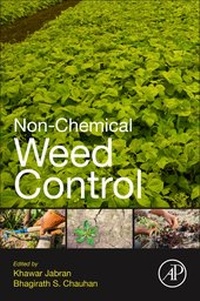
Non-Chemical Weed Control
Published on 4. January 2018
Book
Paperback/Softback
172 pages
978-0-12-809881-3 (ISBN)
Description
Non-Chemical Weed Control is the first book to present an overview of plant crop protection against non-food plants using non-chemical means. Plants growing wild-particularly unwanted plants found in cultivated ground to the exclusion of the desired crop-have been treated with herbicides and chemical treatments in the past. As concern over environmental, food and consumer safety increases, research has turned to alternatives, including the use of cover crops, thermal treatments and biotechnology to reduce and eliminate unwanted plants. This book provides insight into existing and emerging alternative crop protection methods and includes lessons learned from past methodologies.
As crop production resources decline while consumer concerns over safety increase, the effective control of weeds is imperative to insure the maximum possible levels of soil, sunlight and nutrients reach the crop plants.
As crop production resources decline while consumer concerns over safety increase, the effective control of weeds is imperative to insure the maximum possible levels of soil, sunlight and nutrients reach the crop plants.
More details
Language
English
Place of publication
San Diego
United States
Publishing group
Elsevier Science Publishing Co Inc
Target group
Professional and scholarly
Dimensions
Height: 235 mm
Width: 191 mm
Weight
390 gr
ISBN-13
978-0-12-809881-3 (9780128098813)
Copyright in bibliographic data and cover images is held by Nielsen Book Services Limited or by the publishers or by their respective licensors: all rights reserved.
Schweitzer Classification
Other editions
Additional editions
Khawar Jabran | Bhagirath Chauhan
Non-Chemical Weed Control
E-Book
01/2018
Academic Press
€45.95
Available for download
Persons
Dr. Khawar Jabran is actively involved in research, teaching and scientific write-up in the discipline of agriculture. His research work is focused on increasing crop yields through improved crop management practices, and management of abiotic and biotic stresses. Recently he is based in a potato growing region, hence, potato is a major focus of his research work. He has more than 150 publications that include research and review articles in peer reviewed journals, edited books, edited conference proceedings, edited special issues in the international scientific journal, papers in the conference proceeding, book chapters in the edited books and popular articles related to agriculture. His editorial roles include Associate Editor in Crop Protection, and Consulting Editor in Sugar Tech. Dr. Chauhan holds Doctor of Philosophy, Weed Science, Master of Science, Agronomy
CCS Haryana Agricultural University and Bachelor of Science (Hons) Agriculture. His research focuses on Weed ecology and seed germination biology, Herbicide use and resistance management, Tillage systems and crop establishment methods, Improving weed competitive ability of crops by optimizing the use of competitive cultivars, seeding rate, and row spacing, Integrated weed management strategies for different cropping systems.
CCS Haryana Agricultural University and Bachelor of Science (Hons) Agriculture. His research focuses on Weed ecology and seed germination biology, Herbicide use and resistance management, Tillage systems and crop establishment methods, Improving weed competitive ability of crops by optimizing the use of competitive cultivars, seeding rate, and row spacing, Integrated weed management strategies for different cropping systems.
Content
1. Introduction
2. Thermal Weed Control
3. The Use of Physics in Weed Control
4. Weed Control Using Ground Cover Systems
5. Weed Control through Crop Plant Manipulations
6. Weed Control through Agronomic Managements
7. Use of Biotechnology for Weed Control
8. Conventional Mechanical Weed Control
2. Thermal Weed Control
3. The Use of Physics in Weed Control
4. Weed Control Using Ground Cover Systems
5. Weed Control through Crop Plant Manipulations
6. Weed Control through Agronomic Managements
7. Use of Biotechnology for Weed Control
8. Conventional Mechanical Weed Control