

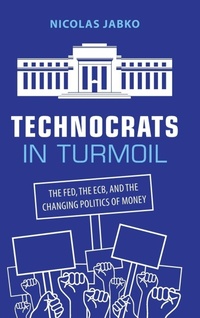
Technocrats in Turmoil
The Fed, the ECB, and the Changing Politics of Money
Will be published approx. on 28. February 2026
Book
Hardback
254 pages
978-1-009-72744-0 (ISBN)
Description
As the economy became more financialized, the politics of money considerably changed after the late 1970s. American and European central bankers first allied with conservative forces to fight inflation in the 1980s; then, that alliance unravelled after the 2008 financial crisis. Many observers gloss over this change because they see central bankers either as stewards of financialization, or as economists dedicated to economic stability. Nicolas Jabko shows how changing alliances between central bankers, economists, and politicians led to momentous shifts in monetary regimes. He argues that central bankers are technocrats who navigate and powerfully shape three overlapping arenas - their own internal monetary policy committees; the economics profession; and the broader public arena. Steeped in a machine-assisted analysis of central bank archives, Technocrats in Turmoil thus reveals the key role that the Fed and the ECB played in the waxing and waning of technocratic neoliberalism.
More details
Language
English
Place of publication
Cambridge
United Kingdom
Illustrations
Worked examples or Exercises
Dimensions
Height: 235 mm
Width: 157 mm
Thickness: 20 mm
Weight
568 gr
ISBN-13
978-1-009-72744-0 (9781009727440)
Copyright in bibliographic data and cover images is held by Nielsen Book Services Limited or by the publishers or by their respective licensors: all rights reserved.
Schweitzer Classification
Other editions
Additional editions
Book
approx. 02/2026
Cambridge University Press
€35.60
Not yet published
Person
Nicolas Jabko is a professor of political science at Johns Hopkins University. A transatlantic scholar at heart, he has spent most of his life and career between the United States and Europe.
Content
1. Fallen conservative heroes; 2. Political economy v. economics; 3. Economists with power; 4. The waxing of technocratic neoliberalism in the United States; 5. The waxing of technocratic neoliberalism in the European Union; 6. The waning of technocratic neoliberalism in the United States; 7. The waning of technocratic neoliberalism in the European Union; 8. Beyond neoliberalism?; 9. Technocrats, neoliberalism, Keynesianism, and democracy.