

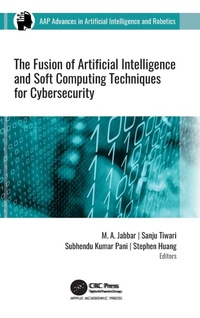
The Fusion of Artificial Intelligence and Soft Computing Techniques for Cybersecurity
1st Edition
Published on 28. June 2024
Book
Hardback
274 pages
978-1-77491-480-9 (ISBN)
Description
With the ever-increasing threat of cyber-attacks, especially as the COVID-19 pandemic helped to ramp up the use of digital communications technology, there is a continued need to find new ways to maintain and improve cybersecurity. This new volume investigates the advances in artificial intelligence and soft computing techniques in cybersecurity. It specifically looks at cybersecurity during the COVID-19 pandemic, the use of cybersecurity for cloud intelligent systems, applications of cybersecurity techniques for web applications, and cybersecurity for cyber-physical systems. A diverse array of technologies and techniques are explored for cybersecurity applications, such as the Internet of Things, edge computing, cloud computing, artificial intelligence, soft computing, machine learning, cross-site scripting in web-based services, neural gas (GNG) clustering technique, and more.
More details
Series
Language
English
Place of publication
Oakville
Canada
Target group
College/higher education
Academic and Postgraduate
Illustrations
67 s/w Abbildungen, 20 s/w Tabellen
20 Tables, black and white; 67 Illustrations, black and white
Dimensions
Height: 235 mm
Width: 157 mm
Thickness: 20 mm
Weight
580 gr
ISBN-13
978-1-77491-480-9 (9781774914809)
Copyright in bibliographic data and cover images is held by Nielsen Book Services Limited or by the publishers or by their respective licensors: all rights reserved.
Schweitzer Classification
Other editions
Additional editions
M. A. Jabbar | Sanju Tiwari | Subhendu Kumar Pani
The Fusion of Artificial Intelligence and Soft Computing Techniques for Cybersecurity
E-Book
06/2024
1st Edition
Apple Academic Press Inc.
€173.99
Available for download
M. A. Jabbar | Sanju Tiwari | Subhendu Kumar Pani
The Fusion of Artificial Intelligence and Soft Computing Techniques for Cybersecurity
E-Book
06/2024
1st Edition
Apple Academic Press Inc.
€173.99
Available for download
Persons
M. A. Jabbar, PhD, is a Professor and Head of the Department of Computer and Science Engineering (AI & ML), Vardhaman College of Engineering India. He has been teaching for more than 20 years. He has published over 60 papers in journals and conferences and served as a technical committee member for over 70 international conferences. He has co-edited several books and has also been editor for several conferences and has been involved as an organizing chair, program committee chair, publication chair, and reviewer.
Sanju Tiwari, PhD, is a Senior Researcher at the Universidad Autonoma de Tamaulipas, Mexico. She has worked as a postdoctoral researcher in the Ontology Engineering Group at the Universidad Polytecnica De Madrid, Spain, and as a research associate for a sponsored research project funded by the Defence Research and Development Organisation, India, where she developed and evaluated a decision support system for Indian defence.
Subhendu Kumar Pani, PhD, is Professor in the Department of Computer Science and Engineering and Research Coordinator, Krupajal Engineering College, India. He was formerly Professor in the Department of Computer Science and Engineering and Research Coordinator at Orissa Engineering College, India. He has more than 100 international publications, five authored books, two edited books, and ten book chapters to his credit. His professional activities include roles such as associate editor, editorial board member, and/or reviewer for various international journals. He is associated with a number of conferences and societies.
Stephen Huang, PhD, is Professor of Computer Science at the University of Houston, Texas, USA, where he also serves as the Director of Research at the Center for Information Security Research and Education. He has published many journals and conference papers and has supervised and graduated many MSc and PhD students. Dr. Huang served in several administrative positions at UH, including Director of Graduate Studies, Associate Chairman, and Department Chairman. He was a National Research Council-NASA Senior Research Associate at the NASA Goddard Space Flight Center, Greenbelt, Maryland, during 1989-90.
Sanju Tiwari, PhD, is a Senior Researcher at the Universidad Autonoma de Tamaulipas, Mexico. She has worked as a postdoctoral researcher in the Ontology Engineering Group at the Universidad Polytecnica De Madrid, Spain, and as a research associate for a sponsored research project funded by the Defence Research and Development Organisation, India, where she developed and evaluated a decision support system for Indian defence.
Subhendu Kumar Pani, PhD, is Professor in the Department of Computer Science and Engineering and Research Coordinator, Krupajal Engineering College, India. He was formerly Professor in the Department of Computer Science and Engineering and Research Coordinator at Orissa Engineering College, India. He has more than 100 international publications, five authored books, two edited books, and ten book chapters to his credit. His professional activities include roles such as associate editor, editorial board member, and/or reviewer for various international journals. He is associated with a number of conferences and societies.
Stephen Huang, PhD, is Professor of Computer Science at the University of Houston, Texas, USA, where he also serves as the Director of Research at the Center for Information Security Research and Education. He has published many journals and conference papers and has supervised and graduated many MSc and PhD students. Dr. Huang served in several administrative positions at UH, including Director of Graduate Studies, Associate Chairman, and Department Chairman. He was a National Research Council-NASA Senior Research Associate at the NASA Goddard Space Flight Center, Greenbelt, Maryland, during 1989-90.
Content
PART I: CYBERSECURITY DURING COVID-19 PANDEMIC 1. An Insight into Cybersecurity During the COVID-19 Pandemic 2. Cyberattack Surges in the COVID-19 Scenario: Reasons and Consequences 3. IoT in Security: Impact and Challenges During a Pandemic 4. Mobile App Development Privacy and Security Checklist During COVID-19 PART II: CYBERSECURITY FOR CLOUD INTELLIGENT SYSTEMS 5. Cloud and Edge Computing Security Using Artificial Intelligence and Soft Computing Techniques 6. Security in IoT Using Artificial Intelligence 7. Cybersecurity for Intelligent Systems PART III: APPLICATIONS OF CYBERSECURITY TECHNIQUES FOR WEB APPLICATIONS 8. Analysis of Advanced Manual Detection and Robust Prevention of Cross-Site Scripting in Web-Based Services 9. Soft Computing Techniques for Cyber-Physical Systems 10. Cyber Security Using Machine Learning Approaches: A Systematic Review PART IV: CYBERSECURITY FOR CYBER-PHYSICAL SYSTEMS 11. Efficient Vehicle-Tracking System in Dense Traffic to Enhance Security 12. Optimized Analysis of Network Forensic Attacks Using Enhanced Growing Neural Gas (GNG) Clustering Technique 13. Security in IoT: Systematic Review