

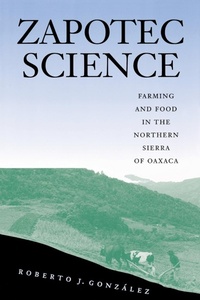
Zapotec Science
Farming and Food in the Northern Sierra of Oaxaca
Published on 1. August 2001
Book
Paperback/Softback
342 pages
978-0-292-72832-5 (ISBN)
Description
2003 - Julian Steward Award - Anthropology & Environment Section, American Anthropological Association
2002 - A CHOICE Outstanding Academic Book
How Zapotec agricultural and dietary theories and practices constitute a valid local science.
Zapotec farmers in the northern sierra of Oaxaca, Mexico, are highly successful in providing their families with abundant, nutritious food in an ecologically sustainable fashion, although the premises that guide their agricultural practices would be considered erroneous by the standards of most agronomists and botanists in the United States and Europe. In this book, Roberto GonzAlez convincingly argues that in fact Zapotec agricultural and dietary theories and practices constitute a valid local science, which has had a reciprocally beneficial relationship with European and United States farming and food systems since the sixteenth century.
GonzAlez bases his analysis upon direct participant observation in the farms and fields of a Zapotec village. By using the ethnographic fieldwork approach, he is able to describe and analyze the rich meanings that campesino families attach to their crops, lands, and animals. GonzAlez also reviews the history of maize, sugarcane, and coffee cultivation in the Zapotec region to show how campesino farmers have intelligently and scientifically adapted their farming practices to local conditions over the course of centuries. By setting his ethnographic study of the Talea de Castro community within a historical world systems perspective, he also skillfully weighs the local impact of national and global currents ranging from Spanish colonialism to the 1910 Mexican Revolution to NAFTA. At the same time, he shows how, at the turn of the twenty-first century, the sustainable practices of "traditional" subsistence agriculture are beginning to replace the failed, unsustainable techniques of modern industrial farming in some parts of the United States and Europe.
2002 - A CHOICE Outstanding Academic Book
How Zapotec agricultural and dietary theories and practices constitute a valid local science.
Zapotec farmers in the northern sierra of Oaxaca, Mexico, are highly successful in providing their families with abundant, nutritious food in an ecologically sustainable fashion, although the premises that guide their agricultural practices would be considered erroneous by the standards of most agronomists and botanists in the United States and Europe. In this book, Roberto GonzAlez convincingly argues that in fact Zapotec agricultural and dietary theories and practices constitute a valid local science, which has had a reciprocally beneficial relationship with European and United States farming and food systems since the sixteenth century.
GonzAlez bases his analysis upon direct participant observation in the farms and fields of a Zapotec village. By using the ethnographic fieldwork approach, he is able to describe and analyze the rich meanings that campesino families attach to their crops, lands, and animals. GonzAlez also reviews the history of maize, sugarcane, and coffee cultivation in the Zapotec region to show how campesino farmers have intelligently and scientifically adapted their farming practices to local conditions over the course of centuries. By setting his ethnographic study of the Talea de Castro community within a historical world systems perspective, he also skillfully weighs the local impact of national and global currents ranging from Spanish colonialism to the 1910 Mexican Revolution to NAFTA. At the same time, he shows how, at the turn of the twenty-first century, the sustainable practices of "traditional" subsistence agriculture are beginning to replace the failed, unsustainable techniques of modern industrial farming in some parts of the United States and Europe.
Reviews / Votes
"cite>Zapotec Science is a major triumph of ethnographic insights in the understanding of farming practices." Sustainable Communities ReviewMore details
Language
English
Place of publication
Austin, TX
United States
Target group
Professional and scholarly
Product notice
Paperback (trade)
Dimensions
Height: 229 mm
Width: 152 mm
Thickness: 20 mm
Weight
559 gr
ISBN-13
978-0-292-72832-5 (9780292728325)
Copyright in bibliographic data and cover images is held by Nielsen Book Services Limited or by the publishers or by their respective licensors: all rights reserved.
Schweitzer Classification
Person
Roberto J. GonzAlez is a professor of anthropology at San JosE State University.
Content
Acknowledgments
1. The Conceptual Bases of Zapotec Farming and Foodways
2. Locating Talea: Geography, History, and Cultural Contexts
3. The Craft of the Campesino: Measures, Implements, and Artifacts
4. "Maize Has a Soul": RincOn Zapotec Notions of Living Matter
5. From Milpa to Tortilla: Growing, Eating, and Exchanging Maize
6. Sweetness and Reciprocity: Sugarcane Work
7. The Invention of "Traditional" Agriculture: The History and Meanings of Coffee
8. Agriculture Unbound: Cultivating the Ground between Science Traditions
Appendix A. Pronunciation of RincOn Zapotec Terms
Appendix B. Talean Food Plants
Appendix C. Talean Livestock and Game Animals
Appendix D. Selected Average Crop Yields
Appendix E. Recipes
Notes
References
Index
1. The Conceptual Bases of Zapotec Farming and Foodways
2. Locating Talea: Geography, History, and Cultural Contexts
3. The Craft of the Campesino: Measures, Implements, and Artifacts
4. "Maize Has a Soul": RincOn Zapotec Notions of Living Matter
5. From Milpa to Tortilla: Growing, Eating, and Exchanging Maize
6. Sweetness and Reciprocity: Sugarcane Work
7. The Invention of "Traditional" Agriculture: The History and Meanings of Coffee
8. Agriculture Unbound: Cultivating the Ground between Science Traditions
Appendix A. Pronunciation of RincOn Zapotec Terms
Appendix B. Talean Food Plants
Appendix C. Talean Livestock and Game Animals
Appendix D. Selected Average Crop Yields
Appendix E. Recipes
Notes
References
Index