

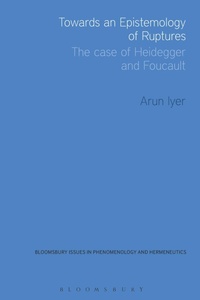
Towards an Epistemology of Ruptures
The Case of Heidegger and Foucault
Published on 30. July 2015
Book
Paperback/Softback
232 pages
978-1-4742-4200-4 (ISBN)
Description
By systematically uncovering and comprehensively examining the epistemological implications of Heidegger's history of being and Foucault's archaeology of discursive formations, Towards an Epistemology of Ruptures shows how Heidegger and Foucault significantly expand the notions of knowledge and thought. This is done by tracing their path-breaking responses to the question: What is the object of thought? The book shows how for both thinkers thought is not just the act by which the object is represented in an idea, and knowledge not just a state of the mind of the individual subject corresponding to the object. Each thinker, in his own way, argues that thought is a productive event in which the subject and the object gain their respective identity and knowledge is the opening up of a space in which the subject and object can encounter each other and in which true and false statements about an object become possible. They thereby lay the ground for a new conceptual framework for rethinking the very relationship between knowledge and its object.
Reviews / Votes
I praise Iyer first and foremost for his clarity of style, which does not come at the expense of intellectual interest or depth. In this book Iyer moves effortlessly between Kant, Heidegger, Husserl, and Foucault in a way that is elucidating and purposeful. -- Stephen Mendelsohn, Boston College, USA * Research in Phenomenology * Epistemology as traditionally conceived seeks to determine the nature of knowledge and justification. Its point of departure is Plato's critique of the relativism of Protagoras, who according to Plato erred by accepting Heraclitus' construal of being as becoming. Truth, knowledge, and justification must be grounded in timeless entities of some sort. Arun Iyer shows how Heidegger and Foucault reverse this Platonic argument. For them, truth, knowledge, and justification are irreducibly historical. Iyer's elaboration of their views is subtle, original, and thought-provoking. * Andrew Cutrofello, Professor of Philosophy, Loyola University Chicago, USA *More details
Language
English
Place of publication
London
United Kingdom
Publishing group
Bloomsbury Publishing PLC
Target group
College/higher education
Dimensions
Height: 234 mm
Width: 156 mm
Thickness: 13 mm
Weight
360 gr
ISBN-13
978-1-4742-4200-4 (9781474242004)
Copyright in bibliographic data and cover images is held by Nielsen Book Services Limited or by the publishers or by their respective licensors: all rights reserved.
Schweitzer Classification
Other editions
Additional editions
E-Book
01/2014
1st Edition
Bloomsbury Academic USA
€42.99
Available for download
Person
Content
Acknowledgements
Abbreviations of Frequently Cited Texts
Introduction
1. Heidegger's Reformulation of the Essence of Thought (I): From the Transcendental Power of the Imagination to the Ontological Power of Thought
2. Heidegger's Reformulation of the Essence of Thought (II): On the Relationship between Thought and Being
3. Heidegger's Reformulation of the Essence of Knowledge: From Husserl's Transcendental Idealism to Heidegger's Historical Ontology
4. Foucault's Reformulation of the Essence of Thought in The Order of Things
5. Foucault's Reformulation of the Essence of Knowledge: From Husserlian Phenomenology to Foucauldian Archaeology
Conclusion
Bibliography
Index
Abbreviations of Frequently Cited Texts
Introduction
1. Heidegger's Reformulation of the Essence of Thought (I): From the Transcendental Power of the Imagination to the Ontological Power of Thought
2. Heidegger's Reformulation of the Essence of Thought (II): On the Relationship between Thought and Being
3. Heidegger's Reformulation of the Essence of Knowledge: From Husserl's Transcendental Idealism to Heidegger's Historical Ontology
4. Foucault's Reformulation of the Essence of Thought in The Order of Things
5. Foucault's Reformulation of the Essence of Knowledge: From Husserlian Phenomenology to Foucauldian Archaeology
Conclusion
Bibliography
Index