

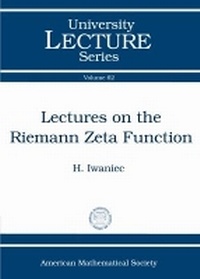
Lectures on the Riemann Zeta Function
Will be published approx. on 30. November 2014
Book
Paperback/Softback
119 pages
978-1-4704-1851-9 (ISBN)
Description
The Riemann zeta function was introduced by L. Euler (1737) in connection with questions about the distribution of prime numbers. Later, B. Riemann (1859) derived deeper results about the prime numbers by considering the zeta function in the complex variable. The famous Riemann Hypothesis, asserting that all of the non-trivial zeros of zeta are on a critical line in the complex plane, is one of the most important unsolved problems in modern mathematics.
The present book consists of two parts. The first part covers classical material about the zeros of the Riemann zeta function with applications to the distribution of prime numbers, including those made by Riemann himself, F. Carlson, and Hardy-Littlewood. The second part gives a complete presentation of Levinson's method for zeros on the critical line, which allows one to prove, in particular, that more than one-third of non-trivial zeros of zeta are on the critical line. This approach and some results concerning integrals of Dirichlet polynomials are new. There are also technical lemmas which can be useful in a broader context.
The present book consists of two parts. The first part covers classical material about the zeros of the Riemann zeta function with applications to the distribution of prime numbers, including those made by Riemann himself, F. Carlson, and Hardy-Littlewood. The second part gives a complete presentation of Levinson's method for zeros on the critical line, which allows one to prove, in particular, that more than one-third of non-trivial zeros of zeta are on the critical line. This approach and some results concerning integrals of Dirichlet polynomials are new. There are also technical lemmas which can be useful in a broader context.
Reviews / Votes
Amazingly, this slim book will take you from the basics to the frontiers on Riemann's zeta function." - Tamas Waldhauser, ACTA Sci. Math"The book under review presents a number of essential research directions in this area in a friendly fashion. It focuses mainly on two questions: the location of zeros in the critical strip (the strip on the complex plane consisting of numbers with real part between 0 and 1) and the proportion of zeros on the critical line (the line at the center of the strip, consisting of numbers with real part 1/2). ... The book is quite technical, and readers need a basic knowledge in complex function theory and also analytic number theory to follow the details. The chapters are short, well-motivated, and well written; there are several exercises. Thus, the book can serve as a source for researchers working on the Riemann zeta-function and also to be a good text for an advanced graduate course."- MAA Reviews
More details
Series
Language
English
Place of publication
Providence
United States
Target group
Professional and scholarly
Dimensions
Height: 229 mm
Width: 152 mm
Weight
235 gr
ISBN-13
978-1-4704-1851-9 (9781470418519)
Copyright in bibliographic data and cover images is held by Nielsen Book Services Limited or by the publishers or by their respective licensors: all rights reserved.
Schweitzer Classification
Person
H. Iwaniec, Rutgers University, Piscataway, NJ, USA.
Content
Classical topics
Panorama of arithmetic functions
Sums of basic arithmetic functions
Tchebyshev's prime seeds
Elementary prime number theorem
The Riemann memoir
The analytic continuation
The functional equation
The product formula over the zeros
The asymptotic formula for N(T)
The asymptotic formula for ?(x)
The zero-free region and the PNT
Approximate functional equations
The Dirichlet polynomials
Zeros off the critical line
Zeros on the critical line
The critical zeros after Levinson
Introduction
Detecting critical zeros
Conrey's construction
The argument variations
Attaching a mollifier
The Littlewood lemma
The principal inequality
Positive proportion of the critical zeros
The first moment of Dirichlet polynomials
The second moment of Dirichlet polynomials
The diagonal terms
The off-diagonal terms
Conclusion
Computations and the optimal mollifier
Smooth bump functions
The gamma function
Bibliography
Index
Panorama of arithmetic functions
Sums of basic arithmetic functions
Tchebyshev's prime seeds
Elementary prime number theorem
The Riemann memoir
The analytic continuation
The functional equation
The product formula over the zeros
The asymptotic formula for N(T)
The asymptotic formula for ?(x)
The zero-free region and the PNT
Approximate functional equations
The Dirichlet polynomials
Zeros off the critical line
Zeros on the critical line
The critical zeros after Levinson
Introduction
Detecting critical zeros
Conrey's construction
The argument variations
Attaching a mollifier
The Littlewood lemma
The principal inequality
Positive proportion of the critical zeros
The first moment of Dirichlet polynomials
The second moment of Dirichlet polynomials
The diagonal terms
The off-diagonal terms
Conclusion
Computations and the optimal mollifier
Smooth bump functions
The gamma function
Bibliography
Index