

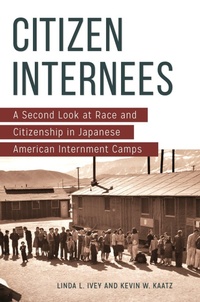
Citizen Internees
A Second Look at Race and Citizenship in Japanese American Internment Camps
Published on 27. March 2017
Book
Hardback
296 pages
978-1-4408-3700-5 (ISBN)
Description
Through a new collection of primary documents about Japanese internment during World War II, this book enables a broader understanding of the injustice experienced by displaced people within the United States in the 20th century.
In the 1940s, Japanese and Japanese American internees of Redwood City, CA, had a dedicated ally: J. Elmer Morrish, a banker who kept their businesses alive, made sure their taxes were paid, and safeguarded their properties until after the end of World War II and the internees were finally released. What were Morrish's motivations for his tireless efforts to help the internees? How did the unjustly incarcerated deal with the loss of freedom in the camps, and how did they envision their future? And how did the internees both cooperate with the U.S. government and attempt to resist victimization?
Citizen Internees: A Second Look at Race and Citizenship in Japanese American Internment Camps is an edited selection from a collection of more than 2,000 pieces of correspondence-some of which is previously unpublished-regarding the internment of Japanese and Japanese Americans from Redwood City, CA. These primary source documents reveal the experiences and emotions of a group of imprisoned people attempting to run the necessary day-to-day tasks of the lives they were forced to leave behind-as property owners, taxpayers, and proprietors. Through these letters about practical matters, readers can gain insight into the internees' changing family relations, their financial concerns, and their struggles in making decisions about an uncertain future. The book also includes essays that supply background information, analysis of the documents' contents and meaning, and historical context.
In the 1940s, Japanese and Japanese American internees of Redwood City, CA, had a dedicated ally: J. Elmer Morrish, a banker who kept their businesses alive, made sure their taxes were paid, and safeguarded their properties until after the end of World War II and the internees were finally released. What were Morrish's motivations for his tireless efforts to help the internees? How did the unjustly incarcerated deal with the loss of freedom in the camps, and how did they envision their future? And how did the internees both cooperate with the U.S. government and attempt to resist victimization?
Citizen Internees: A Second Look at Race and Citizenship in Japanese American Internment Camps is an edited selection from a collection of more than 2,000 pieces of correspondence-some of which is previously unpublished-regarding the internment of Japanese and Japanese Americans from Redwood City, CA. These primary source documents reveal the experiences and emotions of a group of imprisoned people attempting to run the necessary day-to-day tasks of the lives they were forced to leave behind-as property owners, taxpayers, and proprietors. Through these letters about practical matters, readers can gain insight into the internees' changing family relations, their financial concerns, and their struggles in making decisions about an uncertain future. The book also includes essays that supply background information, analysis of the documents' contents and meaning, and historical context.
Reviews / Votes
This may be the only book to present a local community's internment history expressly by highlighting a particular archive that is dedicated to documenting its imprisonment. . . . The internees' lives take shape in stories that speak to anyone who has endured injustice. The authors provide, variously, excerpts from letters, transcribed letters, and photocopies of letters that illuminate the internees' subjugation and that likewise feature what this archive has preserved. An extraordinary book whose subject matter speaks for itself. Summing Up: Essential. All public and academic levels/libraries. * Choice * December 2017 Top Community College Resource * Choice * The heart of Citizen Internees is the steady stream of mailings, numbering some 2,000, transacted between Morrish and the Redwood City inmates, which are excerpted throughout the first half of the book and selectively reproduced in full in the book's closing half. * Nichi Bei *More details
Language
English
Place of publication
United States
Publishing group
Bloomsbury Publishing Plc
Target group
College/higher education
Professional and scholarly
Illustrations
65 bw illus
Dimensions
Height: 240 mm
Width: 161 mm
Thickness: 21 mm
Weight
611 gr
ISBN-13
978-1-4408-3700-5 (9781440837005)
Copyright in bibliographic data and cover images is held by Nielsen Book Services Limited or by the publishers or by their respective licensors: all rights reserved.
Schweitzer Classification
Other editions
Additional editions
Linda L. Ivey | Kevin W. Kaatz
Citizen Internees
A Second Look at Race and Citizenship in Japanese American Internment Camps
E-Book
03/2017
1st Edition
Praeger Publishers Inc
€55.99
Available for download
Linda L. Ivey | Kevin W. Kaatz
Citizen Internees
A Second Look at Race and Citizenship in Japanese American Internment Camps
E-Book
03/2017
1st Edition
Praeger Publishers Inc
€55.99
Available for download
Persons
Linda L. Ivey, PhD, is associate professor of history at California State University, East Bay.
Kevin W. Kaatz, PhD, is assistant professor of history at California State University, East Bay.
Kevin W. Kaatz, PhD, is assistant professor of history at California State University, East Bay.
Content
Preface
Part One: The Idea of the Citizen Internee
Chapter 1 Citizen Internees
Chapter 2 History of the Japanese and Anti-Japanese Sentiment in California
Chapter 3 Planning for Relocation and the Protection of Property
Chapter 4 The Move to Tanforan
Chapter 5 The Move to Topaz
Chapter 6 Citizenship Restored? Joining the Army, Going Home
Part Two: The Banker and His Documents
Chapter 7 What Morrish Was Doing during This Period (Transcribed Letters)
Original Letters with Annotations
Epilogue: History of Morrish
Bibliography
Index
Part One: The Idea of the Citizen Internee
Chapter 1 Citizen Internees
Chapter 2 History of the Japanese and Anti-Japanese Sentiment in California
Chapter 3 Planning for Relocation and the Protection of Property
Chapter 4 The Move to Tanforan
Chapter 5 The Move to Topaz
Chapter 6 Citizenship Restored? Joining the Army, Going Home
Part Two: The Banker and His Documents
Chapter 7 What Morrish Was Doing during This Period (Transcribed Letters)
Original Letters with Annotations
Epilogue: History of Morrish
Bibliography
Index