

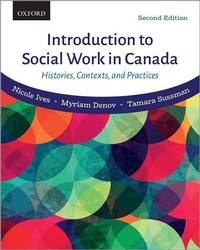
Introduction to Social Work in Canada
Histories, Contexts, and Practices
2nd Edition
Published on 17. March 2020
Book
Paperback/Softback
504 pages
978-0-19-902881-8 (ISBN)
Description
This comprehensive introduction to social work integrates perspectives from English, French, and Indigenous peoples in Canada to provide an inclusive treatment of the history, foundational skills, and specific fields of social work practice and research.
Part I begins with an exploration of the origins and foundational concepts of social work in Canada, including how Indigenous, French, and English traditions have shaped and informed social work practice in Canada. The text then discusses theoretical approaches, and the values and ethics at the core of professional practice. Part II examines foundational skills for social workers through a focus on working with individuals and families, and groups and communities. Part III explores specific fields of social work practice and research, with chapters focused on the health field and on working with children, Indigenous peoples, persons with disabilities, immigrants and refugees, the LGBTQ community, aging populations, and international social work. With an emphasis on diversity and drawing extensively on Canadian statistics and scholarship, this is an ideal text for introduction to social work courses. This updated, new edition features a substantially revised and expanded chapter on Indigenous Peoples and Social Work.
Part I begins with an exploration of the origins and foundational concepts of social work in Canada, including how Indigenous, French, and English traditions have shaped and informed social work practice in Canada. The text then discusses theoretical approaches, and the values and ethics at the core of professional practice. Part II examines foundational skills for social workers through a focus on working with individuals and families, and groups and communities. Part III explores specific fields of social work practice and research, with chapters focused on the health field and on working with children, Indigenous peoples, persons with disabilities, immigrants and refugees, the LGBTQ community, aging populations, and international social work. With an emphasis on diversity and drawing extensively on Canadian statistics and scholarship, this is an ideal text for introduction to social work courses. This updated, new edition features a substantially revised and expanded chapter on Indigenous Peoples and Social Work.
More details
Edition
2nd Revised edition
Language
English
Place of publication
Toronto
Canada
Target group
Professional and scholarly
Edition type
Revised edition
Product notice
Paperback (trade)
Unsewn / adhesive bound
Illustrations
58 Photos; 15 figures; 18 tables
Dimensions
Height: 251 mm
Width: 203 mm
Thickness: 20 mm
Weight
862 gr
ISBN-13
978-0-19-902881-8 (9780199028818)
Copyright in bibliographic data and cover images is held by Nielsen Book Services Limited or by the publishers or by their respective licensors: all rights reserved.
Schweitzer Classification
Persons
Nicole Ives is an Associate Professor and Director of the Bachelor of Social Work program at McGill Universitys School of Social Work. She is a qualitative researcher with a focus on refugee and immigrant issues and issues of acculturation, exploring the lived experience of policies. Her research has included examining outcomes for refugees that have been sponsored by religious congregations, the effects of US immigration policy on Liberian refugee families, and Bosnian refugee resettlement in the United States and Denmark. Ives teaches Anti-Oppressive Social Work Practice and Qualitative Research Methods, participates on the BSW Program Task Force, and is a member of the First Nations and Inuit Social Work Program Steering Group. She has taught at McGill, the University of Pennsylvania, and Rutgers.
Myriam Denov is James McGill Professor, a Trudeau Fellow, and Canada Research Chair in Youth, Gender, and Armed Conflict (Tier 1) at the School of Social Work at McGill University. Her research and teaching interests lie in the areas of child and youth in adversity, and international child protection, with an emphasis on war and political violence, children in armed conflict, and gender-based violence. Denov has authored five books, including for Cambridge University Press and for Palgrave Macmillan. She holds a PhD from the University of Cambridge, where she was a Commonwealth Scholar.
Tamara Sussman is an Associate Professor in the School of Social Work, McGill University. Her research focuses on how health services and systems impact older adults and their family members. Her research projects include spousal carers experiences with home care; older adults and family members experiences with the transition into long-term care; barriers and facilitators to the delivery of effective interventions for depressed older adults and their care partners; and most recently the experiences of more marginalized populations of older adults such as older homeless adults and older adults identifying as gay, lesbian, bisexual and transgender (LGBT). In 2011, Dr. Sussman was awarded the H. Noel Fieldhouse Award for Distinguished Teaching in recognition of her teaching excellence.
Myriam Denov is James McGill Professor, a Trudeau Fellow, and Canada Research Chair in Youth, Gender, and Armed Conflict (Tier 1) at the School of Social Work at McGill University. Her research and teaching interests lie in the areas of child and youth in adversity, and international child protection, with an emphasis on war and political violence, children in armed conflict, and gender-based violence. Denov has authored five books, including for Cambridge University Press and for Palgrave Macmillan. She holds a PhD from the University of Cambridge, where she was a Commonwealth Scholar.
Tamara Sussman is an Associate Professor in the School of Social Work, McGill University. Her research focuses on how health services and systems impact older adults and their family members. Her research projects include spousal carers experiences with home care; older adults and family members experiences with the transition into long-term care; barriers and facilitators to the delivery of effective interventions for depressed older adults and their care partners; and most recently the experiences of more marginalized populations of older adults such as older homeless adults and older adults identifying as gay, lesbian, bisexual and transgender (LGBT). In 2011, Dr. Sussman was awarded the H. Noel Fieldhouse Award for Distinguished Teaching in recognition of her teaching excellence.
Content
From the Publisher
From the Authors
Part I: Historical, Theoretical, and Philosophical Frameworks
1. Historical Foundations of Addressing Need: Indigenous, French, and English Traditions
Learning Objectives
Chapter Outline
Indigenous Helping and Healing Traditions
- Indigenous Approaches to Holistic Helping and Healing
- Helping and Healing from Generation to Generation
French Historical Foundations of Social Work
- Poverty Relief and the Involvement of the Roman Catholic Church
- Benevolent Societies and Other Ways of Helping
- Myriad Approaches to Poverty Relief
English Historical Foundations of Social Work
- Early Approaches to Addressing the Needs of Vulnerable Populations
- Social Reform Post-Confederation
Women and Poverty
Major Social Legislation from the Depression Onwards
The Development of Social Work as a Profession
From All Our Histories to Today: A Vision of Contemporary Canadian Social Work
Conclusion
Questions for Critical Thought
2. Social Work Theories
Learning Objectives
Chapter Outline
Theory and Social Work: An Awkward and Unwanted Partnership?
What Is Theory?
Can One Theory Do It All?
Ways of Seeing and Ways of Knowing: Power and Politics in Social Work Theory
Theoretical Perspectives
- Ecosystem Theories
- Onion-Peeling Theories
- Faulty-Engine Theories
- Story-Telling Theories
- Mountain-Moving Theories
Conclusion
Questions for Critical Thought
3. Ethics in Social Work
Learning Objectives
Chapter Outline
Why Are Ethics Important in Social Work?
A Brief History of Ethics in Social Work
- The Morality Period
- The Values Period
- The Ethical Theory and Decision-Making Period
- The Ethical Standards and Risk Management Period
The Canadian Association of Social Workers' Code of Ethics
- Code of Ethics Core Values
- Strengths and Limitations of the CASW Code of Ethics
Addressing Ethical Dilemmas: The Process of Reflexive Decision-Making
- Describe the Case and Context
- Define the Ethical Problem
- Explore Values and Biases
- Gather Information: Research, Theory, and the Code of Ethics
- Explore Options
Ethical Social Work Practice and Self-Care
Conclusion
Questions for Critical Thought
Part II: Foundational Skills for Social Workers
4. Social Work with Individuals and Families
Learning Objectives
Chapter Outline
Historical Contexts of Social Work with Individuals and Families
Practice with Individuals and Families
Communication Skills
- Attending
- Questioning
- Reflecting
- Summarizing
The Social Work Relationship
- Care and Concern
- Genuineness
- Empathy
- Collaboration
- Self-Disclosure: A Contested Issue in Supporting the Development of Common Factors
- Hope: A Neglected Common Factor
Official Language Legislation and Social Services in Canada
Phases of the Helping Process
- Phase I: Exploration/Assessment
- Phase II: Contracting/Planning
- Phase III: Implementation/Intervention
- Phase IV: Ending/Evaluation
The Helping Process with Families
- The Genogram
Conclusion
Questions for Critical Thought
5. Social Work with Groups and Communities
Learning Objectives
Chapter Outline
Historical Contexts of Social Work with Groups and Communities
Different Forms of Social Work Groups
- Treatment Groups
- Task Groups
Stages of Group Development
Group Leadership and Facilitation
Community Social Work Practice
- Community Practice Frameworks
Conclusion
Questions for Critical Thought
Part III: Fields of Social Work Practice
6. Social Work and Health
Learning Objectives
Chapter Outline
Early Health-Care Provision
Contemporary Approaches to Health-Care Provision
- Report by the Commission of Inquiry into Health and Welfare (1970)
- Canada Health Act (1984)
- Romanow Report (2002)
The Privatization of Health Services in Canada
Social Work Practice in Health Care
- Hospital-Based Social Work
- Social Work and End-of-Life Care
Social Work and Mental Health Care
Social Determinants of Health in Canada
- Income
- Early Childhood and Adolescence
- Unemployment and Working Conditions
- Food Insecurity
- Housing
- Indigenous Status
- Racialized Identity
- Disability
- Gender
- Access to Health Services
- Substance Use and Abuse
- Education
Conclusion
Questions for Critical Thought
7. Social Work Practice with Children
Learning Objectives
Chapter Outline
Canada's Children: Issues, Facts, and Figures
- Child Poverty
- Family Violence
- Child Maltreatment
Changing Conceptions of Children in Canada: A History of Child Welfare
- Stage One: Children as Objects: The Absence of Legal Rights and Protections
- Stage Two: Children as Vulnerable Individuals in Need of Protection
- Stage Three: Children as Subjects
The Canadian Human Rights Tribunal on First Nations Child Welfare
- Contemporary Child Welfare Practice
Youth Justice in Canada
- Children as Objects: The Absence of Legal Protections
- The Vulnerable Child and "Parens Patriae": The Introduction of the Juvenile Delinquents Act
- Children as Subjects? The Clash Between "Rights" and "Accountability"
- Youth Crime in Canada
- Recent Reforms: Bill C-25 and Bill C-10
- The Role of Social Workers in Youth Justice
Preventive Social Work with Children
Key Challenges in Child Welfare and Youth Justice: Implications for Social Workers
Conclusion
Question for Critical Thought
8. Indigenous Peoples and Social Work (by Cyndy Baskin and Alyssa McLeod)
Learning Objectives
Chapter Outline
Who Are Indigenous Peoples?
Since the Beginning of Time: Indigenous Ways of Helping
Colonization: The Time of the Great Struggle
- "Kill the Indian in the Child"
- The Sixties Scoop
Contemporary Challenges in Indigenous Communities
Contemporary Challenges in Urban Settings
Disappeared and Murdered Indigenous Women and Girls
- National Inquiry into Missing and Murdered Indigenous Women and Girls
- Walking with Our Sisters
Steps toward Healing
- The Medicine Wheel as a Healing Tool
Indigenous Worldviews in Social Work
- Uniqueness of the Metis
- Social Work Theories as Seen Through an Indigenous Lens
- Challenges Facing Indigenous Social Workers
Indigenous Focused Social Work Programs
Being an Ally
- Idle No More
- The Eighth Fire
Truth and Reconciliation Commission of Canada
Conclusion
Questions for Critical Thought
9. Social Work with Immigrants and Refugees
Learning Objectives
Chapter Outline
Overview of the Contemporary Canadian Migration Landscape
- Who Are Today's Migrants?
- Who Is Where? Migrant Countries of Origin and Settlement across Canada
- The War in Syria
Migration Policy Overview
- International-Level Policies
- National-Level Policies
Theoretical Approaches to Working with Migrant Populations
- Ecological Systems Theory
- Strengths and Empowerment Approaches
- Integrating Culture into Practice Approaches
- Stages of Migration Framework
Settlement Issues Facing Migrants in Canada
- Goals and Expectations
- Employment and Education
- Language
- Health
- Housing
- Social Support
Settlement Services
Vulnerable Groups
- Gender and Migration
- Trafficking
- Unaccompanied Minors
- Lesbian, Gay, Bisexual, Transgender, and Queer (LGBTQ) Immigrants and Refugees
- Refugee and Immigrant Older Adults
- Migrants with Disabilities
- Survivors of Torture
Conclusion
Questions for Critical Thought
10. Social Work and Sexual and Gender Diversity (by Edward Ou Jin Lee and Shari Brotman)
Learning Objectives
Chapter Outline
Taking Up Sexual and Gender Identity Terms
Overview of the TSLGBTQ Human Rights Global and Canadian Landscape
- Global Context
Canadian Context
Violence, Discrimination, and Stigma
- Internalized Homophobia and Transphobia
Intersectionality as a Theoretical Framework
- Intersectionality, Identity, and Social Location
Disclosure of Sexual and Gender Identity: Coming Out
Families and Communities
- Families
- Communities
Social Work Practice with TSLGBTQ People across Health-Care and Social Service Settings
- Historical Dimensions
- Social Dimensions
- Access to Health Care for Specific TSLGBTQ Groups
- Access to Social Services for TSLGBTQ People
Barriers to Access for TSLGBTQ Individuals across Health/Care and Social Service Settings
The Continuum of Attitudes towards Sexual and Gender Difference in Health-Care and Social Services
Guidelines for Social Workers to Foster Safe and Affirming Space for TSLGBTQ People
Social Location and Institutional Power
Collective Empowerment
Conclusion
Questions for Critical Thought
11. Disability and Social Work Practice (by Carl Ernst and Radha MacCulloch)
Learning Objectives
Chapter Outline
Defining Disability
- What Is Disability? How Is Disability Defined in Canada?
Theorizing Disability
- The Medical Model of Disability
- The Social Model of Disability
- The World Health Organization's International Classification of Functioning, Disability, and Health (ICF)
Categorizing Disability
- The Categorical or Diagnostic Approach
- The Non-categorical or Functional Approach
Prevalence of Disability in Canada
History of Disability Policy in Canada
- Early Beliefs about Individuals with Disabilities
- Asylum, Confinement, and Institutionalization
- De-institutionalization
- Progress and Development of Disability Rights in Canada
Social Work Practice with Individuals with a Disability
- Health and Social Services for Individuals with Disabilities: Navigating the Systems of Care
- Settings for Social Workers in a Disability Context
- Promoting Inclusion: Roles for Social Workers in a Disability Context
- Social Work Practice Guidelines
Conclusion
Questions for Critical Thought
12. Social Work with Aging Populations
Learning Objectives
Chapter Outline
Overview of Canada's Aging Population
- Ethnic and Racial Diversity among Older Adults in Canada
- Aging of Minority French-Speaking Canadians
- Rural Aging
- Mental Health and Aging
Theorizing Aging
- Micro Theories of Aging
- Macro Theories of Aging
Policies that Have an Impact on Older Adults
- Retirement Policies and Programs
- Long-Term Care Policies and Programs
- Elder Abuse: A Global Issue
- Elder Abuse in Canada
- Theorizing Elder Abuse
- Social Location and Elder Abuse
Conclusion
Questions for Critical Thought
13. International Social Work
Learning Objectives
Chapter Outline
Why International Social Work?
- Social Work beyond Borders: Historical Patterns of Expansion and the Canadian Connection
Defining International Social Work: An Ongoing Challenge
International Social Welfare Organizations and Their Functions
- The United Nations and Its Agencies
- Government Agencies
- Non-governmental Organizations
- International Non-governmental Organizations
- Faith-Based Organizations
Values and Ethics in International Social Work
- International Social Work Practice: Implications of the "Export Model"
Social Work and International Issues: The Global Reality of Child Soldiers
- Girls and War
- The UN System
- Non-governmental Organizations
- Canadian Government Agencies
- Canadian NGOs and Agencies
Conclusion
Questions for Critical Thought
Appendix: Code of Ethics, 2005
Glossary
References
Index
From the Authors
Part I: Historical, Theoretical, and Philosophical Frameworks
1. Historical Foundations of Addressing Need: Indigenous, French, and English Traditions
Learning Objectives
Chapter Outline
Indigenous Helping and Healing Traditions
- Indigenous Approaches to Holistic Helping and Healing
- Helping and Healing from Generation to Generation
French Historical Foundations of Social Work
- Poverty Relief and the Involvement of the Roman Catholic Church
- Benevolent Societies and Other Ways of Helping
- Myriad Approaches to Poverty Relief
English Historical Foundations of Social Work
- Early Approaches to Addressing the Needs of Vulnerable Populations
- Social Reform Post-Confederation
Women and Poverty
Major Social Legislation from the Depression Onwards
The Development of Social Work as a Profession
From All Our Histories to Today: A Vision of Contemporary Canadian Social Work
Conclusion
Questions for Critical Thought
2. Social Work Theories
Learning Objectives
Chapter Outline
Theory and Social Work: An Awkward and Unwanted Partnership?
What Is Theory?
Can One Theory Do It All?
Ways of Seeing and Ways of Knowing: Power and Politics in Social Work Theory
Theoretical Perspectives
- Ecosystem Theories
- Onion-Peeling Theories
- Faulty-Engine Theories
- Story-Telling Theories
- Mountain-Moving Theories
Conclusion
Questions for Critical Thought
3. Ethics in Social Work
Learning Objectives
Chapter Outline
Why Are Ethics Important in Social Work?
A Brief History of Ethics in Social Work
- The Morality Period
- The Values Period
- The Ethical Theory and Decision-Making Period
- The Ethical Standards and Risk Management Period
The Canadian Association of Social Workers' Code of Ethics
- Code of Ethics Core Values
- Strengths and Limitations of the CASW Code of Ethics
Addressing Ethical Dilemmas: The Process of Reflexive Decision-Making
- Describe the Case and Context
- Define the Ethical Problem
- Explore Values and Biases
- Gather Information: Research, Theory, and the Code of Ethics
- Explore Options
Ethical Social Work Practice and Self-Care
Conclusion
Questions for Critical Thought
Part II: Foundational Skills for Social Workers
4. Social Work with Individuals and Families
Learning Objectives
Chapter Outline
Historical Contexts of Social Work with Individuals and Families
Practice with Individuals and Families
Communication Skills
- Attending
- Questioning
- Reflecting
- Summarizing
The Social Work Relationship
- Care and Concern
- Genuineness
- Empathy
- Collaboration
- Self-Disclosure: A Contested Issue in Supporting the Development of Common Factors
- Hope: A Neglected Common Factor
Official Language Legislation and Social Services in Canada
Phases of the Helping Process
- Phase I: Exploration/Assessment
- Phase II: Contracting/Planning
- Phase III: Implementation/Intervention
- Phase IV: Ending/Evaluation
The Helping Process with Families
- The Genogram
Conclusion
Questions for Critical Thought
5. Social Work with Groups and Communities
Learning Objectives
Chapter Outline
Historical Contexts of Social Work with Groups and Communities
Different Forms of Social Work Groups
- Treatment Groups
- Task Groups
Stages of Group Development
Group Leadership and Facilitation
Community Social Work Practice
- Community Practice Frameworks
Conclusion
Questions for Critical Thought
Part III: Fields of Social Work Practice
6. Social Work and Health
Learning Objectives
Chapter Outline
Early Health-Care Provision
Contemporary Approaches to Health-Care Provision
- Report by the Commission of Inquiry into Health and Welfare (1970)
- Canada Health Act (1984)
- Romanow Report (2002)
The Privatization of Health Services in Canada
Social Work Practice in Health Care
- Hospital-Based Social Work
- Social Work and End-of-Life Care
Social Work and Mental Health Care
Social Determinants of Health in Canada
- Income
- Early Childhood and Adolescence
- Unemployment and Working Conditions
- Food Insecurity
- Housing
- Indigenous Status
- Racialized Identity
- Disability
- Gender
- Access to Health Services
- Substance Use and Abuse
- Education
Conclusion
Questions for Critical Thought
7. Social Work Practice with Children
Learning Objectives
Chapter Outline
Canada's Children: Issues, Facts, and Figures
- Child Poverty
- Family Violence
- Child Maltreatment
Changing Conceptions of Children in Canada: A History of Child Welfare
- Stage One: Children as Objects: The Absence of Legal Rights and Protections
- Stage Two: Children as Vulnerable Individuals in Need of Protection
- Stage Three: Children as Subjects
The Canadian Human Rights Tribunal on First Nations Child Welfare
- Contemporary Child Welfare Practice
Youth Justice in Canada
- Children as Objects: The Absence of Legal Protections
- The Vulnerable Child and "Parens Patriae": The Introduction of the Juvenile Delinquents Act
- Children as Subjects? The Clash Between "Rights" and "Accountability"
- Youth Crime in Canada
- Recent Reforms: Bill C-25 and Bill C-10
- The Role of Social Workers in Youth Justice
Preventive Social Work with Children
Key Challenges in Child Welfare and Youth Justice: Implications for Social Workers
Conclusion
Question for Critical Thought
8. Indigenous Peoples and Social Work (by Cyndy Baskin and Alyssa McLeod)
Learning Objectives
Chapter Outline
Who Are Indigenous Peoples?
Since the Beginning of Time: Indigenous Ways of Helping
Colonization: The Time of the Great Struggle
- "Kill the Indian in the Child"
- The Sixties Scoop
Contemporary Challenges in Indigenous Communities
Contemporary Challenges in Urban Settings
Disappeared and Murdered Indigenous Women and Girls
- National Inquiry into Missing and Murdered Indigenous Women and Girls
- Walking with Our Sisters
Steps toward Healing
- The Medicine Wheel as a Healing Tool
Indigenous Worldviews in Social Work
- Uniqueness of the Metis
- Social Work Theories as Seen Through an Indigenous Lens
- Challenges Facing Indigenous Social Workers
Indigenous Focused Social Work Programs
Being an Ally
- Idle No More
- The Eighth Fire
Truth and Reconciliation Commission of Canada
Conclusion
Questions for Critical Thought
9. Social Work with Immigrants and Refugees
Learning Objectives
Chapter Outline
Overview of the Contemporary Canadian Migration Landscape
- Who Are Today's Migrants?
- Who Is Where? Migrant Countries of Origin and Settlement across Canada
- The War in Syria
Migration Policy Overview
- International-Level Policies
- National-Level Policies
Theoretical Approaches to Working with Migrant Populations
- Ecological Systems Theory
- Strengths and Empowerment Approaches
- Integrating Culture into Practice Approaches
- Stages of Migration Framework
Settlement Issues Facing Migrants in Canada
- Goals and Expectations
- Employment and Education
- Language
- Health
- Housing
- Social Support
Settlement Services
Vulnerable Groups
- Gender and Migration
- Trafficking
- Unaccompanied Minors
- Lesbian, Gay, Bisexual, Transgender, and Queer (LGBTQ) Immigrants and Refugees
- Refugee and Immigrant Older Adults
- Migrants with Disabilities
- Survivors of Torture
Conclusion
Questions for Critical Thought
10. Social Work and Sexual and Gender Diversity (by Edward Ou Jin Lee and Shari Brotman)
Learning Objectives
Chapter Outline
Taking Up Sexual and Gender Identity Terms
Overview of the TSLGBTQ Human Rights Global and Canadian Landscape
- Global Context
Canadian Context
Violence, Discrimination, and Stigma
- Internalized Homophobia and Transphobia
Intersectionality as a Theoretical Framework
- Intersectionality, Identity, and Social Location
Disclosure of Sexual and Gender Identity: Coming Out
Families and Communities
- Families
- Communities
Social Work Practice with TSLGBTQ People across Health-Care and Social Service Settings
- Historical Dimensions
- Social Dimensions
- Access to Health Care for Specific TSLGBTQ Groups
- Access to Social Services for TSLGBTQ People
Barriers to Access for TSLGBTQ Individuals across Health/Care and Social Service Settings
The Continuum of Attitudes towards Sexual and Gender Difference in Health-Care and Social Services
Guidelines for Social Workers to Foster Safe and Affirming Space for TSLGBTQ People
Social Location and Institutional Power
Collective Empowerment
Conclusion
Questions for Critical Thought
11. Disability and Social Work Practice (by Carl Ernst and Radha MacCulloch)
Learning Objectives
Chapter Outline
Defining Disability
- What Is Disability? How Is Disability Defined in Canada?
Theorizing Disability
- The Medical Model of Disability
- The Social Model of Disability
- The World Health Organization's International Classification of Functioning, Disability, and Health (ICF)
Categorizing Disability
- The Categorical or Diagnostic Approach
- The Non-categorical or Functional Approach
Prevalence of Disability in Canada
History of Disability Policy in Canada
- Early Beliefs about Individuals with Disabilities
- Asylum, Confinement, and Institutionalization
- De-institutionalization
- Progress and Development of Disability Rights in Canada
Social Work Practice with Individuals with a Disability
- Health and Social Services for Individuals with Disabilities: Navigating the Systems of Care
- Settings for Social Workers in a Disability Context
- Promoting Inclusion: Roles for Social Workers in a Disability Context
- Social Work Practice Guidelines
Conclusion
Questions for Critical Thought
12. Social Work with Aging Populations
Learning Objectives
Chapter Outline
Overview of Canada's Aging Population
- Ethnic and Racial Diversity among Older Adults in Canada
- Aging of Minority French-Speaking Canadians
- Rural Aging
- Mental Health and Aging
Theorizing Aging
- Micro Theories of Aging
- Macro Theories of Aging
Policies that Have an Impact on Older Adults
- Retirement Policies and Programs
- Long-Term Care Policies and Programs
- Elder Abuse: A Global Issue
- Elder Abuse in Canada
- Theorizing Elder Abuse
- Social Location and Elder Abuse
Conclusion
Questions for Critical Thought
13. International Social Work
Learning Objectives
Chapter Outline
Why International Social Work?
- Social Work beyond Borders: Historical Patterns of Expansion and the Canadian Connection
Defining International Social Work: An Ongoing Challenge
International Social Welfare Organizations and Their Functions
- The United Nations and Its Agencies
- Government Agencies
- Non-governmental Organizations
- International Non-governmental Organizations
- Faith-Based Organizations
Values and Ethics in International Social Work
- International Social Work Practice: Implications of the "Export Model"
Social Work and International Issues: The Global Reality of Child Soldiers
- Girls and War
- The UN System
- Non-governmental Organizations
- Canadian Government Agencies
- Canadian NGOs and Agencies
Conclusion
Questions for Critical Thought
Appendix: Code of Ethics, 2005
Glossary
References
Index