

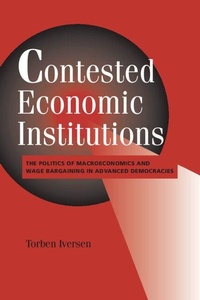
Contested Economic Institutions
The Politics of Macroeconomics and Wage Bargaining in Advanced Democracies
Published on 28. August 1999
Book
Hardback
238 pages
978-0-521-64226-2 (ISBN)
Description
This book helps explain one of the most intriguing and politically salient puzzles in comparative political economy: why some countries have much higher unemployment rates than others. Contrary to new classical economics the focus is on explaining distribution and equilibrium unemployment, and contrary to neo-corporatist theory the role of monetary policy and rational expectation is integral to the analysis. The book makes two central arguments. The first is that monetary policies affect equilibrium employment whenever wages are set above the firm level. The second argument focuses on the distributive effects of different institutions, and models institutional design as a strategic game between partisan governments and cross-class alliances of unions and employers.
Reviews / Votes
"...provocative, interesting, and well written." Review of Radical Political Economics "Explores how macroecenomic policies and economic institutions jointly determine economic performance and distribution." Journal of Economic LiteratureMore details
Series
Language
English
Place of publication
Cambridge
United Kingdom
Target group
College/higher education
Professional and scholarly
Illustrations
19 Tables, unspecified; 22 Line drawings, unspecified
Dimensions
Height: 235 mm
Width: 157 mm
Thickness: 18 mm
Weight
504 gr
ISBN-13
978-0-521-64226-2 (9780521642262)
Copyright in bibliographic data and cover images is held by Nielsen Book Services Limited or by the publishers or by their respective licensors: all rights reserved.
Schweitzer Classification
Other editions
Additional editions
Torben Iversen
Contested Economic Institutions
The Politics of Macroeconomics and Wage Bargaining in Advanced Democracies
Book
08/1999
Cambridge University Press
€37.50
Shipment within 15-20 days
Person
Content
1. Introduction; Part I. The Real Effects of Monetary Policies: 2. An institutional model of economic performance; 3. Economic institutions and performance: quantitative evidence; Part II. The Politics of Institutional Design: 4. A theory of contested institutions; 5. From Keynesian centralization to Monetarist decentralization: five Northern European experiences; 6. Conclusion: the fork in the road for social democracy.