

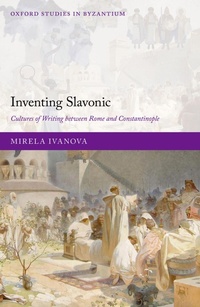
Inventing Slavonic
Cultures of Writing Between Rome and Constantinople
Published on 8. February 2024
Book
Hardback
296 pages
978-0-19-889150-5 (ISBN)
Description
Few alphabets in the world are actively celebrated, and none more so than the Slavonic. Annually across Eastern Europe, the alphabet and its inventors, Cyril and Methodios, are celebrated with parades, concerts, liturgical services, and public addresses by presidents, ministers, and mayors. Inventing Slavonic: Cultures of Writing Between Rome and Constantinople offers a new reading of the invention of the Slavonic alphabet and its implications. Its premise is simple: namely, that the alphabet was not invented once, but that it continued to be contested and redefined in the century after its creation. However, Inventing Slavonic goes against the grain of modern scholarship and popular common sense, where a stable and fossilized story about Cyril, his brother and companion Methodios, and the alphabet still persists.
Mirela Ivanova shows that this well-known story is, in fact, a Frankenstein's monster, bolted together from texts which originally attributed quite different and often conflicting meanings to the elements which make up this supposedly unified narrative. In this narrative's place, the book offers a series of new readings of our earliest sources for the alphabet's appearance. In doing so, it constructs a new social history of the early script's fragility, and the ways in which its existence was conditioned by changes in socio-political life between Rome and Constantinople.
Mirela Ivanova shows that this well-known story is, in fact, a Frankenstein's monster, bolted together from texts which originally attributed quite different and often conflicting meanings to the elements which make up this supposedly unified narrative. In this narrative's place, the book offers a series of new readings of our earliest sources for the alphabet's appearance. In doing so, it constructs a new social history of the early script's fragility, and the ways in which its existence was conditioned by changes in socio-political life between Rome and Constantinople.
Reviews / Votes
The monograph is published by OUP in the Oxford Studies in Byzantium series. At this price point, the book will mainly be of interest to libraries and specialist academics. * Giles Gilbert, Classics for all *More details
Series
Language
English
Place of publication
Oxford
United Kingdom
Target group
Professional and scholarly
Product notice
sewn/stitched
Cloth over boards
Illustrations
6 black and white illustrations and 1 map
Dimensions
Height: 226 mm
Width: 147 mm
Thickness: 23 mm
Weight
635 gr
ISBN-13
978-0-19-889150-5 (9780198891505)
Copyright in bibliographic data and cover images is held by Nielsen Book Services Limited or by the publishers or by their respective licensors: all rights reserved.
Schweitzer Classification
Other editions
Additional editions
E-Book
01/2024
1st Edition
OUP eBook
€89.99
Available for download
E-Book
01/2024
1st Edition
OUP eBook
€89.99
Available for download
Person
Mirela Ivanova is Lecturer in Medieval History at the University of Sheffield. Her research explores the intellectual and social history of Byzantium and Central and Eastern Europe in the early middle ages. Relatedly, she is interested in the historiography of medievalism and nation building in the Balkans, Russia and Turkey today. To this end she is co-editor of Is Byzantine Studies a Colonialist Discipline? Towards a Critical Historiography (2023).
Content
Acknowledgements
Note on Transliteration
Abbreviations
List of Figures
Map
Introduction
Part One: Inventing Slavonic
1: Constantine-Cyril Today: A Critical Assessment
2: The Life of Constantine-Cyril: A New Reading
3: Learned Saints between Rome and Constantinople: The VC in Context
Part Two: Institutionalising Slavonic
4: The Myth of Cyril and Methodios Revisited
5: Cyril, Slavonic, and the Pope in the Life of Methodios
6: Popes, Bishops, and Emperors between Rome and Constantinople
Part Three: Defending Slavonic
7: Where Not to Start: Slavonic in Balkan History
8: A Case for Slavonic: The Earliest Defence of the Alphabet
9: Slavonic and Greek Bookmen in the Tenth-Century Balkans
Conclusions
Bibliography
Index
Note on Transliteration
Abbreviations
List of Figures
Map
Introduction
Part One: Inventing Slavonic
1: Constantine-Cyril Today: A Critical Assessment
2: The Life of Constantine-Cyril: A New Reading
3: Learned Saints between Rome and Constantinople: The VC in Context
Part Two: Institutionalising Slavonic
4: The Myth of Cyril and Methodios Revisited
5: Cyril, Slavonic, and the Pope in the Life of Methodios
6: Popes, Bishops, and Emperors between Rome and Constantinople
Part Three: Defending Slavonic
7: Where Not to Start: Slavonic in Balkan History
8: A Case for Slavonic: The Earliest Defence of the Alphabet
9: Slavonic and Greek Bookmen in the Tenth-Century Balkans
Conclusions
Bibliography
Index