

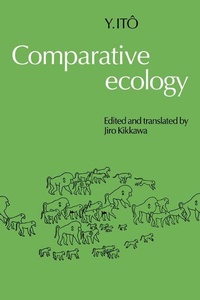
Comparative Ecology
Published on 12. March 1981
Book
Paperback/Softback
450 pages
978-0-521-29845-2 (ISBN)
Description
This 1980 book considers the patterns of population fluctuations of animals and intraspecific social relations by means of comparative methods and discusses the evolution of population regulation mechanisms and social relations. The author proposes that parental care has evolved in environments in which it is difficult for the young to obtain food, whilst high fecundity has evolved in the opposite environment. He presents evidence from a wide range of organisms to argue that during evolution animals repeatedly face the 'choice' of two strategies - low fecundity combined with parental protection, or high fecundity - and that this choice determined the amplitude, regularity and associated main factors of population fluctuations as well as the main characteristics of social relations as expressed in group life or dispersed living involving territory. Although many examples are drawn from insects, with which the author is most familiar, mammal, birds and other animal groups are also examined in depth.
More details
Language
English
Place of publication
Cambridge
United Kingdom
Target group
College/higher education
Product notice
Paperback (trade)
Illustrations
Worked examples or Exercises
Dimensions
Height: 229 mm
Width: 152 mm
Thickness: 26 mm
Weight
726 gr
ISBN-13
978-0-521-29845-2 (9780521298452)
Copyright in bibliographic data and cover images is held by Nielsen Book Services Limited or by the publishers or by their respective licensors: all rights reserved.
Schweitzer Classification
Other editions
Additional editions

Y. Ito
Comparative Ecology
Book
03/1981
Cambridge University Press
€52.62
Article exhausted; check for reprint
Previous edition
Y. Ito
Comparative Ecology
Book
03/1981
Cambridge University Press
€52.62
Article exhausted; check for reprint
Persons
Content
Preface to the English edition; Preface to the second Japanese edition; Acknowledgements; 1. Evolution of reproductive rates; 2. Strategies of survival; 3. Population fluctuation; 4. Territoriality; 5. Social insects; 6. Group life; References; Taxonomic index; Author index; Subject index.