

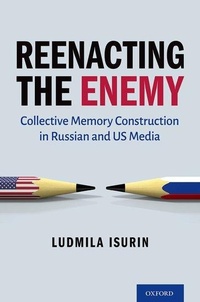
Reenacting the Enemy
Collective Memory Construction in Russian and US Media
Published on 12. July 2022
Book
Hardback
328 pages
978-0-19-760546-2 (ISBN)
Description
This book examines how Russian and American media narratives inform the ways individuals in both countries consume and construct collective memories of one another in an age of media distrust. Using research on collective memory, media, and the individual mind, this book applies an interdisciplinary sociocognitive framework to study seven 21st century political events involving Russia. With each event, this book analyzes how ideological bias, distortion, and schemata in both Russian and American media outlets work to reestablish a Cold War-like narrative--and by extension, reignite perceived enmities in the individual minds and collective memories of both nations. The book examines this old phenomenon at the interface of conscious media distrust among individuals who subconsciously embrace these constructs, forming memories along the ideological lines promoted by the same institutions they question.
By bringing together content analyses of media texts and empirical data, Reenacting the Enemy serves as an interdisciplinary study of psychological mechanisms behind Russian and US media to uncover both old and new patterns of collective and individual memory constructs in the two societies.
By bringing together content analyses of media texts and empirical data, Reenacting the Enemy serves as an interdisciplinary study of psychological mechanisms behind Russian and US media to uncover both old and new patterns of collective and individual memory constructs in the two societies.
Reviews / Votes
Isurin brings deep expertise on culture and media in the U.S. and Russia to show how prejudice toward the other grows out its desire to project its own attitudes and values as superior. She then goes on to demonstrate how this dynamic organizes national memory. She also argues that at least in some instances an independent, liberal media in Russia provides a surprising critical view that is less evident on the American side. Her conclusions may be uncomfortable for both American and Russian readers, but that is the point and one of the book's great contributions. This is a brilliant contribution to memory studies in general, and to advancing understanding of why relations between Russia and the U.S. remain so fraught. * James V. Wertsch, David R. Francis Distinguished Professor, Department of Anthropology, Washington University in St. Louis. Author of How Nations Remember: A Narrative Approach * In a masterful marriage between a deep understanding of Russian and American political culture and a careful reading of both countries' media, Isurin provides a unique insight into how media both shapes and reflects the collective memories of a nation. This book is a must-read for any student interested in the current antagonisms between Russia and the US, as well as for students of collective memory exploring the role of media in politics. * William Hirst, Professor of Psychology, The New School for Social Research * Overall, Reenacting the Enemy. Collective Memory Construction in Russian and US Media is a useful, thought-provoking and meticulous book...It will be of value to those interested in cognitive psychology, international relations and media studies, especially the interplay between collective memory, media and the mind. * Tingting Hu, Associate Professor, School of International Studies, Hangzhou Dianzi University, Hangzhou, People's Republic of China, * A brief review cannot do justice to the extraordinary depth of the interdisciplinary analysis of collective memory formation from media accounts in Russia and the US given in Reenacting the Enemy: Collective Memory Construction in Russian and US Memory. In this book, Ludmila Isurin considers three processes of collective memory construction, including the deliberate or subconscious reorientation of accepted historical facts, different interpretations of the causes of past conflicts, and the understanding of who should be blamed for these conflicts. * Henry (Chip) Carey, EuropeNow *More details
Language
English
Place of publication
New York
United States
Target group
Professional and scholarly
Product notice
sewn/stitched
Cloth over boards
Dimensions
Height: 239 mm
Width: 165 mm
Thickness: 28 mm
Weight
576 gr
ISBN-13
978-0-19-760546-2 (9780197605462)
Copyright in bibliographic data and cover images is held by Nielsen Book Services Limited or by the publishers or by their respective licensors: all rights reserved.
Schweitzer Classification
Other editions
Additional editions
E-Book
04/2022
OUP eBook
€34.99
Available for download
E-Book
04/2022
OUP eBook
€34.99
Available for download
Person
Ludmila Isurin is a professor at the Ohio State University. An interdisciplinary scholar whose research encompasses psycho- and sociolinguistics, social sciences and humanities with a recent focus on how collective memory is reflected in text and constructed in individual minds, she has written numerous chapters and journal articles, including an award-winning article in Language Learning. She has authored or coedited six books, including Collective Remembering.
Content
Introduction
Part I: Theoretical background
Chapter 1: Group memory: Construction, reconstruction, and distortion
Chapter 2: Collective memory, journalism, and news making
Chapter 3: How the mind processes text, media news, and misinformation
Chapter 4: Socio-cognitive approach to the construction of memory: At the intersection of media, memory, and the mind
Part 2: Collective memory construction in Russian and U.S. media
Chapter 5: Media, the mind and the reenactment of the enemy: Methodology
Chapter 6: Takeover of Crimea
Chapter 7: Conflict in Eastern Ukraine and the MH17 downing
Chapter 8: Civil war in Syria and the 2016 U.S. elections
Chapter 9: The 2014 Sochi Olympics and the 2018 poisoning of the Skripals
Chapter 10: How the mind constructs a memory of recent political events
Part 3: Reenacting the enemy in media and in the mind
Chapter 11: Memory, media, and the mind: Revisiting the framework
Conclusion
Part I: Theoretical background
Chapter 1: Group memory: Construction, reconstruction, and distortion
Chapter 2: Collective memory, journalism, and news making
Chapter 3: How the mind processes text, media news, and misinformation
Chapter 4: Socio-cognitive approach to the construction of memory: At the intersection of media, memory, and the mind
Part 2: Collective memory construction in Russian and U.S. media
Chapter 5: Media, the mind and the reenactment of the enemy: Methodology
Chapter 6: Takeover of Crimea
Chapter 7: Conflict in Eastern Ukraine and the MH17 downing
Chapter 8: Civil war in Syria and the 2016 U.S. elections
Chapter 9: The 2014 Sochi Olympics and the 2018 poisoning of the Skripals
Chapter 10: How the mind constructs a memory of recent political events
Part 3: Reenacting the enemy in media and in the mind
Chapter 11: Memory, media, and the mind: Revisiting the framework
Conclusion