

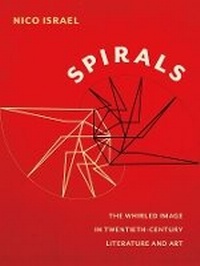
Spirals
The Whirled Image in Twentieth-Century Literature and Art
Will be published approx. on 12. December 2017
Book
Paperback/Softback
272 pages
978-0-231-15303-4 (ISBN)
Description
In this elegantly written and beautifully illustrated book, Nico Israel reveals how spirals are at the heart of the most significant literature and visual art of the twentieth century. Juxtaposing the work of writers and artists-including W. B. Yeats and Vladimir Tatlin, James Joyce and Marcel Duchamp, and Samuel Beckett and Robert Smithson-he argues that spirals provide a crucial frame for understanding the mutual involvement of modernity, history, and geopolitics, complicating the spatio-temporal logic of literary and artistic genres and of scholarly disciplines. The book takes the spiral not only as its topic but as its method. Drawing on the writings of Walter Benjamin and Alain Badiou, Israel theorizes a way of reading spirals, responding to their dual-directionality as well as their affective power. The sensations associated with spirals--flying, falling, drowning, being smothered-reflect the anxieties of limits tested or breached, and Israel charts these limits as they widen from the local to the global and recoil back.
Chapters mix literary and art history to explore 'pataphysics, Futurism, Vorticism, Dada and Surrealism, "Concentrisme," minimalism, and entropic earth art; a coda considers the work of novelist W. G. Sebald and contemporary artist William Kentridge. In Spirals, Israel offers a refreshingly original approach to the history of modernism and its aftermaths, one that gives modernist studies, comparative literature, and art criticism an important new spin.
Chapters mix literary and art history to explore 'pataphysics, Futurism, Vorticism, Dada and Surrealism, "Concentrisme," minimalism, and entropic earth art; a coda considers the work of novelist W. G. Sebald and contemporary artist William Kentridge. In Spirals, Israel offers a refreshingly original approach to the history of modernism and its aftermaths, one that gives modernist studies, comparative literature, and art criticism an important new spin.
Reviews / Votes
Nico Israel's superb Spirals revisits a history of modernity whose most secret desires and powerful realizations are captured by the dialectical image of the spiral. Not just echoes of Baroque forms, modernist spirals fascinate with endless lines and infinite dynamism. From Tatlin's Constructivism to Yeats's gyres, from Duchamp's Rotoreliefs to Smithson's Spiral Jetty, from Ubu's helical paunch to Kentridge's whirling cartoons, we rediscover works that renew our understanding of the world. -- Jean-Michel Rabate, Professor of English and Comparative Literature at the University of Pennsyvlania Nico Israel's brilliant Spirals skyrockets across the extreme twentieth century to land with utmost illumination in our own. In tensile prose as elegant as it is urgent, as sinuous as it is conceptually agile, and with a dazzling command of the multiple languages, disciplines, and global remit of modernity, Israel reveals how embedded the spiral is in the tissue of modern thought and ethics, and how important it is as a mode of reading the world. Breaking through the silo of our understanding, the vibrant matter Israel sets whirling in this crucial book is nothing less than a world future, a spiraling ring of agency that encircles and enacts a commons. -- Jennifer Wicke, University of Virginia As it transversely curves from one plane of inquiry to another, this book brilliantly enacts its central insight and mystery: the path of artistic inquiry offered, and accepted, by the spiral. Nico Israel is a wonderful stylist of perception, and this is a joyful and profound work. -- Joseph O'Neill, Bard College, author of Netherland Elegantly written, theoretically sophisticated... Israel's ground-breaking work... may have scholars in Modernist Studies, Comparative Literature, and Visual Culture seeing spirals everywhere. -- Adrienne Janus Modern Language Review Stunningly ambitious... Israel's book opens up a number of new avenues for investigation. -- Roger Rothman Modernism/modernityMore details
Series
Language
English
Place of publication
New York
United States
Target group
Professional and scholarly
Product notice
Paperback (trade)
Illustrations
<B>60 b&w illus. and 18 color illus.</B>
Dimensions
Height: 203 mm
Width: 152 mm
ISBN-13
978-0-231-15303-4 (9780231153034)
Copyright in bibliographic data and cover images is held by Nielsen Book Services Limited or by the publishers or by their respective licensors: all rights reserved.
Schweitzer Classification
Other editions
Additional editions
Book
02/2015
Columbia University Press
€55.79
Shipment within 10-20 days
Person
Nico Israel is an associate professor of English at the City University of New York Graduate Center and Hunter College. He is the author of Outlandish: Writing Between Exile and Diaspora and has published numerous academic essays on twentieth-century literature and critical theory. He has also published widely on modern and contemporary visual art in Artforum, art exhibition catalogs, and other publications.
Content
List of Illustrations
Introduction: On Spirals
1. Definitions: A Brief History of Spirals (and a Way of Reading Spirally)
2. Entering the Whirlpool: 'Pataphysics, Futurism, Vorticism
3. Twinned Towers: Yeats, Tatlin, and the Unfashionable Performance of Internationalism
4. L'Habite en Spirale: Duchamp, Joyce, and the Ineluctable Visibility of Entropy
Plates
5. At the End of the Jetty: Beckett . . . Smithson. Recoil . . Return
In Conclusion: The Spiral and the Grid
Notes
Acknowledgments
Index
Introduction: On Spirals
1. Definitions: A Brief History of Spirals (and a Way of Reading Spirally)
2. Entering the Whirlpool: 'Pataphysics, Futurism, Vorticism
3. Twinned Towers: Yeats, Tatlin, and the Unfashionable Performance of Internationalism
4. L'Habite en Spirale: Duchamp, Joyce, and the Ineluctable Visibility of Entropy
Plates
5. At the End of the Jetty: Beckett . . . Smithson. Recoil . . Return
In Conclusion: The Spiral and the Grid
Notes
Acknowledgments
Index