

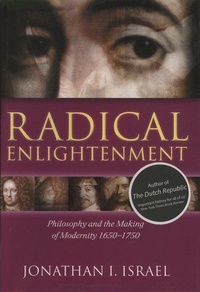
Radical Enlightenment
Philosophy and the Making of Modernity 1650-1750
Published on 18. July 2002
Book
Paperback/Softback
866 pages
978-0-19-925456-9 (ISBN)
Description
Arguably the most decisive shift in the history of ideas in modern times was the complete demolition during the late seventeenth and eighteenth centuries - in the wake of the Scientific Revolution - of traditional structures of authority, scientific thought, and belief, by the new philosophy and the philosophies, culminating in Voltaire, Diderot, and Rousseau. In this revolutionary process which effectively overthrew all justification for monarchy, aristocracy, slavery, and ecclesiastical authority, as well as man's asendancy over woman and theology's domination over education and study, substituting the modern principles of equality, democracy, and universality, the Radical Enlightenment played a crucially important part. Despite the present-day interest in the revolutions of the late eighteenth century, the origins and rise of the Radical Enlightenment have been astonishingly little studied, doubtless largely because if its very wide international sweep and the obvious difficulties of fitting it into the restrictive conventions of 'national history' which until recently tended to dominate all historiography. The greatest obstacle to the Radical Enlightenment finding its proper place in modern historical writing is simply that it was not French, British, German, Italian, Jewish or Dutch, but all of these at the same time. In this novel interpretation of the Radical Enlightenment down to La Mettrie and Diderot, two of its key exponents, particular stress is placed on the pivotal role of Spinoza and the widespread underground international philosophical movement known before 1750 as Spinozism.
Reviews / Votes
The tributes which Israel has received for Radical Enlightenment are thoroughly merited; this book will become a modern classic upon the subject. * David J. Sturdy, Cultural and Social History 2004-2006 * Deserves to be widely read because it is an example of ground-breaking vastly well-informed and thoroughly new history * David Horspool, The Guardian * The scholarship is breathtaking. Israel has read everything, absorbed every nuance, followed up every byway ... Five years from now, our views of the Enlightenment will have been enormously influenced by Israel. * Peter Watson, New Statesman * There is much to praise in Israel's majestic account of the Enlightenment and his detective work in placing Spinoza at the heart of it. * A.C. Grayling, FT Weekend * Magnificent and magisterial, Radical Enlightenment will undoubtedly be one of truly great historical works of the decade. * John Adamson, Sunday Telegraph * We have gained a much more detailed and fine-grained view of the sheer diversity and intellectual creativity not just amongst those who may have been influenced by Spinoza, but also amongst their critics, and those who may be deemed part of either the moderate Enlightenment or even a Counter-Enlightenment. * Professor Thomas Munck, Reviews in History *More details
Language
English
Place of publication
Oxford
United Kingdom
Target group
Professional and scholarly
Illustrations
16pp halftone plates and 1 map
Dimensions
Height: 233 mm
Width: 158 mm
Thickness: 58 mm
Weight
1279 gr
ISBN-13
978-0-19-925456-9 (9780199254569)
Copyright in bibliographic data and cover images is held by Nielsen Book Services Limited or by the publishers or by their respective licensors: all rights reserved.
Schweitzer Classification
Other editions
Additional editions
Book
02/2001
Oxford University Press
€194.99
Shipment within 15-20 days
Person
Jonathan Israel is a professor in the School of Historical Studies, Institute for Advanced Study, Princeton.
Content
I. THE 'RADICAL ENLIGHTENMENT'; II. THE RISE OF PHILOSOPHICAL RADICALISM; III. EUROPE AND THE 'NEW' INTELLECTUAL CONTROVERSIES 1680-1720; IV. THE INTELLECTUAL COUNTER-OFFENSIVE; V. THE CLANDESTINE PROGRESS OF THE RADICAL ENLIGHTENMENT 1680-1750