

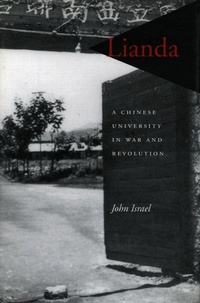
Lianda
A Chinese University in War and Revolution
Published on 1. January 1999
Book
Hardback
480 pages
978-0-8047-2929-1 (ISBN)
Description
In the summer of 1937, Japanese troops occupied the campuses of Beijing's two leading universities, Beida and Qinghua, and reduced Nankai, in Tianjin, to rubble. These were China's leading institutions of higher learning, run by men educated in the West and committed to modern liberal education. The three universities first moved to Changsha, 900 miles southwest of Beijing, where they joined forces. But with the fall of Nanjing in mid-December, many students left to fight the Japanese, who soon began bombing Changsha.
In February 1938, the 800 remaining students and faculty made the thousand-mile trek to Kunming, in China's remote, mountainous southwest, where they formed the National Southwest Associated University (Lianda). In makeshift quarters, subject to sporadic bombing by the Japanese and shortages of food, books, and clothing, students and professors did their best to conduct a modern university. In the next eight years, many of China's most prominent intellectuals taught or studied at Lianda. This book is the story of their lives and work under extraordinary conditions.
Lianda's wartime saga crystallized the experience of a generation of Chinese intellectuals, beginning with epic journeys, followed by years of privation and endurance, and concluding with politicization, polarization, and radicalization, as China moved from a war of resistance against a foreign foe to a civil war pitting brother against brother. The Lianda community, which had entered the war fiercely loyal to the government of Chiang Kai-shek, emerged in 1946 as a bastion of criticism of China's ruling Guomindang party. Within three years, the majority of the Lianda community, now returned to its north China campuses in Beijing and Tianjin, was prepared to accept Communist rule.
In addition to struggling for physical survival, Lianda's faculty and students spent the war years striving to uphold a model of higher education in which modern universities, based in large part on the American model, sought to preserve liberal education, political autonomy, and academic freedom. Successful in the face of wartime privations, enemy air raids, and Guomindang pressure, Lianda's constituent universities eventually succumbed to Communist control. By 1952, the Lianda ideal had been replaced with a politicized and technocratic model borrowed from the Soviet Union.
In February 1938, the 800 remaining students and faculty made the thousand-mile trek to Kunming, in China's remote, mountainous southwest, where they formed the National Southwest Associated University (Lianda). In makeshift quarters, subject to sporadic bombing by the Japanese and shortages of food, books, and clothing, students and professors did their best to conduct a modern university. In the next eight years, many of China's most prominent intellectuals taught or studied at Lianda. This book is the story of their lives and work under extraordinary conditions.
Lianda's wartime saga crystallized the experience of a generation of Chinese intellectuals, beginning with epic journeys, followed by years of privation and endurance, and concluding with politicization, polarization, and radicalization, as China moved from a war of resistance against a foreign foe to a civil war pitting brother against brother. The Lianda community, which had entered the war fiercely loyal to the government of Chiang Kai-shek, emerged in 1946 as a bastion of criticism of China's ruling Guomindang party. Within three years, the majority of the Lianda community, now returned to its north China campuses in Beijing and Tianjin, was prepared to accept Communist rule.
In addition to struggling for physical survival, Lianda's faculty and students spent the war years striving to uphold a model of higher education in which modern universities, based in large part on the American model, sought to preserve liberal education, political autonomy, and academic freedom. Successful in the face of wartime privations, enemy air raids, and Guomindang pressure, Lianda's constituent universities eventually succumbed to Communist control. By 1952, the Lianda ideal had been replaced with a politicized and technocratic model borrowed from the Soviet Union.
More details
Edition
New edition
Language
English
Place of publication
Palo Alto
United States
Target group
College/higher education
Professional and scholarly
Edition type
New edition
Product notice
Cloth
Illustrations
36 illustrations, 4 maps
Dimensions
Height: 234 mm
Width: 158 mm
Thickness: 33 mm
Weight
844 gr
ISBN-13
978-0-8047-2929-1 (9780804729291)
Copyright in bibliographic data and cover images is held by Nielsen Book Services Limited or by the publishers or by their respective licensors: all rights reserved.
Schweitzer Classification
Person
John Israel is Professor of History at the University of Virginia. He is the author of Student Nationalism in China, 1927-1937 (Stanford, 1966).
Content
Preface Introduction Part I. Patriot's Pilgrimage: 1. From Beiping to Changsha 2. Lianda's long march 3. The charms of Mengzi Part II. Interactions: 4. Lianda and the Yunnanese 5. Chongqing and Kunming 6. The Lianda ethos Part III. A Pride of Professors: 7. The College of Arts 8. The College of Social Sciences 9. War and scholarship 10. The College of Natural Sciences 11. The College of Engineering 12. The teachers' college 13. Years of hope: 1938-1941 14. Years of endurance 1941-1943 15. Years of trial: 1943-1945 16. Fulfilling the mandate: 1945-1946 Conclusion Appendices Notes Bibliography Index.