

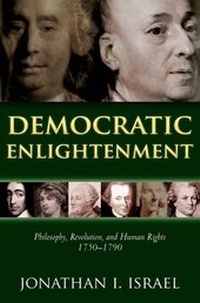
Democratic Enlightenment
Philosophy, Revolution, and Human Rights 1750-1790
Published on 11. August 2011
Book
Hardback
1088 pages
978-0-19-954820-0 (ISBN)
Description
The Enlightenment shaped modernity. Western values of representative democracy and basic human rights, gender and racial equality, individual liberty, and freedom of expression and the press, form an interlocking system that derives directly from the Enlightenment's philosophical revolution. This fact is uncontested - yet remarkably few historians or philosophers have attempted to trace the process of ideas from the political and social turmoil of the late eighteenth century to the present day. This is precisely what Jonathan Israel now does. He demonstrates that the Enlightenment was an essentially revolutionary process, driven by philosophical debate. From 1789, its impetus came from a small group of philosophe-revolutionnaires, men such as Mirabeau, Sieyes, Condorcet, Volney, Roederer, and Brissot.
Not aligned to any of the social groups who took the lead in the French National assembly, the Paris commune, or the editing of the Parisian revolutionary journals, they nonetheless forged 'la philosophie moderne' -- in effect Radical Enlightenment ideas -- into a world-transforming ideology that had a lasting impact in Latin America and eastern Europe as well as France, Italy, Germany, and the Low Countries. Whilst all French revolutionary journals clearly stated that la philosophie moderne was the main cause of the French Revolution, the main stream of historical thought has failed to grasp what this implies. Israel sets the record straight, demonstrating the true nature of the engine that drove the Revolution, and the intimate links between the radical wing of the Enlightenment and the anti-Robespierriste 'Revolution of reason'.
Not aligned to any of the social groups who took the lead in the French National assembly, the Paris commune, or the editing of the Parisian revolutionary journals, they nonetheless forged 'la philosophie moderne' -- in effect Radical Enlightenment ideas -- into a world-transforming ideology that had a lasting impact in Latin America and eastern Europe as well as France, Italy, Germany, and the Low Countries. Whilst all French revolutionary journals clearly stated that la philosophie moderne was the main cause of the French Revolution, the main stream of historical thought has failed to grasp what this implies. Israel sets the record straight, demonstrating the true nature of the engine that drove the Revolution, and the intimate links between the radical wing of the Enlightenment and the anti-Robespierriste 'Revolution of reason'.
Reviews / Votes
Israel has turned up evidence of the Radical Enlightenment's influence in surprising places, and that labor alone should ensure that this book finds a place on every specialist's shelf. New York Times Book Review a brave and ambitious historian...Israel has found a way of dramatising the debates and attitudes which eventually lay the foundations for something we can call modernity. BBC History Magazine Taken either singly or as part of a trilogy, Democratic Enlightenment is a remarkable achievement, and deservedly places Israel among the finest intellectual historians of our day. Times Literary SupplementMore details
Language
English
Place of publication
Oxford
United Kingdom
Target group
College/higher education
Professional and scholarly
Illustrations
16 page plate section
Dimensions
Height: 234 mm
Width: 156 mm
Thickness: 61 mm
Weight
1589 gr
ISBN-13
978-0-19-954820-0 (9780199548200)
Copyright in bibliographic data and cover images is held by Nielsen Book Services Limited or by the publishers or by their respective licensors: all rights reserved.
Schweitzer Classification
Other editions
Additional editions
Book
01/2013
Oxford University Press
€34.00
Shipment within 15-20 days
Person
Jonathan Israel, Professor of Modern History, Institute for Advanced Study, Princeton
Jonathan Israel taught successively at the universities of Newcastle, Hull, and at University College London from 1970 to 2000. Since 2001 he has been Professor of Modern history at the Institute for Advance Study, Princeton. He is a Fellow of the British Academy and corresponding fellow of the Royal Netherlands Academy of Sciences. His previous books include The Dutch Republic: Its Rise, Greatness and Fall, 1477-1806 (OUP, 1995); The Radical Enlightenment (OUP, 2001) and Enlightenment Contested (OUP, 2006).
Jonathan Israel taught successively at the universities of Newcastle, Hull, and at University College London from 1970 to 2000. Since 2001 he has been Professor of Modern history at the Institute for Advance Study, Princeton. He is a Fellow of the British Academy and corresponding fellow of the Royal Netherlands Academy of Sciences. His previous books include The Dutch Republic: Its Rise, Greatness and Fall, 1477-1806 (OUP, 1995); The Radical Enlightenment (OUP, 2001) and Enlightenment Contested (OUP, 2006).
Content
1. Introduction; PART 1: THE RADICAL CHALLENGE; 2. Nature and Providence: Earthquakes and the Human Condition; 3. The Encyclopedie Suppressed (1752-60); 4. Rousseau against the Philosophes; 5. Voltaire, Enlightenment and the European Courts; 6. Anti-Philosophes; 7. Central Europe: Aufklarung divided; PART II: RATIONALIZING THE ANCIEN REGIME; 8. Hume, Scepticism, and Moderation; 9. Scottish Enlightenment and Man's Progress; 10. Enlightened Despotism; 11. Aufklarung and the Fracturing of German Protestant Culture; 12. Catholic Enlightenment: the Papacy's Retreat; 13. Society and the Rise of the Italian revolutionary Enlightenment; 14. Spain and the Challenge of Reform; PART III: EUROPE AND THE RE-MAKING OF THE WORLD; 15. The Histoire Philosophique, or Colonialism Overturned; 16. The American Revolution; 17. Europe and the Amerindians; 18. Philosophy and Revolt in Ibero-America (1765-92); 19. Commercial Despotism: Dutch Colonialism in Asia; 20. China, Japan, and the West; 21. India and the Two Enlightenments; 22. Russia's Greeks, Poles, and Serfs; PART IV: SPINOZA CONTROVERSIES IN THE LATER ENLIGHTENMENT; 23. Rousseau, Spinoza and the 'General Will'; 24. Radical Break-Through; 25. The Pantheismusstreit (1780-87); 26. Kant and the Radical Challenge; 27. Goethe, Schiller and the new "Dutch Revolt against Spain"; PART V: REVOLUTION; 28. 1788-9: the "General Revolution" begins; 29. The Diffusion; 30. 'Philosophy' as the Maker of Revolutions; 31. Aufklarung and the Secret Societies (1776-92); 32. Small State Revolution in the 1780s; 33. The Dutch Democratic Revolution of the 1780s; 34. The French Revolution: from 'Philosophy' to Basic Human Rights (1788-90); 35. Epilogue: 1789 as an Intellectual Revolution