

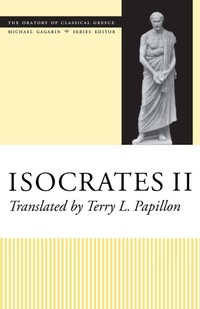
Isocrates II
University of Texas Press
Published on 1. July 2004
Book
Paperback/Softback
332 pages
978-0-292-70246-2 (ISBN)
Description
This is the seventh volume in the Oratory of Classical Greece. This series presents all of the surviving speeches from the late fifth and fourth centuries BC in new translations prepared by classical scholars who are at the forefront of the discipline. These translations are especially designed for the needs and interests of today's undergraduates, Greekless scholars in other disciplines, and the general public.
Classical oratory is an invaluable resource for the study of ancient Greek life and culture. The speeches offer evidence on Greek moral views, social and economic conditions, political and social ideology, law and legal procedure, and other aspects of Athenian culture that have been largely ignored: women and family life, slavery, and religion, to name just a few. The Athenian rhetorician Isocrates (436-338) was one of the leading intellectual figures of the fourth century. This volume contains his orations 4, 5, 6, 8, 12, and 14, as well as all of his letters. These are Isocrates' political works. Three of the discourses-Panathenaicus, On the Peace, and the most famous, Panegyricus-focus on Athens, Isocrates' home. Archidamus is written in the voice of the Spartan prince to his assembly, and Plataicus is in the voice of a citizen of Plataea asking Athens for aid, while in To Philip, Isocrates himself calls on Philip of Macedon to lead a unified Greece against Persia.
Classical oratory is an invaluable resource for the study of ancient Greek life and culture. The speeches offer evidence on Greek moral views, social and economic conditions, political and social ideology, law and legal procedure, and other aspects of Athenian culture that have been largely ignored: women and family life, slavery, and religion, to name just a few. The Athenian rhetorician Isocrates (436-338) was one of the leading intellectual figures of the fourth century. This volume contains his orations 4, 5, 6, 8, 12, and 14, as well as all of his letters. These are Isocrates' political works. Three of the discourses-Panathenaicus, On the Peace, and the most famous, Panegyricus-focus on Athens, Isocrates' home. Archidamus is written in the voice of the Spartan prince to his assembly, and Plataicus is in the voice of a citizen of Plataea asking Athens for aid, while in To Philip, Isocrates himself calls on Philip of Macedon to lead a unified Greece against Persia.
Reviews / Votes
[Papillon] has produced not only a lucid, accurate and fluent translation but also a valuable tool and an easy-to-use introduction to the works of Isocrates. (Bryn Mawr Classical Review)More details
Series
Language
English
Place of publication
Austin, TX
United States
Target group
Professional and scholarly
Product notice
Paperback (trade)
Dimensions
Height: 216 mm
Width: 140 mm
Thickness: 20 mm
Weight
472 gr
ISBN-13
978-0-292-70246-2 (9780292702462)
Copyright in bibliographic data and cover images is held by Nielsen Book Services Limited or by the publishers or by their respective licensors: all rights reserved.
Schweitzer Classification
Person
Terry L. Papillon is Associate Professor in the Department of Foreign Languages and Literatures at Virginia Tech.
Content
The Works of Isocrates
Acknowledgments
Series Introduction (Michael Gagarin)
Oratory in Classical Athens
The Orators
The Works of the Orators
Government and Law in Classical Athens
The Translation of Greek Oratory
Abbreviations
Note on Currency
Bibliography of Works Cited
Introduction to Isocrates (Michael Gagarin, David Mirhady, Terry L. Papillon, and Yun Lee Too)
Life and Career
Philosophia, Education, and Politics
Style
A Note on Terminology
Text
The Works of Isocrates
Introduction to Isocrates, Volume II (Terry L. Papillon)
The Translation
Speeches
4. Panegyricus
5. To Philip
6. Archidamus
8. On the Peace
12. Panathenaicus
14. Plataicus
Letters
General Introduction to the Letters
1. To Dionysius
2. To Philip 1
3. To Philip 2
4. To Antipater
5. To Alexander
6. To the Children of Jason
7. To Timotheus
8. To the Rulers of the Mytileneans
9. To Archidamus
Bibliography
Index
Acknowledgments
Series Introduction (Michael Gagarin)
Oratory in Classical Athens
The Orators
The Works of the Orators
Government and Law in Classical Athens
The Translation of Greek Oratory
Abbreviations
Note on Currency
Bibliography of Works Cited
Introduction to Isocrates (Michael Gagarin, David Mirhady, Terry L. Papillon, and Yun Lee Too)
Life and Career
Philosophia, Education, and Politics
Style
A Note on Terminology
Text
The Works of Isocrates
Introduction to Isocrates, Volume II (Terry L. Papillon)
The Translation
Speeches
4. Panegyricus
5. To Philip
6. Archidamus
8. On the Peace
12. Panathenaicus
14. Plataicus
Letters
General Introduction to the Letters
1. To Dionysius
2. To Philip 1
3. To Philip 2
4. To Antipater
5. To Alexander
6. To the Children of Jason
7. To Timotheus
8. To the Rulers of the Mytileneans
9. To Archidamus
Bibliography
Index