

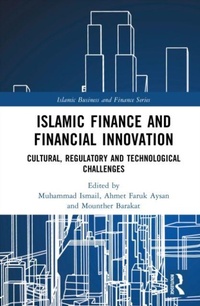
Islamic Finance and Financial Innovation
Cultural, Regulatory and Technological Challenges
1st Edition
Will be published approx. on 11. September 2026
Book
Hardback
268 pages
978-1-041-00486-8 (ISBN)
Description
This book explores the dynamic evolution of Islamic finance in the face of global financial transformation. It addresses critical challenges, from unemployment and economic justice to cutting-edge innovations such as blockchain, cryptocurrencies, and Central Bank Digital Currencies. It delves into practical applications, including microfinance, Shariah governance technologies, and the Sustainable Development Goals. The book comprises three key sections. The first explores theoretical foundations and economic perspectives; it begins by reviewing mainstream economic theories and introducing Islamic economic principles. It explores alternative frameworks through the lenses of Islamic and heterodox economic perspectives, offering insights into how these viewpoints can contribute to a more equitable economic landscape, and underscores the rich potential for future exploration, emphasizing the transformative impact of integrating diverse economic viewpoints into policy discourse. The second part examines Islamic finance innovations and technological advancements. It investigates the use of technology-based solutions in the Islamic finance industry for regulatory and supervisory purposes. It discusses the profound implications of these technological advancements on financial systems, with a particular focus on stability, security, and regulation. Notably, these transformative changes have posed distinctive challenges in Muslim-majority countries, largely due to the absence of Shariah-compliant financial services. The third and final section illustrates how the theoretical concepts and innovations can be applied in real-world settings. The book provides insights applicable to various regions, particularly in Muslim-majority countries, and effectively focuses on both the contemporary challenges faced by Islamic finance and the innovations that are shaping its future. By bridging traditional principles with modern advancements, this book offers valuable insights for academics, practitioners, and policymakers navigating the rapidly changing landscape of Islamic finance.
Muhammad Ismail is Assistant Professor and Head, Department of Business and Management, University of Veterinary and Animal Sciences (UVAS), Swat, Pakistan.
Ahmet Faruk Aysan is Professor of Islamic Economy and Finance at Hamad Bin Khalifa University, Qatar.
Mounther Barakat is Professor of Finance at New York University Abu Dhabi, United Arab Emirates.
Muhammad Ismail is Assistant Professor and Head, Department of Business and Management, University of Veterinary and Animal Sciences (UVAS), Swat, Pakistan.
Ahmet Faruk Aysan is Professor of Islamic Economy and Finance at Hamad Bin Khalifa University, Qatar.
Mounther Barakat is Professor of Finance at New York University Abu Dhabi, United Arab Emirates.
More details
Series
Language
English
Place of publication
London
United Kingdom
Publishing group
Taylor & Francis Ltd
Target group
College/higher education
Postgraduate
Illustrations
28 s/w Tabellen, 15 s/w Zeichnungen, 15 s/w Abbildungen
28 Tables, black and white; 15 Line drawings, black and white; 15 Illustrations, black and white
Dimensions
Height: 234 mm
Width: 156 mm
Weight
453 gr
ISBN-13
978-1-041-00486-8 (9781041004868)
Copyright in bibliographic data and cover images is held by Nielsen Book Services Limited or by the publishers or by their respective licensors: all rights reserved.
Schweitzer Classification
Other editions
Additional editions
Muhammad Ismail | Ahmet Faruk Aysan | Mounther Barakat
Islamic Finance and Financial Innovation
Cultural, Regulatory and Technological Challenges
E-Book
approx. 09/2026
1st Edition
Routledge
€60.49
Not yet available
Muhammad Ismail | Ahmet Faruk Aysan | Mounther Barakat
Islamic Finance and Financial Innovation
Cultural, Regulatory and Technological Challenges
E-Book
approx. 09/2026
1st Edition
Routledge
€60.49
Not yet available
Persons
Muhammad Ismail is Assistant Professor and Head, Department of Business and Management, University of Veterinary and Animal Sciences (UVAS), Swat, Pakistan.
Ahmet Faruk Aysan is Professor of Islamic Economy and Finance at Hamad Bin Khalifa University, Qatar.
Mounther Barakat is Professor of Finance at New York University Abu Dhabi, United Arab Emirates.
Ahmet Faruk Aysan is Professor of Islamic Economy and Finance at Hamad Bin Khalifa University, Qatar.
Mounther Barakat is Professor of Finance at New York University Abu Dhabi, United Arab Emirates.
Content
PART 1. Theoretical Foundations and Economic Perspectives 1. The Critique of Unemployment: Common Criticisms of Islamic and Heterodox Economics against Mainstream Economics 2. Redistribution and Economic Justice: An Exploration of Islamic and Heterodox Perspectives in Contrast to Mainstream Economics 3. The Concept of Debt in Islam 4. Beyond Borders: United Nation's Discovery of Infaq in Islamic Social Finance Paradigm PART 2. Islamic Finance Innovations and Technological Advancements 5. RegTech and SupTech for Shariah Governance: A Case Study of IRSHAD and ORION 6. Digital Transformation and Central Bank Digital Currencies Innovations for Payment Settlements: An Overview of Pilot Projects and the Way Forward for the Muslim-Majority Countries 7. Cryptocurrencies', Fintech, DeFi-Blockchain, Central Bank Digital Currencies, and Structural Transformation in the Financial System in the United States, China, Japan, and European Countries, a Lesson for the Muslim World 8. Application of Islamic Commercial Contracts in Blockchain-Based Smart Contract PART 3. Practical Applications and Case Studies 9. The Impact of Market Risk on Financial Performance of Banks in Tuerkiye: A Comparative Panel Data Analysis 10. Rethinking Pseudo-Islamic Products: The Case of Running Musharakah 11. Proposing an Islamic Microfinance Model for Financial Inclusion in North Macedonia 12. Micro-Takaful: Enhancing Financial Inclusion and Flexibility 13. Digital Empowerment of Women Entrepreneurs in a Post-COVID-19 World: Examining the Role of Islamic Microfinance Institutions in Achieving Sustainable Development Goals 14. Sustainable Responsible Investment Sukuk for Sustainable Development Goals: Analyzing the Regulatory Framework of Sustainable Responsible Investment Sukuk in Turkey