

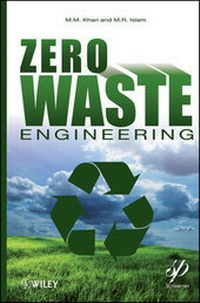
Zero-Waste Engineering
Published on 28. February 2012
Book
Hardback
488 pages
978-0-470-62604-7 (ISBN)
Description
The idea of "Zero-Waste Engineering" has been developing over years, in many areas of engineering, such as energy production (renewable energy), construction (green buildings), and many others. This book is a huge step in the continued march toward truly sustainable engineering practices. This book presents methods in various areas for sustainability purposes, such as new mathematical models, recyclable material selection, and renewable energy. Engineers and scientists of all industries will benefit from these principles of zero-waste engineering and how it applies to construction, energy production, and many other areas of engineering.
More details
Series
Edition
1. Auflage
Language
English
Place of publication
Chichester
United Kingdom
Publishing group
John Wiley and Sons Ltd
Target group
Professional and scholarly
Dimensions
Height: 24 cm
Width: 15.6 cm
Thickness: 3 cm
Weight
774 gr
ISBN-13
978-0-470-62604-7 (9780470626047)
Schweitzer Classification
Other editions
New editions
Book
12/2016
2nd Edition
Wiley-Scrivener
€257.50
Article not available at the moment
Additional editions
M. M. Khan | M. R. Islam
Zero Waste Engineering
E-Book
02/2012
Wiley-Scrivener
€183.99
Available for download
Person
M. M. Khan was recently a lecturer in chemical engineering at the Bangladesh University of Engineering and Technology, before moving to Canada. He has written a dozen papers and coauthored a book on zero waste engineering and sustainable technology.
M. R. Islam is Professor of Petroleum Engineering at the Civil and Resource Engineering Department of Dalhousie University, Canada. He has over 700 publications to his credit, including 6 books. He is on the editorial boards of several scholarly journals. In addition to his teaching duties, he is also director of Emertec Research and Development Ltd. and has been on the boards of a number of companies in North America and overseas.
M. R. Islam is Professor of Petroleum Engineering at the Civil and Resource Engineering Department of Dalhousie University, Canada. He has over 700 publications to his credit, including 6 books. He is on the editorial boards of several scholarly journals. In addition to his teaching duties, he is also director of Emertec Research and Development Ltd. and has been on the boards of a number of companies in North America and overseas.
Content
Preface
Chapter 1. Introduction
Chapter 2. A Delinearized History of Time and Its Impact on Scientific Cognition
Chapter 3. Towards Modeling of Zero Waste Engineering Processes with Inherent Sustainability
Chapter 4. The Formulation of a Comprehensive Mass and Energy Balance Equation
Chapter 5. Colony Collapse Disorder (CCD): The Case for a Science of Intangibles and Zero Waste Engineering
Chapter 6. Zero Waste Lifestyle with Inherently Sustainable Technologies
Chapter 7. A Novel Sustainable Combined Heating/Cooling/Refrigeration System
Chapter 8. A Zero Waste Design for Direct Usage of Solar Energy
Chapter 9. Investigation of Vegetable Oil as the Thermal Fluid in a Parabolic Solar Collector
Chapter 10. The Potential of Biogas in the Zero Waste Mode in the Cold-Climate Environment
Chapter 11. The New Synthesis: Application of all Natural Material for Engineering Applications
Chapter 12. Sustainability of Nuclear Energy
Chapter 13. High Temperature Reactors for Hydrogen Production
Chapter 14. Economic Assessment of Zero Waste Engineering
Chapter 15. Conclusions and Recommendations
References
Chapter 1. Introduction
Chapter 2. A Delinearized History of Time and Its Impact on Scientific Cognition
Chapter 3. Towards Modeling of Zero Waste Engineering Processes with Inherent Sustainability
Chapter 4. The Formulation of a Comprehensive Mass and Energy Balance Equation
Chapter 5. Colony Collapse Disorder (CCD): The Case for a Science of Intangibles and Zero Waste Engineering
Chapter 6. Zero Waste Lifestyle with Inherently Sustainable Technologies
Chapter 7. A Novel Sustainable Combined Heating/Cooling/Refrigeration System
Chapter 8. A Zero Waste Design for Direct Usage of Solar Energy
Chapter 9. Investigation of Vegetable Oil as the Thermal Fluid in a Parabolic Solar Collector
Chapter 10. The Potential of Biogas in the Zero Waste Mode in the Cold-Climate Environment
Chapter 11. The New Synthesis: Application of all Natural Material for Engineering Applications
Chapter 12. Sustainability of Nuclear Energy
Chapter 13. High Temperature Reactors for Hydrogen Production
Chapter 14. Economic Assessment of Zero Waste Engineering
Chapter 15. Conclusions and Recommendations
References