

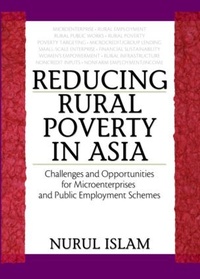
Reducing Rural Poverty in Asia
Challenges and Opportunities for Microenterprises and Public Employment Schemes
1st Edition
Published on 6. March 2006
Book
Hardback
404 pages
978-1-56022-300-9 (ISBN)
Description
Fight rural poverty through the creation of significant policy mechanisms, microenterprises, and employment programs
The majority of the world's poor live in Asia, and most of these live in rural areas. These areas are also infamous for the food insecurity and malnutrition associated with poverty. Making even a modest dent in rural Asian poverty has the potential to realize large gains in global human development.
Reducing Rural Poverty in Asia provides evidence-based guidelines for policymakers in developing countries, for researchers focusing on development problems, and for the international development assistance community in the continuing search for ways to effectively reduce poverty in the developing world. Detailed examinations are clearly presented on the efforts for poverty alleviation through microenterprise development and rural public employment programs that focus on public works and household/small-scale industries. Asia-based case studies of various microenterprises and rural public employment projects reveal important policy mechanisms and the effectiveness of each poverty reduction measure. Tables, figures, and relevant glossaries make unfamiliar terms and difficult information easy to understand.
Part I of Reducing Rural Poverty in Asia:
presents a framework for the analysis of rural microenterprises with a focus on microfinance
highlights the main findings of country-specific case studies
suggests guidelines for an appropriate strategy for the provision of microfinance to reach the poor, alleviate poverty, and create financial stability
analyzes the issues relating to public wage employment schemes and the principal findings of the case studies
draws policy conclusions for the formulation of effective public employment schemes
Part II of Reducing Rural Poverty in Asia presents case studies conducted in India, Bangladesh, and the Philippinesalong with revealing conclusions. These studies include:
the SIDBI Foundation for Micro Credit in Indiaincluding the continuing problem of the exclusion of the poorest
the Maharashtra Rural Credit Project in India and concerns about the sustainability of the financial infrastructure
the Small Enterprises Development Project in Bangladesh and the high rate of return on capital from financed enterprises
the successes of the Grameen Uddog, Agrani Bank Micro-Enterprise Development Unit (MEDU), and Kishoreganj Community-Based Projects in Bangladesh
the income-stabilizing role of the Employment Guarantee Scheme in Maharashtra, India
guidelines for the Public Works Employment policy and implementation in the Philippines
Reducing Rural Poverty in Asia is a concise overview of the crucial research undertaken at the request of the International Fund for Agricultural Development (IFAD) and makes this a vital resource for researchers, educators, students, policymakers, and development experts working towards the goal of poverty reduction.
The majority of the world's poor live in Asia, and most of these live in rural areas. These areas are also infamous for the food insecurity and malnutrition associated with poverty. Making even a modest dent in rural Asian poverty has the potential to realize large gains in global human development.
Reducing Rural Poverty in Asia provides evidence-based guidelines for policymakers in developing countries, for researchers focusing on development problems, and for the international development assistance community in the continuing search for ways to effectively reduce poverty in the developing world. Detailed examinations are clearly presented on the efforts for poverty alleviation through microenterprise development and rural public employment programs that focus on public works and household/small-scale industries. Asia-based case studies of various microenterprises and rural public employment projects reveal important policy mechanisms and the effectiveness of each poverty reduction measure. Tables, figures, and relevant glossaries make unfamiliar terms and difficult information easy to understand.
Part I of Reducing Rural Poverty in Asia:
presents a framework for the analysis of rural microenterprises with a focus on microfinance
highlights the main findings of country-specific case studies
suggests guidelines for an appropriate strategy for the provision of microfinance to reach the poor, alleviate poverty, and create financial stability
analyzes the issues relating to public wage employment schemes and the principal findings of the case studies
draws policy conclusions for the formulation of effective public employment schemes
Part II of Reducing Rural Poverty in Asia presents case studies conducted in India, Bangladesh, and the Philippinesalong with revealing conclusions. These studies include:
the SIDBI Foundation for Micro Credit in Indiaincluding the continuing problem of the exclusion of the poorest
the Maharashtra Rural Credit Project in India and concerns about the sustainability of the financial infrastructure
the Small Enterprises Development Project in Bangladesh and the high rate of return on capital from financed enterprises
the successes of the Grameen Uddog, Agrani Bank Micro-Enterprise Development Unit (MEDU), and Kishoreganj Community-Based Projects in Bangladesh
the income-stabilizing role of the Employment Guarantee Scheme in Maharashtra, India
guidelines for the Public Works Employment policy and implementation in the Philippines
Reducing Rural Poverty in Asia is a concise overview of the crucial research undertaken at the request of the International Fund for Agricultural Development (IFAD) and makes this a vital resource for researchers, educators, students, policymakers, and development experts working towards the goal of poverty reduction.
More details
Language
English
Place of publication
New York
United States
Publishing group
Taylor & Francis Inc
Target group
Professional and scholarly
Academic, Postgraduate, Professional, and Undergraduate
Dimensions
Height: 229 mm
Width: 152 mm
Weight
778 gr
ISBN-13
978-1-56022-300-9 (9781560223009)
Copyright in bibliographic data and cover images is held by Nielsen Book Services Limited or by the publishers or by their respective licensors: all rights reserved.
Schweitzer Classification
Other editions
Additional editions
Nurul Islam
Reducing Rural Poverty in Asia
Challenges and Opportunities for Microenterprises and Public Employment Schemes
E-Book
11/2024
1st Edition
Routledge
€69.99
Available for download
Nurul Islam
Reducing Rural Poverty in Asia
Challenges and Opportunities for Microenterprises and Public Employment Schemes
E-Book
11/2024
1st Edition
Routledge
€69.99
Available for download
Nurul Islam
Reducing Rural Poverty in Asia
Challenges and Opportunities for Microenterprises and Public Employment Schemes
Book
02/2006
1st Edition
Routledge
€85.60
Article not available at the moment
Person
International Food Policy Research Institute (IFPRI), Washin
Content
List of Acronyms,, Foreword (Joachim von Braun),, Preface,, PART I: SYNTHESIS AND MAJOR LESSONS,, Chapter 1. Rural Poverty and the Nonfarm Sector in Rural Asia,, Rural Poverty and the Nonfarm Employment Nexus,, Public Policies for the Nonfarm Sector,, Chapter 2. Rural Nonfarm Microenterprise: Salient Features and Issues,, Introduction,, Microfinance,, Financial Sustainability,, Nonfinancial Inputs,, Chapter 3. Bangladesh Case Studies: Review and Analysis,, Main Features of Microenterprise/Finance Projects,, Review of Performance,, Conclusions,, Chapter 4. Indian Case Studies: Review and Analysis,, Maharashtra Rural Credit Project,, SIDBI Foundation for Micro Credit,, Main Findings,, Conclusions,, Chapter 5. Overview of Country Experiences,, Introduction,, Patterns of Nonfarm Lending,, Institutional Mechanisms for Credit Delivery,, Noncredit Inputs: Skill, Transfer of Technology, and Market Access,, Appendix: Rural Employment Support Foundation ,, Chapter 6. Conclusions: Microfinance for Microenterprise,, Group versus Individual Lending,, Targeting the Poor,, To Reach the Poorest: An Illustration,, Financial Sustainability,, Upscaling and Financing the Missing Middle,, Not by Credit Alone,, Chapter 7. Public Employment Schemes: Case Studies in India, Bangladesh, and the Philippines,, Introduction,, The Food-for-Work Program in Bangladesh,, Jawahar Rozgar Yojana in India,, Maharashtra Employment Guarantee Scheme in India,, Public Employment Program in the Philip