

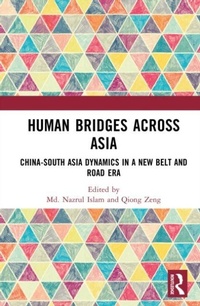
Human Bridges Across Asia
Description
Entering its second decade, the Belt and Road Initiative (BRI) has shifted toward a more people-centered orientation, emphasizing cultural interaction, human connectivity, environmental sustainability, and digital integration. The edited volume examines these dimensions of the BRI through the lens of cross-cultural exchange between China and South Asia.
Adopting the theoretical framework of Culturalization, the editors discuss why cultural, social, and human dimensions are essential for understanding the initiative's long-term impact. Contributors explore a wide range of topics, including community engagement, traditional Chinese medicine and Ayurveda, culinary exchanges, language and literary translation, gender and diaspora connections, religion and social change, as well as education and academic mobility. The highlighted everyday interactions and lived experiences showcase how South Asian cultures are entering China, and vice versa, through various avenues.
The book will appeal to scholars and students interested in China's Belt and Road Initiative and China-South Asia relations.
More details
Other editions
Additional editions

Persons
Md. Nazrul Islam, PhD. is an Associate Professor of Digital Social Science at Beijing Normal-Hong Kong Baptist University, Zhuhai, China. His research interests span traditional medicine, food, and China's Belt and Road Initiative (BRI). Dr. Islam has held visiting positions at prestigious institutions, including the University of Sydney, Australia (2024); the University of British Columbia, Canada (2016); the University of Hong Kong, Hong Kong SAR (2008-2011); and Ateneo de Manila University, the Philippines (2003). He holds a PhD from the University of Hong Kong and an MSc from Heidelberg University, Germany.
Qiong Zeng, PhD. is a Professor and the Head of the Bengali Department at the School of Asian Studies, Beijing Foreign Studies University, China. She also serves as the Director of the Center of South Asia Studies at the same institute. Her research interests include the comparative study of Chinese and Indian literature, as well as Oriental literature and culture.
Content
Introduction, Conceptualization, and Methodology 1: China in South Asia, South Asia in China: Towards a human-centric Belt and Road Initiative Section One: Historical ties and religious crossroads 2: Psychoactive Substance Use and Social Solidarity in the Indo-China Borderlands 3: Gandharan Buddhist Libraries Network: Xuanzang's Journey and Beyond on the Silk Road Section Two: Cultural and educational exchange 4: From Transculturation to Glocalization of the "Belt and Road": A Study on Decoding of Confucian Culture in Shang-Chi 5: Two-Way Culturalization and People-to-People Connectivity: South Asian Students' Academic Mobility and Cultural Practices in Chinese Universities 6: Culturalizing Solidarity in Eastern Literature: A Contemporary History of Chinese-Urdu Literary Translation in Pakistan Section Three: Culturalization along the Culinary Practice to Health 7: From Trade Routes to Taste Routes: South Asian Culinary Presence in China's Belt and Road Era 8: Building an Evidence-Based Ayurveda-TCM Corridor for BRI 2.0 Section Four: Gender mobility, diasporic engagement, and working culture 9: Culturalising the Belt and Road Initiative as a Human-Centric Project: Religion, Gender, and Soft Power in Bangladesh 10: Global Capital Flows and Transnational Company Governance: Chinese-owned Ready-Made Garment Factories in Bangladesh 11: Understanding Historical Legacies and Contemporary Dynamics of the Chinese Diaspora in South Asia within the Belt and Road Initiative