

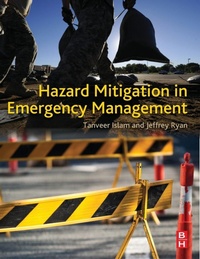
Hazard Mitigation in Emergency Management
Published on 3. September 2015
Book
Hardback
458 pages
978-0-12-420134-7 (ISBN)
Description
Hazard Mitigation in Emergency Management introduces readers to mitigation, one of the four foundational phases of emergency management, and to the hazard mitigation planning process.
Authors Islam and Ryan review the hazard mitigation framework in both private sector and governmental agencies, covering the regulatory and legal frameworks for mitigation, as well as risk assessment processes and strategies, and tools and techniques that can prevent, or lessen, the impact of disasters.
The book specifically addresses hazards posed by human activity, including cyber threats and nuclear accidents, as well as hurricanes, floods, and earthquakes. Readers will learn about the framework for the mitigation process, hazard identification, risk assessment, and the tools and techniques available for mitigation.
Coverage includes both GIS and HAZUS, with tutorials on these technologies, as well as case studies of best practices in the United States and around the world. The text is ideal for students, instructors, and practitioners interested in reducing, or eliminating, the effects of disasters.
Authors Islam and Ryan review the hazard mitigation framework in both private sector and governmental agencies, covering the regulatory and legal frameworks for mitigation, as well as risk assessment processes and strategies, and tools and techniques that can prevent, or lessen, the impact of disasters.
The book specifically addresses hazards posed by human activity, including cyber threats and nuclear accidents, as well as hurricanes, floods, and earthquakes. Readers will learn about the framework for the mitigation process, hazard identification, risk assessment, and the tools and techniques available for mitigation.
Coverage includes both GIS and HAZUS, with tutorials on these technologies, as well as case studies of best practices in the United States and around the world. The text is ideal for students, instructors, and practitioners interested in reducing, or eliminating, the effects of disasters.
More details
Language
English
Place of publication
Woburn
United States
Publishing group
Elsevier - Health Sciences Division
Target group
Professional and scholarly
Product notice
Laminated cover
Dimensions
Height: 235 mm
Width: 191 mm
Thickness: 25 mm
Weight
1001 gr
ISBN-13
978-0-12-420134-7 (9780124201347)
Copyright in bibliographic data and cover images is held by Nielsen Book Services Limited or by the publishers or by their respective licensors: all rights reserved.
Schweitzer Classification
Other editions
Additional editions
Tanveer Islam | Jeffrey Ryan
Hazard Mitigation in Emergency Management
E-Book
08/2015
Butterworth-Heinemann
€71.95
Available for download
Persons
Tanveer Islam is a Professor and Chair of the Department of Emergency Management and Public Administration at Jacksonville State University, where he teaches hazard mitigation, community resilience and GIS courses. He received a PhD in land use planning from Texas Tech University and did postdoctoral research at Texas A&M marine branch in Galveston and at the National Oceanic and Atmospheric Administration's (NOAA) Environmental Cooperative Science Center. He is also a certified floodplain manager. Mr. Ryan is a retired US Army officer and currently a Professor at Jacksonville State University's Department of Emergency Management within the Institute of Emergency Preparedness. The program provide instruction on various aspects of emergency preparedness with a focus on terrorism, Weapons of Mass Destruction, medical aspects of emergency management, public health preparedness, biodefense, and biosecurity. His research interests are biothreat pathogen detection, agro-terrorism and the role of military forces in disaster response and humanitarian assistance.Since 2003, Professor Ryan has also served as Managing Director of Quetzal Consulting, Inc. a private firm specializing in a wide array of consultative services related to biothreat pathogen detection, tropical diseases research, course development, diagnostics development, marketing and product management. Services are provided to the U.S. Department of Defense, Department of Homeland Security, defense contractors (SAIC, GeoCenters and EAI) and biotechnology and diagnostics companies, among others.
Content
Foreword
PART 1: MITIGATION FRAMEWORK Chapter 1 - Introduction Chapter 2 - Mitigation Rules and Regulations Chapter 3 - The Role of Governments in Hazard MitigationChapter 4 - Mitigation in Private Sector
PART 2: RISK ASSESSMENTS Chapter 5 - Hazard Identification - Natural Hazards
Chapter 6 - Hazard Identification - Man-made HazardsChapter 7 - Vulnerability Assessment and Impact AnalysisChapter 8 - Threat and Hazard Identification and Risk Assessment (THIRA)
PART 3: MITIGATION STRATEGIES, TOOLS AND TECHNIQUES Chapter 9 - Mitigation Strategies for Natural Hazards Chapter 10 - Mitigation Strategies for Man-made Hazards Chapter 11 - Mitigation Tools Chapter 12 - Mitigation Best Practices and Resources
Epilogue - Tying it All Together
PART 1: MITIGATION FRAMEWORK Chapter 1 - Introduction Chapter 2 - Mitigation Rules and Regulations Chapter 3 - The Role of Governments in Hazard MitigationChapter 4 - Mitigation in Private Sector
PART 2: RISK ASSESSMENTS Chapter 5 - Hazard Identification - Natural Hazards
Chapter 6 - Hazard Identification - Man-made HazardsChapter 7 - Vulnerability Assessment and Impact AnalysisChapter 8 - Threat and Hazard Identification and Risk Assessment (THIRA)
PART 3: MITIGATION STRATEGIES, TOOLS AND TECHNIQUES Chapter 9 - Mitigation Strategies for Natural Hazards Chapter 10 - Mitigation Strategies for Man-made Hazards Chapter 11 - Mitigation Tools Chapter 12 - Mitigation Best Practices and Resources
Epilogue - Tying it All Together