

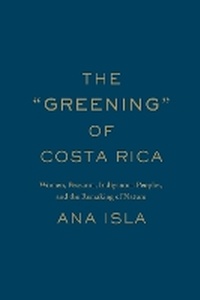
The "Greening" of Costa Rica
Women, Peasants, Indigenous Peoples, and the Remaking of Nature
Will be published approx. on 19. February 2015
Book
Hardback
224 pages
978-1-4426-4936-1 (ISBN)
Description
Since the 1992 Earth Summit in Rio de Janeiro, the concept of sustainable development has become the basis for a vast number of "green industries" from eco-tourism to carbon sequestration. In The "Greening" of Costa Rica, Ana Isla exposes the results of the economist's rejection of physical limits to growth, the biologist's fetish with such limits, and the indebtedness of peripheral countries.
Isla's case study is the 250,000 hectare Arenal-Tilaran Conservation Area, created in the late 1990s as the result of Canada-Costa Rica debt-for-nature swaps. Rather than reducing poverty and creating equality, development in and around the conservation area has dispossessed and disenfranchised subsistence farmers, expropriating their land, water, knowledge, and labour.
Drawing on a decade of fieldwork in these communities, Isla exposes the duplicity of a neoliberal model in which the environment is converted into commercial assets such as carbon credits, intellectual property, cash crops, open-pit mining, and eco-tourism, few of whose benefits flow to the local population.
Isla's case study is the 250,000 hectare Arenal-Tilaran Conservation Area, created in the late 1990s as the result of Canada-Costa Rica debt-for-nature swaps. Rather than reducing poverty and creating equality, development in and around the conservation area has dispossessed and disenfranchised subsistence farmers, expropriating their land, water, knowledge, and labour.
Drawing on a decade of fieldwork in these communities, Isla exposes the duplicity of a neoliberal model in which the environment is converted into commercial assets such as carbon credits, intellectual property, cash crops, open-pit mining, and eco-tourism, few of whose benefits flow to the local population.
More details
Language
English
Place of publication
Toronto
Canada
Target group
College/higher education
Professional and scholarly
Illustrations
4 figures, 1 map
Dimensions
Height: 235 mm
Width: 159 mm
Thickness: 18 mm
Weight
450 gr
ISBN-13
978-1-4426-4936-1 (9781442649361)
Copyright in bibliographic data and cover images is held by Nielsen Book Services Limited or by the publishers or by their respective licensors: all rights reserved.
Schweitzer Classification
Person
Ana Isla is an associate professor in the Department of Sociology and the Centre for Women's and Gender Studies at Brock University.
Content
Prologue
Introduction
Part I: Embodied Foreign Debt in the National System of Conservation Areas
1 - Political Economy: Building Costa Rica's Neo-liberal State
2 - Political Ecology: Debt-for-Nature and Its Experts
Part II: Embodied Debt-for-Nature: Women, Peasants, Indigenous Peoples, and the Remaking of Nature
3 - The Land Plan in Arenal-Tilaran Conservation Area: New Natures and New Workers in Fortuna, Z-Trece, Abanico, and Miramar
4 - Genetics as a Site of Biotechnology or Biopiracy: Dispossession of Indigenous Peoples' and Peasants' Knowledge
5 - Forests as Carbon Sinks: Dispossession of Peasant Access to the Forest
6 - Scenery as Eco-tourism: Dispossession of Peasant Agricultural Land and the Rise of Prostitution
7 - Medicinal Plants in Micro-enterprises: The Dispossession of Rural Women's Labour and Knowledge
8 - Mountains as Open-Pit Mining Sites: Dispossession of Peasants' Water and Livelihood
9 - The Need for Alternative Relations
Introduction
Part I: Embodied Foreign Debt in the National System of Conservation Areas
1 - Political Economy: Building Costa Rica's Neo-liberal State
2 - Political Ecology: Debt-for-Nature and Its Experts
Part II: Embodied Debt-for-Nature: Women, Peasants, Indigenous Peoples, and the Remaking of Nature
3 - The Land Plan in Arenal-Tilaran Conservation Area: New Natures and New Workers in Fortuna, Z-Trece, Abanico, and Miramar
4 - Genetics as a Site of Biotechnology or Biopiracy: Dispossession of Indigenous Peoples' and Peasants' Knowledge
5 - Forests as Carbon Sinks: Dispossession of Peasant Access to the Forest
6 - Scenery as Eco-tourism: Dispossession of Peasant Agricultural Land and the Rise of Prostitution
7 - Medicinal Plants in Micro-enterprises: The Dispossession of Rural Women's Labour and Knowledge
8 - Mountains as Open-Pit Mining Sites: Dispossession of Peasants' Water and Livelihood
9 - The Need for Alternative Relations